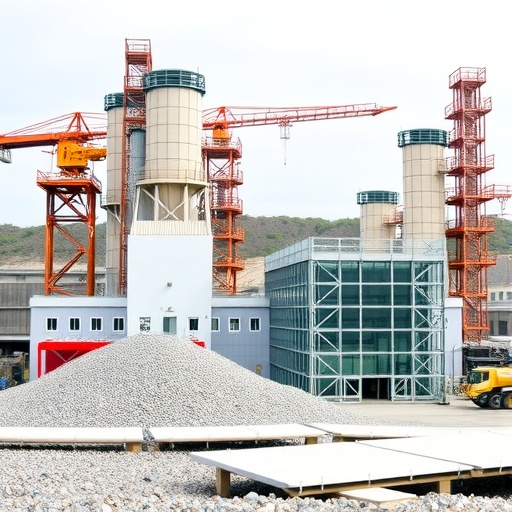
Europe’s cement industry is facing a decarbonization challenge that cannot be solved by switching fuels alone. A new study by P. Tautorat, D. Sultani, N. Ljubic and colleagues examines how the European Union could reduce emissions from cement production while navigating two sources of uncertainty that could determine whether climate plans succeed: the future availability of industrial technologies and the direction of public policy. Published in Nature Communications, the research, titled “Decarbonizing the EU cement industry under technology and policy uncertainty,” focuses on one of the hardest sectors to transform because cement production generates carbon dioxide not only from energy use, but also from the chemistry of making cement itself.
Cement is the binding ingredient in concrete, the most widely used construction material on Earth. Its production begins with limestone, which is heated to extremely high temperatures in a kiln to create clinker, the central component of ordinary Portland cement. During this process, limestone breaks down into lime and carbon dioxide in a reaction known as calcination. This chemical release occurs even if the kiln is powered by renewable electricity or low-carbon fuels. Additional emissions come from burning fuel to maintain kiln temperatures, from transporting raw materials and finished products, and from the electricity consumed by grinding and processing equipment. Because a substantial share of emissions is locked into the manufacturing chemistry, the sector requires a portfolio of solutions rather than a single technological fix.
The study addresses this complexity by considering how different decarbonization routes may perform when the future is not known with certainty. Industrial forecasts often assume that technologies will become available on schedule, that their costs will fall as expected, and that governments will adopt stable climate policies. In reality, carbon-capture systems may face delays, alternative binders may encounter standards or supply constraints, clean hydrogen may remain expensive, and infrastructure for transporting captured carbon may develop unevenly across Europe. At the same time, carbon prices, emissions regulations, public funding and market demand for low-carbon construction materials could change as political priorities evolve. By placing technology and policy uncertainty at the center of the analysis, the researchers examine how robust different strategies may be under competing future conditions.
One of the most important distinctions in cement decarbonization is between reducing the amount of clinker in cement and eliminating emissions from the clinker that remains necessary. Blended cements can replace part of the clinker with materials such as slag, fly ash, calcined clay or other supplementary cementitious components. This can lower process emissions and reduce the energy required per tonne of product. However, the availability of some traditional substitutes depends on other industries, including steelmaking and coal-fired power generation, both of which are themselves changing. Calcined clay could offer a more independent source of alternative material in some regions, but it requires additional processing and must meet performance and construction standards. These trade-offs make material efficiency and product innovation important, while also limiting how quickly any single substitute can be expanded.
The research also considers the role of carbon capture, utilization and storage, commonly known as CCUS. Because calcination directly produces carbon dioxide, capture at cement plants is one of the few approaches capable of addressing process emissions at large scale. In principle, captured carbon can be compressed, transported and permanently stored underground, or used in industrial products. In practice, capture equipment consumes energy, increases plant complexity and requires extensive infrastructure beyond the factory gate. Storage sites, pipelines, shipping routes, permitting systems and monitoring arrangements must all be available. The climate benefit depends on capturing a high share of emissions and ensuring that the carbon remains securely stored. These requirements create substantial investment risks, especially when future carbon prices and regulatory incentives are uncertain.
Alternative fuels and cleaner heat can reduce the combustion-related portion of cement emissions, but they do not solve the entire problem. Cement kilns already use a range of fuels, including waste-derived materials, and electrification or hydrogen could eventually provide lower-carbon heat in selected applications. Yet the temperatures required for clinker production are exceptionally high, and industrial-scale alternatives must compete for limited supplies of clean electricity, hydrogen and sustainable biomass. Replacing fossil fuels can also alter operating conditions, fuel costs and the management of waste streams. The study’s broader message is that energy substitution must be coordinated with changes in cement chemistry, plant design and infrastructure if the EU is to achieve deep emissions reductions rather than incremental improvements.
Policy uncertainty is particularly significant because cement plants are long-lived assets. A kiln can operate for decades, meaning that investment decisions made today may determine emissions well into the future. If companies expect strong carbon prices and strict emissions standards, they may be more willing to invest in capture systems, alternative binders and low-carbon production lines. If policy signals are weak or unstable, firms may delay investment or choose equipment that is cheaper in the short term but difficult to decarbonize later. Carbon leakage is another concern: if production costs rise in Europe while imports from regions with weaker climate rules become more competitive, emissions may shift rather than disappear. Measures such as carbon-border policies, public support for demonstration projects and common technical standards could influence whether European decarbonization strengthens or undermines industrial competitiveness.
The study arrives at a moment when the EU is under pressure to cut industrial emissions while preserving domestic manufacturing capacity. Its analysis highlights why cement policy cannot be judged only by the theoretical potential of individual technologies. A solution may be technically effective but unavailable at the necessary scale; affordable in one scenario but uneconomic under another; or capable of cutting emissions at the plant while depending on infrastructure that does not yet exist. Planning under uncertainty therefore favors flexibility: expanding low-clinker products where materials and standards allow, improving energy efficiency, developing clean heat, preparing transport and storage networks for captured carbon, and creating policies that reward verified emissions reductions. Such an approach can reduce the risk of betting Europe’s construction future on one uncertain pathway.
The implications extend beyond the cement sector. Roads, bridges, housing and renewable-energy infrastructure all depend heavily on concrete, so the success or failure of cement decarbonization will shape the carbon footprint of the wider energy transition. Tautorat, Sultani, Ljubic and their colleagues present the issue as a strategic problem involving engineering, economics, regulation and resource availability at the same time. The study does not reduce the challenge to a race between competing inventions; it asks how technologies and policies must work together when the future cannot be predicted with confidence. For an industry responsible for emissions that are partly unavoidable through chemistry, that systems-level perspective may be essential. Europe’s cement revolution will depend not only on discovering cleaner production methods, but on making sure those methods can survive changing markets, shifting policies and the immense scale of global construction.
Subject of Research: Decarbonization of the European Union cement industry under technological and policy uncertainty
Article Title: Decarbonizing the EU cement industry under technology and policy uncertainty
Article References: Tautorat, P., Sultani, D., Ljubic, N. et al. “Decarbonizing the EU cement industry under technology and policy uncertainty.” Nature Communications (2026). https://doi.org/10.1038/s41467-026-76611-3
Image Credits: AI Generated
DOI: 10.1038/s41467-026-76611-3
Keywords: Cement industry, decarbonization, European Union, carbon capture, alternative fuels, clinker reduction, industrial policy, technology uncertainty, climate change, emissions reduction