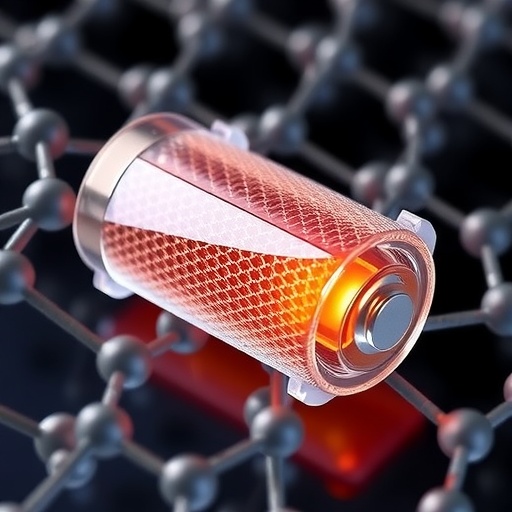
Lithium-ion batteries have transformed everything from smartphones to electric vehicles, yet the thin separator hidden inside each cell remains one of their most vulnerable components. It must keep the positive and negative electrodes apart to prevent short circuits, while simultaneously allowing lithium ions to pass through during charging and discharging. It also has to survive heat, mechanical stress and repeated deformation without losing its structure. A new study by Kim, Jang, Kim and colleagues introduces a “core-shell” nanofiber separator designed to address two of those challenges at once: thermal instability and stretching. Published in npj Flexible Electronics, the work points toward battery architectures that could be safer and more durable in flexible electronics, wearable devices and next-generation energy systems.
The separator is not an electrode and does not directly store energy. Its role is more subtle but just as critical. In a conventional lithium-ion cell, the separator is a porous membrane saturated with electrolyte. The pores provide pathways for lithium ions to travel between the electrodes, while the membrane acts as an electronic barrier that prevents the electrodes from touching. If the separator shrinks, tears or melts under abnormal conditions, the electrodes can come into contact, triggering an internal short circuit. That short circuit can generate intense localized heating and initiate thermal runaway, a self-accelerating chain of chemical reactions that may lead to fire or cell failure. Improving the separator is therefore one of the most direct ways to increase the safety margin of a battery without changing its entire chemistry.
The researchers’ solution is based on nanofibers with a core-shell structure. Instead of making each fiber from a single material, the design places one material at the center and another around it, creating a coaxial architecture at the nanoscale. This arrangement allows the properties of the core and the outer shell to be tuned independently. One component can provide mechanical support and resistance to deformation, while the other can contribute thermal stability, electrolyte compatibility or controlled surface properties. At the scale of a battery separator, millions of these fibers can form an interconnected porous network. The resulting membrane can remain sufficiently open for ion transport while offering greater structural integrity than a simple, uniform polymer film.
That combination is particularly important for flexible and stretchable electronics. Conventional battery components are generally optimized for rigid cylindrical, prismatic or pouch cells, where the dimensions of the device remain relatively stable. Wearable electronics, soft sensors and foldable systems impose a different set of demands. Their batteries may be bent, folded, twisted or stretched repeatedly during normal use. A separator that performs well when flat may develop cracks, permanent deformation or collapsed pores when subjected to such motion. The core-shell nanofiber concept seeks to distribute mechanical stress across a fibrous network rather than concentrating it in a continuous film. This could help the separator maintain its insulating function and ion-conducting pathways even as the battery changes shape.
The thermal aspect of the design is equally significant. Most commercial lithium-ion separators are based on polyolefin materials because they are chemically stable, lightweight and relatively inexpensive. However, these materials can soften or shrink when exposed to high temperatures. Some separators incorporate ceramic coatings or other heat-resistant layers, but those additions can increase thickness, reduce flexibility or make the membrane brittle. A nanofiber separator with a thermally robust shell could provide a different route to heat resistance. By stabilizing the fiber network at elevated temperatures, the shell may help preserve the distance between the electrodes and reduce the risk of catastrophic dimensional collapse. The core, meanwhile, can be selected or engineered to retain flexibility and support the membrane’s mechanical response.
The architecture also highlights a central engineering trade-off in battery design. A separator must be strong enough to resist puncture and deformation, but not so dense that it blocks lithium-ion movement. It must be thin enough to minimize the distance ions travel, yet thick and stable enough to prevent electrical contact between electrodes. Its pores must be interconnected and wetted by the electrolyte, while its surfaces must remain compatible with the complex chemical environment inside a cell. Nanofibers offer a way to create high surface area and tunable porosity, but increased porosity can also reduce mechanical strength if the network is not carefully reinforced. The core-shell strategy is intended to balance these competing requirements by assigning different functions to different regions of each fiber.
For battery researchers, the most promising feature may be the possibility of integrating mechanical resilience directly into the separator rather than adding external protective structures. In a stretchable battery, every extra layer can increase weight, thickness and resistance to deformation. A separator that contributes both thermal protection and elasticity could simplify the internal design of the cell. It could also help maintain more stable contact among the electrodes, separator and electrolyte during repeated movement. Stable interfaces matter because uneven contact can increase local current density, accelerate degradation and create hot spots. By reducing the mechanical disruption caused by stretching, a resilient separator may support more consistent electrochemical operation over the battery’s lifetime.
The study arrives as the battery field expands beyond electric vehicles and portable electronics into systems that must operate under unusual mechanical conditions. Medical patches, electronic textiles, robotic skins and soft actuators all require power sources that can conform to curved or moving surfaces. In such applications, safety cannot be treated as a secondary feature. A battery that cracks, shorts or overheats while attached to the body or embedded in clothing presents risks that are fundamentally different from those of a rigid consumer device. A separator engineered to tolerate deformation while resisting heat could become an enabling component for these technologies. The concept may also be relevant to batteries that experience vibration, impact or pressure changes in transportation and industrial environments.
Still, a promising separator design must pass demanding tests before it can become a commercial technology. Laboratory demonstrations need to be followed by evaluations under repeated stretching, long-term cycling, rapid charging, elevated temperatures and mechanical abuse. The separator must also be compatible with large-scale manufacturing, uniform across wide areas and economically viable. Its performance cannot be judged solely by tensile strength or thermal shrinkage; researchers must measure ionic conductivity, electrolyte uptake, interfacial stability, puncture resistance and the effect of the membrane on overall cell impedance. Manufacturing conditions must preserve the core-shell structure without introducing defects that could become pathways for electrical failure. These practical questions will determine whether the concept remains a laboratory innovation or advances toward real battery products.
The broader message of the work is that battery safety and flexibility do not necessarily have to be opposing goals. By designing materials from the nanoscale upward, researchers are attempting to make a single separator perform several jobs at once: block electrons, transport lithium ions, withstand heat and accommodate mechanical motion. The core-shell nanofiber approach offers a visual example of this strategy, turning an almost invisible internal membrane into an active piece of battery engineering. If future studies confirm that the architecture can deliver durable performance at manufacturing scale, it could help reshape the design of flexible lithium-ion batteries and bring safer, more resilient power sources closer to the devices that move, bend and stretch with the human world.
Subject of Research: Core-shell nanofiber separators for heat-resistant and stretch-tolerant lithium-ion batteries
Article Title: Core-shell nanofiber separators for heat-resistant and stretch-tolerant lithium-ion batteries
Article References: Kim, NR., Jang, Y., Kim, B. et al. Core-shell nanofiber separators for heat-resistant and stretch-tolerant lithium-ion batteries. npj Flex Electron (2026). https://doi.org/10.1038/s41528-026-00632-7
Image Credits: AI Generated
DOI: 10.1038/s41528-026-00632-7
Keywords: lithium-ion batteries, battery separators, core-shell nanofibers, heat resistance, stretchable batteries, flexible electronics, nanofiber membranes, battery safety, thermal runaway prevention
Tags: advanced battery separator materialsCore-shell nanofiber separators for lithium-ion batterieselectrolyte-permeable battery separatorsflexible electronics battery safetyheat-resistant and stretchable battery componentsinnovations in battery separator designmechanical durability of battery separatorsnanofiber membrane technology for energy storagenext-generation energy system safetypreventing internal shorts in lithium-ion cellsthermal stability in lithium-ion batterieswearable device battery components