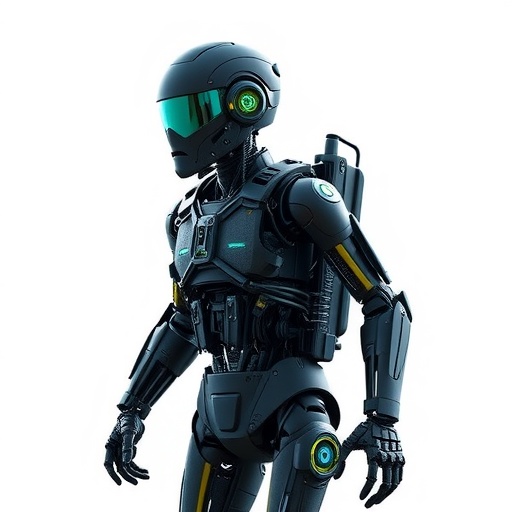
Lower-limb exoskeletons are moving toward a decisive technological turning point. Instead of asking a wearable robot to identify whether a person is walking, climbing stairs, lifting a load or standing still, researchers are exploring control systems that respond continuously to what the user’s body is doing in real time. This emerging approach could transform exoskeletons from devices designed for a handful of carefully defined tasks into adaptable machines capable of supporting human movement across unpredictable environments. In a new Perspective published in Nature Machine Intelligence, Shepherd, Schonhaut, Scherpereel and colleagues outline a roadmap for “end-to-end” and task-agnostic exoskeleton control, a strategy that uses artificial intelligence to translate physiological signals directly into assistance at the joints.
The promise of lower-limb exoskeletons extends far beyond laboratory demonstrations. By generating mechanical power around the hip, knee or ankle, these wearable systems could help people experiencing age-related loss of mobility, support individuals with disabilities, reduce fatigue during physically demanding work and lower the risk of musculoskeletal injuries in industrial settings. Yet the human body rarely moves in discrete categories. A person does not switch cleanly between “walking mode” and “stair mode” in the way a computer changes software settings. Movement continuously varies with speed, terrain, posture, fatigue, balance, clothing, footwear and individual anatomy. A control system built around rigid task labels may therefore struggle precisely when real-world adaptability is most important.
Traditional exoskeleton controllers commonly rely on task classification. Sensors collect information such as joint angles, foot contact, acceleration or muscle activity, and an algorithm attempts to determine what the wearer is doing. Once a task has been identified, the controller selects a predefined assistance strategy. This approach has enabled impressive results, but it creates a growing catalogue of special cases. Walking slowly, walking quickly, starting, stopping, turning, stepping over an obstacle and moving across a slope may all require different rules. The more behaviours a device must recognize, the more difficult it becomes to design, test and maintain a reliable classification system. Misclassification can also produce abrupt changes in assistance, potentially making the device feel unnatural or destabilizing.
The alternative described by the researchers is to estimate biological joint moments, the torques that a person’s muscles and tissues are producing around their joints, and use those estimates as a direct representation of physiological demand. Biological joint moments cannot normally be measured by simply placing a sensor on the skin. They are typically inferred from combinations of motion measurements, force data and biomechanical models. In a laboratory, motion-capture systems and force plates can help calculate these internal torques. For a wearable exoskeleton, however, the challenge is to approximate them using compact sensors and algorithms that operate quickly enough for real-time control.
An end-to-end artificial-intelligence controller could learn a mapping from sensor data to assistance commands without requiring an explicit task-recognition layer. Inputs might include joint motion, segment acceleration, ground-contact information, inertial measurements, electromyography or forces measured at the interface between the body and the robot. The system would process these signals and produce commands for the exoskeleton’s actuators, which then deliver torque at the appropriate joints. Rather than asking, “What task is the user performing?” the controller would ask, in effect, “What mechanical support does this body need at this instant?” That distinction is central to making assistance continuous rather than divided into isolated operating modes.
The approach also reflects a broader shift in robotics toward learning from human behaviour. Human-in-the-loop optimization has already helped researchers tune exoskeleton assistance by measuring outcomes such as metabolic cost and adjusting control parameters to reduce the wearer’s energy expenditure. These experiments have shown that users can adapt to assistance and that algorithms can discover beneficial patterns that may not be obvious from engineering intuition alone. However, many demonstrations have focused on a specific task, a limited range of speeds or a particular participant group. A controller optimized for one setting may not automatically transfer to another person, another device or another environment. End-to-end learning could offer greater flexibility, but it introduces its own technical demands.
One of the most difficult problems is optimization. A useful controller must balance several objectives that can conflict with one another. Reducing metabolic effort is important, but so are stability, comfort, speed, natural movement and low electrical power consumption. Assistance that maximizes support at one joint could increase effort elsewhere or alter balance in an undesirable way. The user’s preferred strategy may also change over time as muscles fatigue or as the person gains experience with the device. An AI controller therefore needs objective functions that reflect the complexity of human movement rather than optimizing a single measurement. It must also learn efficiently, because extensive trial-and-error experimentation with a person wearing a powerful machine is impractical and potentially unsafe.
Safety is an equally fundamental challenge. Data-driven systems can detect patterns that engineers did not explicitly program, but their decisions may be difficult to predict under conditions absent from the training data. A sudden stumble, an unexpected obstacle, a sensor failure or a loose attachment could generate signals unlike those seen during development. The exoskeleton must respond conservatively when uncertainty rises. The Perspective highlights the need for safety mechanisms that work alongside learning-based control, including limits on torque and speed, rapid detection of abnormal conditions, fall-sensitive responses, redundant sensing and reliable fallback modes. Such protections cannot be treated as optional additions. For a wearable robot physically connected to a human body, safe operation must be integrated into the architecture from the beginning.
Training data presents another barrier to deployment. High-quality examples of biological joint moments often require specialized laboratory equipment, biomechanical expertise and carefully controlled experiments. Data collected from a small group of young, healthy participants may not capture the movement strategies of older adults, people with disabilities, industrial workers or users with different body sizes and levels of strength. It may also fail to represent unusual but important situations, such as fatigue, uneven terrain or recovery from a perturbation. Building sufficiently broad datasets could be expensive and time-consuming, while sharing data between laboratories may be complicated by differences in sensors, protocols and annotation methods. The researchers therefore point toward methods that can reduce data requirements, transfer knowledge between users and devices, and combine real-world measurements with physical models or simulated experience.
Generalization is particularly important because every user interacts with an exoskeleton differently. The same assistance profile may feel helpful to one person and restrictive to another. Anatomical differences affect joint alignment, actuator leverage and the relationship between external measurements and internal biomechanics. Neural networks trained on one exoskeleton may also struggle when deployed on another with different motors, sensor placements or mechanical limits. A successful task-agnostic system will need to separate patterns that are broadly shared across human movement from characteristics that must be personalized. Calibration procedures, online adaptation and hybrid controllers combining learned components with interpretable biomechanical constraints could help bridge that gap.
The roadmap ultimately describes a race to make exoskeletons less like machines waiting for instructions and more like responsive partners that continuously interpret the wearer’s physical state. Achieving that vision will require progress across machine learning, biomechanics, wearable sensing, robotics and human factors. The most convincing systems will not simply produce impressive assistance in a controlled experiment; they will remain stable when users move unpredictably, function across diverse populations and environments, and communicate their behaviour clearly enough to earn trust. If researchers can reduce the need for enormous training datasets while enforcing rigorous safety and personalization, end-to-end control based on biological joint moments could become a foundation for the next generation of mobility-augmenting technology. The result would be exoskeletons capable of adapting not only to tasks, but to the continuous complexity of human life.
Subject of Research: End-to-end, artificial-intelligence-driven, task-agnostic control of lower-limb exoskeletons using real-time estimates of biological joint moments.
Article Title: A roadmap for end-to-end task-agnostic exoskeleton control
Article References:
Shepherd, M.K., Schonhaut, E.B., Scherpereel, K.L. et al. A roadmap for end-to-end task-agnostic exoskeleton control. Nat Mach Intell (2026). https://doi.org/10.1038/s42256-026-01297-7
Image Credits: AI Generated
DOI: https://doi.org/10.1038/s42256-026-01297-7
Keywords: Lower-limb exoskeletons, artificial intelligence, task-agnostic control, biological joint moments, wearable robotics, human–robot interaction, mobility assistance, biomechanics, human-in-the-loop optimization, rehabilitation technology.
Tags: adaptive lower-limb exoskeletonsAI-powered human movement supportbiomechanical signal processing for wearable robotscontinuous movement support for mobility impairmentsend-to-end exoskeleton control strategiesexoskeleton controlexoskeletons for aging and disabilityfuture directions in exoskeleton technologyphysiological signal translation for assistive devicesreal-time assistance in exoskeletonsrobotics in industrial injury preventiontask-agnostic wearable robots