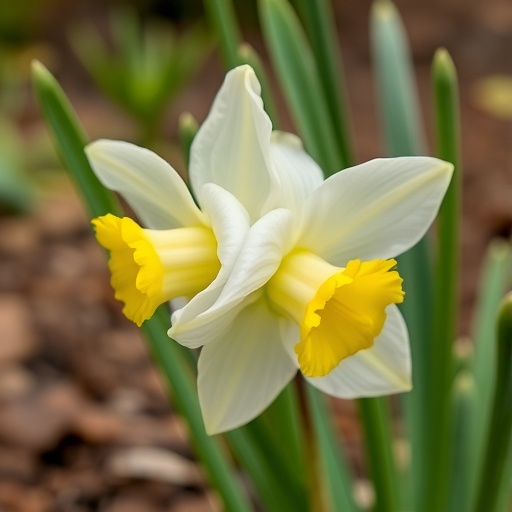
For centuries, gardeners have prized double flowers—blooms in which stamens quietly surrender their pollen-bearing duties and transform into extra layers of petals. The phenomenon turns a simple cup of six tepals into a ruffled, ornate showpiece, and in Chinese narcissus (Narcissus tazetta var. chinensis), the double-flowered cultivar known as ‘Yulinglong’ has been celebrated for its ornate form in gardens and festive displays across China. Yet despite the flower’s cultural and economic importance, the genetic rules that govern how its petals, corona, stamens, and ovary are specified—and how those rules break down to produce double flowers—remained largely uncharted. A new study published in Plant Molecular Biology now fills that gap, mapping the full complement of floral identity genes in Chinese narcissus and revealing a surprising twist in one of biology’s oldest frameworks for understanding how flowers are built.
The research, led by Yujun Ren and Ying Miao of the Fujian Provincial Key Laboratory of Plant Functional Biology at Fujian Agriculture and Forestry University, with Xuewei Chen and Qisi Xu as key contributors, systematically mined the PacBio Sequel II full-length floral transcriptome of the single-flowered cultivar ‘Jinzhanyintai’ to identify every member of the ABCDE model gene family expressed in the flower. The ABCDE model is the fundamental paradigm of angiosperm floral development: it proposes that floral organs are specified by combinatorial actions of homeotic transcription factor classes, with A-class genes defining sepals and petals, B-class genes defining petals and stamens, C-class genes defining stamens and carpels, D-class genes specifying ovules, and E-class genes acting as required cofactors throughout all whorls. In Chinese narcissus, the team identified sixteen such genes: nine A-class homologs, two B-class homologs, one C-class homolog, and four E-class homologs.
The most striking finding was what the team did not find. Across multiple independent transcriptome datasets—including the previously published SRP083093 and SUB10083597 datasets from flowering-stage Chinese narcissus, and a third floral-scent dataset (PRJNA523125) used for cross-validation—no canonical D-class genes could be detected. D-class genes, exemplified by the SEEDSTICK and AGAMOUS-like ovule regulators in other species, are typically conserved components of the angiosperm floral gene toolkit. Their apparent absence in narcissus raises the question of how ovules develop at all. The researchers’ answer, supported by phylogenetic reconstruction and expression profiling, is that the single C-class gene, NtAG, may have taken over the D-class role, functioning in a dual capacity to direct both the identity of reproductive organs and the development of ovules. This kind of functional co-option, in which one gene lineage absorbs the duties of a lost duplicate, is a known evolutionary strategy but has rarely been documented so cleanly at the transcriptome scale in a bulb crop.
Based on these findings, the team constructed a modified ABCDE model specifically for Chinese narcissus. The model captures the standard combinatorial logic for the outer tepal whorls and reproductive organs but incorporates two novel features. First, it formalizes the C/D dual function of NtAG in place of dedicated D-class genes. Second, and perhaps more visually compelling, it documents expanded expression domains of the B- and C-class genes beyond their canonical boundaries. In the classic model, B-class expression is confined to the second and third whorls—petals and stamens—but in narcissus, B-class gene expression spills into additional floral territories. The researchers argue that this expanded B- and C-class activity provides the molecular underpinning for the paracorolla, the trumpet- or cup-shaped crown that sits atop the tepals and defines the narcissus silhouette. Molecular evidence, they report, supports the long-debated hypothesis that this unique organ is derived from stamens: the paracorolla expresses stamen-identity genes in a way consistent with a partially petaloid stamen-derived structure.
The comparative dimension of the study delivers the double-flower story. By contrasting the transcriptomes of ‘Jinzhanyintai’, a single-flowered cultivar with the classic six tepals and central cup, and ‘Yulinglong’, the double-flowered cultivar whose stamens have converted into petal-like structures, the team pinpointed a specific molecular lesion in identity: abnormal upregulation of the B-class genes NtAP3 and NtPI within the stamen whorl of the double cultivar. In the canonical framework, B-class genes are the engine of petal identity; when they are expressed ectopically in the stamen whorl, the developmental program in that whorl is redirected toward petal fate. This is the essence of stamen petaloidy, and it explains the doubling phenotype: with the stamens reprogrammed into petals, the flower gains extra petaloid layers at the expense of male fertility. Interestingly, this mechanism differs from the C-class loss mechanism documented in double roses, where tinkering with the C-function drives the doubling, illustrating that different ornamental lineages have arrived at the same horticultural endpoint through different genetic routes.
To confirm that the identified genes are not merely correlates but functional regulators, the team carried out subcellular localization and heterologous overexpression experiments. NtPI, the narcissus PISTILLATA homolog, was shown to be a nuclear-localized transcriptional regulator, as expected for a MADS-box transcription factor, and overexpression of the gene in Arabidopsis thaliana—the standard reference plant for such assays—confirmed a conserved role in floral organ morphogenesis. These validation experiments strengthen the case that the narcissus ABCDE genes behave as bona fide homeotic regulators rather than merely sequence-similar relics, and they anchor the modified model in functional, not just descriptive, evidence.
Technically, the study illustrates the power of full-length transcriptome sequencing for gene discovery in non-model species. PacBio Iso-Seq technology captures complete transcript molecules, allowing unambiguous assignment of isoforms and full coding sequences—critical for MADS-box genes, where conserved domains and divergent C-terminal regions must both be resolved to place genes correctly in phylogenies. The team combined this with Illumina-based expression quantification, phylogenetic analysis using reference sequences from model plants, motif and domain characterization, spatiotemporal expression mapping across floral organs and developmental stages, and quantitative reverse-transcription PCR validation between the two cultivars. The layering of three independent transcriptome datasets also allowed the absence of D-class transcripts to be treated as a robust biological signal rather than a sampling artifact—a subtle but important point, since transcript absence alone can be misleading without replication across tissues and conditions.
The evolutionary implications extend beyond narcissus. In monocots generally, the boundary between “petals” and “sepals” is blurry—many monocots have tepals, undifferentiated perianth organs whose identity involves B-class activity extending into the outer whorl. Narcissus, an Amaryllidaceae with a true paracorolla superimposed on this tepal plan, represents an extreme of this trend. The modified model proposed here suggests that the paracorolla arose not by inventing a new organ program de novo, but by redeploying and expanding existing stamen- and petal-identity programs into a novel position—a mechanism consistent with the broader principle that floral diversity among angiosperms is largely a story of shifting expression boundaries among a small, conserved set of MADS-box regulators. Comparative evidence from orchids, where B-class genes also show expanded and diversified expression domains, suggests that such boundary shifts may be a recurring engine of monocot floral innovation.
For breeders and horticulturists, the study is more than an academic exercise. Chinese narcissus is a commercially significant ornamental bulb crop, and double-flowered forms command particular market value. By identifying NtAP3 and NtPI upregulation as the molecular trigger of stamen petaloidy, the researchers have supplied concrete molecular breeding targets. Marker-assisted selection or gene-editing strategies could, in principle, tune B-class expression in the stamen whorl to generate or stabilize double-flower phenotypes, while knowledge of the modified ABCDE framework could guide crosses aimed at modulating paracorolla size and shape—traits central to the aesthetic identity of narcissus cultivars. The work also provides a foundational gene inventory that will be useful as genomic resources for Chinese narcissus continue to develop.
As with any transcriptome-based study, some caveats remain. The dual C/D function of NtAG is inferred from phylogenetic position and expression pattern rather than demonstrated through loss-of-function experiments in narcissus itself, which remain technically challenging in a six-to-seven-year bulb crop with a long generation time. Functional confirmation in heterologous systems, while valuable, cannot fully capture the quantitative dynamics of gene dosage and protein complex formation—so-called “floral quartets”—that operate in the native floral meristem. Nonetheless, the systematic inventory, the robust multi-dataset evidence for D-class loss, and the clean correlation between B-class misexpression and the doubling phenotype collectively represent a substantial advance. The study transforms Chinese narcissus from a horticulturally important but molecularly opaque species into a system in which the classical rules of floral development can be interrogated, modified, and applied—showing once again that even a framework as venerable as the ABCDE model continues to yield surprises when tested against the full diversity of flowering plants.
Subject of Research: Floral organ identity genes (ABCDE model) and the molecular mechanism of double flower formation in Chinese narcissus (Narcissus tazetta var. chinensis)
Subject of Research: Biology
Article Title: Full-length floral transcriptome analysis reveals a modified ABCDE model with D-class gene loss and the molecular mechanism of double flower formation in Narcissus tazetta var. chinensis
Article References: Ren, Y., Chen, X., Xu, Q., & Miao, Y. (2026). Full-length floral transcriptome analysis reveals a modified ABCDE model with D-class gene loss and the molecular mechanism of double flower formation in Narcissus tazetta var. chinensis. Plant Molecular Biology, 116(5), Article 86. https://doi.org/10.1007/s11103-026-01749-z
Image Credits: AI Generated
DOI: 10.1007/s11103-026-01749-z
Keywords: Chinese narcissus, ABCDE model, floral organ development, double flower, D-class gene, paracorolla, MADS-box transcription factors, NtAP3, NtPI, stamen petaloidy, full-length transcriptome, molecular breeding
Cite Scienmag News
APA MLA Chicago
Juliet Wilcox. (September 4, 2026). Narcissus transcriptomics reveals modified ABCDE model and double flower mechanism. Scienmag. https://scienmag.com/narcissus-transcriptomics-reveals-modified-abcde-model-and-double-flower-mechanism/
Copy citation Download RIS
Tags: ABCDE floral development modelChinese narcissus cultivationChinese narcissus genetic analysisdouble flower formation mechanismdouble flower formation mechanismsdouble flower mutation geneticsfloral identity gene expressionfloral identity gene regulationfloral organ differentiation in bulbsfloral organ identity genesfloral organ identity regulationflower morphology and petal developmentflower morphology geneticsgenetic basis of ornamental flower traitsgenetic basis of ornate flower traitsNarcissus flower transcriptomicsNarcissus transcriptomicsPacBio Sequel II transcriptome analysisPacBio Sequel II transcriptome sequencingpetal and stamen transformationplant molecular biologyplant molecular biology of floweringtranscriptome sequencing in flowering plants