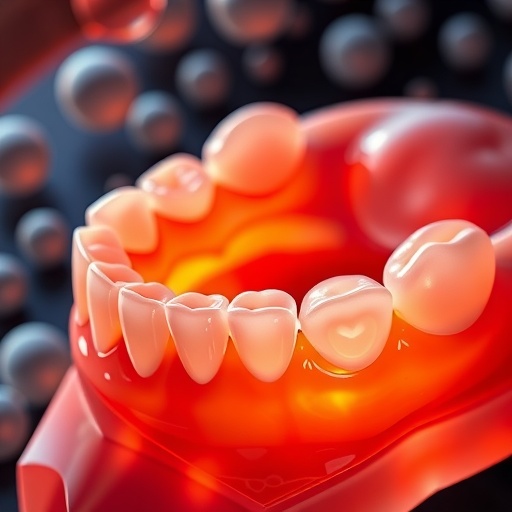
Periodontitis, one of the most widespread chronic inflammatory diseases in the world, has long frustrated dentists and biomedical researchers alike. The disease silently erodes the tissues and bone that anchor teeth, driven by stubborn bacterial biofilms that colonize the narrow, irregular spaces of periodontal pockets. Now, a research team at Jilin University, led by Lin Quan and Zhou Yanmin, has unveiled a strikingly inventive solution: an injectable hydrogel built around futuristic two-dimensional MXene nanosheets that not only demolishes bacterial biofilms but also reprograms the metabolism of immune cells to reverse bone loss. The work, published in Nano Research, could mark a turning point in how one of the most common oral diseases on the planet is treated.
The scale of the problem is hard to overstate. Periodontitis begins when microbial communities—dominated by pathogens such as Porphyromonas gingivalis and Fusobacterium nucleatum—establish highly organized biofilms within the pockets between teeth and gums. These biofilms are notoriously tolerant of conventional antimicrobials, their dense extracellular matrices acting as fortresses that drugs struggle to penetrate. Compounding the difficulty is the anatomy of the periodontal pocket itself: a deep, narrow, irregular channel constantly flushed by saliva and gingival crevicular fluid, which rapidly washes away topically applied medications before they can act. Mechanical debridement and local antibiotic therapy, the clinical mainstays, can reduce bacterial loads but often fail to achieve a lasting cure, and the specter of antimicrobial resistance looms over any strategy that leans heavily on antibiotics.
But bacteria are only half of the story. Even when treatment successfully reduces bacterial counts, persistent inflammation can continue to destroy bone. The Jilin University team zeroed in on a critical biological mechanism underlying this stubborn pathology: immune cell metabolic dysfunction. In an inflammatory environment, macrophages—the versatile immune cells that patrol damaged tissue—undergo a dramatic metabolic shift. Instead of generating energy efficiently through mitochondrial oxidative phosphorylation, they flip to glycolysis, the rapid but inefficient sugar-burning pathway typical of activated inflammatory cells. This metabolic reprogramming is accompanied by the accumulation of reactive oxygen species and the release of pro-inflammatory cytokines, driving macrophages toward the so-called M1 polarization state, which fuels inflammatory bone resorption. The result is a self-perpetuating vicious cycle of infection, inflammation, and bone destruction that no amount of sterilization alone can break.
The team’s answer, a composite hydrogel designated GQM, is engineered to attack the disease on both fronts simultaneously. GQM is composed of three carefully chosen components: oxidized gellan gum (OG), quaternized chitosan (QCS), and magnesium-tannic acid-modified MXene nanosheets (MTA-Mg). The choice of materials reflects an elegant piece of supramolecular engineering. Oxidized gellan gum and quaternized chitosan form dynamic imine bonds with one another, giving the hydrogel its remarkable mechanical behavior. These reversible crosslinks allow GQM to flow under shear stress—which means it can be injected directly into the periodontal pocket through a fine syringe—and then rapidly self-heal once in place, conforming to the pocket’s irregular geometry. Unlike conventional gels that wash away within hours, GQM remains anchored where it is needed, providing a stable reservoir for the therapeutic nanosheets and solving one of the most persistent challenges in local periodontal drug delivery.
Once lodged in the pocket, the hydrogel wages its antibacterial campaign through two complementary mechanisms. The first relies on chemistry: quaternized chitosan carries densely packed cationic quaternary ammonium groups that electrostatically adsorb onto the negatively charged components of bacterial membranes and biofilm matrices. This electrostatic attraction disrupts bacterial membrane barriers and tears apart the extracellular polymeric substances that hold biofilms together, neutralizing the microbes’ structural defenses. The second mechanism is physical: when illuminated with an 808-nanometer near-infrared laser, the MXene nanosheets generate a gentle photothermal effect, raising the local temperature just enough to destabilize and break apart even dense, mature biofilms without damaging surrounding tissue. Together, these two forces—electrostatic sterilization and photothermal disruption—form a one-two punch against the microbial architects of periodontal destruction.
The most scientifically ambitious part of the work, however, lies in what the nanosheets do to the immune system. MXene nanosheets are exceptional electrical conductors, and the team exploited this property in a surprising way: as electron transport channels within inflamed macrophages. Tannic acid, the organic molecule coating the nanosheets, participates in a reversible redox cycle between its phenol and quinone forms, which stabilizes the transfer of electrons across the material–cell interface. Magnesium ion coordination further reinforces this interface, ensuring the electron transfer process remains robust. By shuttling electrons, the nanosheets help restore the NAD⁺/NADH balance within inflamed macrophages—a critical coenzyme equilibrium that is disrupted during inflammation. With this balance repaired, the mitochondrial respiratory chain reactivates, oxidative phosphorylation resumes, and the cell’s energy economy flips back from inflammatory glycolysis to efficient respiration.
The downstream consequences are profound. As their metabolism normalizes, macrophages transition from the pro-inflammatory M1 phenotype to the reparative M2 phenotype, the state associated with tissue healing, resolution of inflammation, and bone regeneration. In effect, the material acts as a metabolic pacemaker for the immune system, nudging cells out of their destructive inflammatory loop and into a constructive repair mode. This is immunometabolic reprogramming achieved not with drugs or gene therapy, but with a carefully engineered biomaterial that interfaces directly with cellular bioenergetics.
The team validated their approach in a rat model of periodontitis, and the results were encouraging across the board. Animals treated with the GQM hydrogel combined with near-infrared light irradiation showed significantly reduced bacterial counts within the periodontal pockets, dampened inflammatory responses, and—most strikingly—reversal of alveolar bone resorption. Because alveolar bone loss is the event that ultimately leads to tooth loosening and loss, the ability of a single injectable treatment to not merely halt but reverse this process represents a substantial advance. The dual mechanism, which the researchers describe as “biofilm disruption–immunometabolic reprogramming,” addresses both the infectious trigger and the immunological amplifier of the disease in one coherent therapeutic platform.
The significance of this study extends beyond dentistry. The concept of using conductive nanomaterials to restore mitochondrial electron transport and rebalance immune cell metabolism could inform treatments for a wide family of inflammatory diseases in which macrophage metabolic dysregulation plays a central role, from implant-associated infections to chronic wounds. At the same time, the delivery vehicle itself—the self-healing, injectable imine-crosslinked hydrogel—offers a general solution for retaining therapeutics in fluid-flushed, hard-to-access anatomical spaces. By uniting photothermal therapy, electrostatic antimicrobial action, and bioenergetic immunomodulation in a single material, the Jilin University team has demonstrated how multifunctional biomaterials can attack complex diseases at multiple levels simultaneously.
The research, titled “MXene-based Hydrogel Disrupt Bacterial Biofilms and Reprogram Immune Cell Metabolism via Photothermal-Electron Transfer Effects to Reverse Bone Resorption in Periodontitis,” was published in Nano Research on July 3, 2026. The work was supported by the Natural Science Foundation of Jilin Province (SKL202302002). As antibiotic resistance continues to erode the reliability of conventional antimicrobial therapy, and as the links between immunity, metabolism, and tissue destruction become ever clearer, approaches like the GQM hydrogel point toward a future in which treating chronic infections means reshaping the body’s own biology rather than simply bombarding it with drugs. For the millions of people worldwide who face the prospect of losing teeth to periodontitis, that future may arrive sooner than expected.
Subject of Research: An injectable MXene-based composite hydrogel (GQM) that disrupts periodontal bacterial biofilms and reprograms macrophage immune metabolism to reverse alveolar bone resorption in periodontitis.
Subject of Research: Chemistry
Article Title: MXene-based Hydrogel Disrupt Bacterial Biofilms and Reprogram Immune Cell Metabolism to Reverse Bone Resorption in Periodontitis
Article References: MXene-based Hydrogel Disrupt Bacterial Biofilms and Reprogram Immune Cell Metabolism to Reverse Bone Resorption in Periodontitis. Nano Research. Not provided Original publication
Image Credits: AI Generated
DOI: Not provided
Keywords: periodontitis, MXene hydrogel, bacterial biofilm, photothermal therapy, immunometabolic reprogramming, macrophage M2 polarization, NAD+/NADH balance, alveolar bone resorption, quaternized chitosan, injectable hydrogel
Cite Scienmag News
APA MLA Chicago
Daisy Hatcher. (September 4, 2026). MXene hydrogel destroys biofilms and reprograms immune metabolism to reverse periodontitis bone loss. Scienmag. https://scienmag.com/mxene-hydrogel-destroys-biofilms-and-reprograms-immune-metabolism-to-reverse-periodontitis-bone-loss/
Copy citation Download RIS
Tags: advanced materials for periodontal regenerationadvances in periodontal disease managementantimicrobial strategies against bacterial biofilmsbiofilm destruction in oral diseasesbiofilm eradication in dental infectionsimmune metabolism reprogramming for bone regenerationimmune metabolism reprogramming in periodontal diseaseinjectable hydrogel for oral healthinjectable hydrogels for periodontal therapyinnovative approaches to reverse periodontal bone lossinnovative periodontal therapyMXene nanosheets for biofilm destructionMXene nanosheets in biomedical applicationsnano-engineered materials for oral healthnanomaterials for periodontal tissue regenerationnanomaterials in dentistrynanotechnology-based oral disease managementovercoming biofilm resistance in dental infectionsperiodontitis treatmentporous tissue regeneration for gum diseasereversing bone loss in periodontitistargeting bacterial biofilms in oral diseasestargeting Porphyromonas gingivalis and Fusobacterium nucleatum