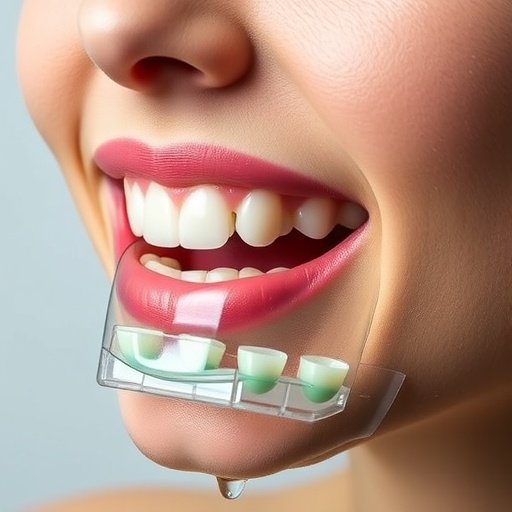
In a development that could reshape how we think about powering medical devices inside the human body, researchers at Tohoku University in Japan have engineered a fully organic, waterproof biobattery designed specifically to operate in the challenging environment of the human mouth. The device, described in a study published in the journal Biomedical Microdevices, is a soft, enzymatic fuel cell patch built to be integrated into an oral mouthpiece, where it can harvest energy from glucose naturally present in saliva while drawing oxygen directly from the air. The work, led by Mirai Matsuura and Matsuhiko Nishizawa, represents a significant step toward self-powered oral healthcare electronics, including electrically assisted drug delivery systems that could one day treat conditions ranging from gum disease to oral infections without any external power source or rigid, potentially toxic battery components.
The central challenge the team confronted is familiar to anyone working in wearable and implantable bioelectronics: conventional batteries rely on heavy metals and corrosive electrolytes that make them poorly suited for close, prolonged contact with living tissue, particularly in the mouth, where the device would be bathed in saliva and exposed to biting forces, fluctuating temperatures, and variable oxygen levels. Enzymatic biofuel cells offer an elegant alternative. Instead of metal electrodes and ionic salts, they use enzymes as catalysts to oxidize glucose at the anode and reduce oxygen at the cathode, generating a small but medically useful electrical current from biochemical reactions that are, in principle, entirely benign to the body. The Tohoku group has spent more than a decade refining this concept, previously demonstrating biobattery-powered skin patches capable of accelerating wound healing and driving transdermal drug delivery through microneedle arrays. The new work extends that philosophy into the oral cavity, arguably one of the most hostile soft-tissue environments in the body.
At the heart of the device is a pair of enzyme-modified carbon fabric electrodes. The anode is coated with glucose dehydrogenase, an enzyme chosen for its ability to oxidize glucose without requiring oxygen as a co-substrate, a property that distinguishes it from the glucose oxidase more commonly used in earlier biofuel cell designs. When glucose from saliva diffuses into the porous carbon textile, the enzyme strips electrons from the sugar molecule, and those electrons flow through an external circuit toward the cathode. The cathode is equally ingenious: it is built from carbon fabric modified with bilirubin oxidase, an enzyme sourced from the fungus Myrothecium verrucaria that catalyzes the four-electron reduction of oxygen to water. What makes this cathode truly remarkable, however, is its waterproof design, which allows it to “breathe” atmospheric oxygen while remaining fully functional in the aqueous, electrolyte-rich environment of saliva.
The waterproofing trick relies on an ultrathin polysilicon membrane deposited over the bilirubin oxidase-modified carbon fabric. This membrane, only nanometers thick, is gas-permeable but liquid-impermeable, meaning oxygen molecules from the air can pass through to reach the enzyme layer while saliva, proteins, and other dissolved components of the oral environment are kept out. The concept builds on the team’s earlier “anti-drying” oxygen cathode, first developed for skin-mounted bioelectric patches in 2022, but adapting it for oral use required careful reconsideration. Earlier versions of the gas-diffusion cathode used polymer membranes such as PDMS, but polysilicon offers a thinner, more uniformly controlled barrier with reliable gas transport characteristics, ensuring the cathode can sustain high current densities without flooding or drying out. In effect, the cathode functions like a microscopic lung, continuously sampling oxygen from the air while sealed against the liquid it is immersed in.
Because a mouthpiece offers only a limited and irregular volume of space, electrode geometry became a critical design variable. The researchers systematically optimized the shape, size, and arrangement of the anode and cathode to maximize power output within the footprint of a dental mouthpiece. Larger electrode areas capture more enzymatic reaction sites, but the anode and cathode cannot simply be made arbitrarily large without wasting precious space or creating unwanted internal shorting pathways. The team evaluated how varying the relative areas of the glucose-oxidizing anode and the oxygen-reducing cathode affected both voltage and current under conditions that mimic the oral cavity. Their analysis revealed that balancing the electrodes so neither becomes the limiting factor is essential for extracting the maximum power from the small glucose concentrations available in saliva, which typically hover in the range of tens to a few hundred micromoles per liter, far more dilute than blood glucose.
Oral conditions impose demands that go well beyond geometry. Temperature inside the mouth fluctuates with food and drink intake, and dissolved oxygen levels vary with breathing patterns, salivary flow, and whether the mouth is open or closed. The researchers therefore characterized battery performance across a range of oxygen concentrations and temperatures representative of real oral use. Their experiments showed that the waterproof oxygen-breathing cathode maintains robust output even when partially or fully immersed, and that the device tolerates the temperature swings expected during eating and drinking without catastrophic loss of enzymatic activity. Bilirubin oxidase is particularly well suited to this task because it retains substantial catalytic activity at physiological temperatures and in the presence of chloride ions, which would rapidly poison many other oxygen-reducing catalysts, including the platinum-based electrodes used in conventional fuel cells.
The implications of a safe, organic power source for the mouth extend into several areas of clinical dentistry and medicine. Periodontal disease affects a large fraction of the adult population worldwide and has been linked through extensive epidemiological work to systemic conditions including diabetes and atherosclerotic cardiovascular disease, making effective, accessible oral care a matter of public health and not merely comfort. Prior research has demonstrated that weak electrical stimulation, sometimes described under the umbrella of “electroceuticals,” can accelerate tissue healing, disrupt bacterial biofilms, and modulate inflammation. A study published in 2023 by Lee and Kim showed that bioelectric devices could help manage biofilm-associated inflammation around dental implants, while other groups have shown that microcurrent stimulation improves blood flow in burn wounds. The biobattery patch provides a way to deliver such therapeutic currents in the mouth without wires, external power supplies, or rigid metal batteries that would be uncomfortable and potentially hazardous if swallowed or aspirated.
Perhaps the most forward-looking application is electrically assisted oral drug delivery. The Tohoku group has previously shown, both on skin and in other contexts, that small applied currents can drive iontophoresis and electroosmosis, actively transporting drug molecules across tissue barriers far more efficiently than passive diffusion alone. A mouthpiece integrating the biobattery could, for example, deliver anti-inflammatory or antimicrobial compounds directly into gingival tissue, concentrating therapy exactly where periodontal pathogens reside while minimizing systemic exposure. The soft, fully organic construction means that even if the device were to degrade or be accidentally ingested, its components, carbon, enzymes, and biocompatible polymers, pose minimal toxicological risk compared with lithium or zinc chemistries. The researchers emphasize that this soft, safe, fully organic biobattery patch represents a promising platform for electrically assisted oral care, including drug delivery, though clinical translation will require further work on long-term enzyme stability, sterilization protocols, and demonstration of therapeutic efficacy in animal or human studies.
Technically, the achievement lies in the integration of multiple delicate subsystems into a single, flexible, mouth-compatible package. Carbon fabric serves as both a mechanically compliant electrode scaffold and an efficient current collector, its woven microstructure providing enormous surface area for enzyme immobilization. The enzyme layers must be stabilized against leaching and denaturation over hours or days of continuous operation in flowing saliva, which contains proteases and surfactant-like molecules from food. The polysilicon membrane must be thin enough to avoid throttling oxygen flux yet robust enough to survive mechanical flexing. And the whole assembly must generate a voltage sufficient to drive practical electronics; individual enzymatic fuel cells typically produce open-circuit voltages below one volt, so practical devices often stack multiple cells in series or use power-management circuitry to boost the output to usable levels. The Tohoku team’s mouthpiece format provides the geometric framework for such integration, matching electrode placement to the contours of the dental arch while keeping the oxygen-breathing cathode exposed to air.
What emerges from this study is a coherent vision of the mouth as a site for self-powered medicine. Saliva supplies a continuous, if modest, stream of glucose fuel; the air provides an effectively unlimited supply of the oxidant; and the enzymes do the electrochemical work that toxic metals would otherwise perform. The research, funded in part by a Grant-in-Aid for Scientific Research S from Japan’s Ministry of Education, Culture, Sports, Science and Technology, positions enzymatic biobatteries not as laboratory curiosities but as plausible power sources for a new generation of oral therapeutic devices. As the population ages and the links between oral health and systemic disease grow ever clearer, the idea of a simple mouthpiece quietly generating healing currents from nothing more than sugar and air is a prospect that seems likely to capture both scientific and popular imagination in the years ahead.
Subject of Research: A fully organic, waterproof enzymatic biobattery designed for integration into oral mouthpieces, using a glucose dehydrogenase-modified carbon fabric anode and a bilirubin oxidase-based oxygen-breathing cathode with an ultrathin polysilicon membrane for electrically assisted oral care and drug delivery.
Article Title: Fully organic waterproof biobattery designed for mouthpiece applications
Article References: Matsuura, M., Suzuki, S., Cho, H., Osaki, S., Tottori, S., & Nishizawa, M. (2026). Fully organic waterproof biobattery designed for mouthpiece applications. Biomedical Microdevices, 28, 38. https://doi.org/10.1007/s10544-026-00822-0
Image Credits: AI Generated
DOI: 10.1007/s10544-026-00822-0
Keywords: biobattery, enzymatic biofuel cell, glucose dehydrogenase, bilirubin oxidase, waterproof oxygen cathode, mouthpiece, oral care, saliva glucose, polysilicon membrane, carbon fabric electrode, electrically assisted drug delivery, electroceuticals
Tags: biobattery development for intraoral applicationsbiocompatible implantable batteriescorrosion-resistant bioenergy devicesenvironmentally friendly medical power sourcesenzymatic fuel cell mouthpiecesflexible oral device power solutionsglucose-powered bioelectronicsoral infection treatment without external powerOrganic waterproof biobattery for oral health devicesoxygen-generating biofuel cellssaliva-based energy harvestingself-powered oral healthcare electronics