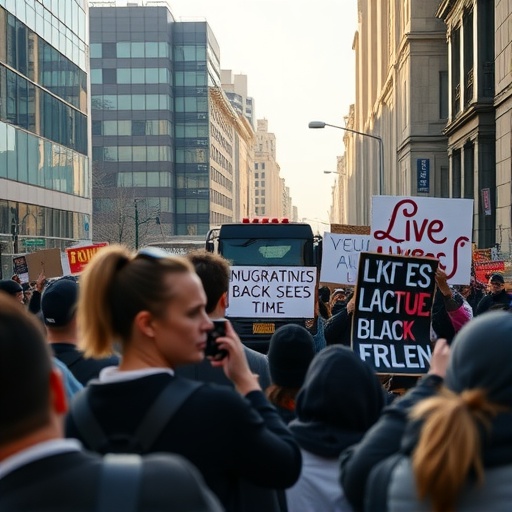
YouTube comments have long been dismissed as the internet’s noisiest backwater, a place where thoughtful discussion goes to die beneath a torrent of insults and emoji. A new study argues that this torrent is itself worth studying, and that when it is mined systematically, it reveals a starkly divided emotional and ideological landscape surrounding one of the most contentious social movements of the past decade. Using an extended streamlined analysis framework that combines topic modeling, sentiment analysis, and ideological polarization detection, researchers analyzed roughly 17,000 English-language YouTube comments related to the Black Lives Matter movement, uncovering a debate that is not merely disagreements about facts but two fundamentally different ways of framing the same events.
The study, published in the journal Neural Computing and Applications, was conducted by Mohammed M. Mostafa of the Institute of Business Administration in Karachi, Pakistan, together with Bahtiyar Kurambayev and Cristina Navarro of the Gulf University for Science and Technology in Kuwait City. Their central finding is stark: politically right-wing YouTube users tend to frame the Black Lives Matter movement as a terrorist ideology, while left-wing users focus instead on the consequences of the events surrounding the movement, from police violence to the social upheaval that followed high-profile incidents. The two camps, in other words, are not arguing about the same subject at all. One side debates the alleged nature of the movement itself; the other debates its real-world fallout. This framing gap, the authors argue, poses a serious practical challenge for healthy debate both online and offline, because productive disagreement requires at least a shared topic of contention.
The technical machinery behind these conclusions draws on several established strands of computational text analysis. Topic modeling, a family of unsupervised machine-learning techniques, was used to detect the latent themes running through the comment corpus. Sentiment analysis, drawing on lexical resources and rule-based classifiers, was used to score the emotional tone of individual comments. Finally, polarization detection methods, adapted from political science approaches that scale texts along latent ideological dimensions, were used to estimate how far apart the opposing camps sit and how consistently their language separates along the left-right axis. The framework is described as streamlined in the sense that it chains these techniques together into a single reproducible pipeline, a design choice the authors present as a labor-saving alternative to labor-intensive manual content coding of massive comment streams.
The data itself is publicly accessible, harvested through the official YouTube API, which means the analysis can in principle be replicated by any researcher with an API key. That transparency matters in a field where proprietary datasets and black-box pipelines have drawn criticism. The authors also subjected their sentiment pipeline to an unusually thorough robustness analysis, comparing three widely used sentiment methods: the NRC emotion lexicon approach, the rule-based VADER model designed specifically for social media text, and the lighter-weight TextBlob classifier. The comparison, reported in an appendix to the paper, is a useful reminder that sentiment scores are model-dependent rather than objective measurements.
The results of that comparison are instructive. Raw agreement between any pair of methods hovered around 70 percent, meaning roughly seven in ten comments receive identical sentiment labels regardless of which tool is applied. But Cohen’s kappa, which corrects for chance agreement, ranged only from 0.418 to 0.517, indicating moderate consistency rather than interchangeability. VADER achieved the highest overall accuracy at 0.745, narrowly ahead of NRC at 0.739 and clearly ahead of TextBlob at 0.693. The differences became sharper at the class level. VADER was strongest on negative comments, achieving an F1 score of 0.804, while TextBlob, despite very high precision of 0.946 when it did flag negativity, suffered from low recall of 0.451, meaning it missed more than half of the genuinely negative comments. In practical terms, TextBlob is conservative: when it calls a comment negative, it is usually right, but it fails to detect many negative comments at all. For a corpus dominated by contentious political discourse, that blind spot matters.
The substantive findings go beyond the ideological framing divide. One of the study’s more unsettling observations is that people tend to get more negative as they comment more. Repetition in the comment section, rather than wearing down hostility, appears to deepen it. This aligns with a broader body of research on online incivility suggesting that sustained participation in contentious threads can entrench adversarial positions, but the finding is notable because it emerges from a large-scale quantitative analysis rather than from small qualitative samples.
The emotional profile of the corpus is dominated by negative affect. The researchers found that negative emotions such as anger, sadness, and fear outweigh positive ones in the BLM-related comment stream. This is perhaps unsurprising given the subject matter, which involves deaths, protests, and racial conflict, but the authors note that negative emotion in contentious politics is not merely noise. Prior research on affective polarization has shown that emotions like anger and threat perception actively fuel the divide between ideological camps, turning political disagreement into social animus. The comment section, on this reading, is not a distorted mirror of public opinion but a genuine recording of the emotional temperature of a polarized public.
Engagement data added a further layer of nuance. When the authors examined the average number of likes received by comments under different sentiment labels, they found that the pattern depended on which model produced the labels. Under both the NRC and VADER approaches, positive comments attracted the highest average number of likes, with negative comments close behind and neutral comments trailing. Under TextBlob, the three categories showed near parity. The authors interpret this carefully: positive sentiment in this context need not mean apolitical praise. Positive comments may express solidarity, affirmation, or support for protest claims, all of which can earn audience endorsement. At the same time, the strong performance of negatively labeled comments suggests that anger, outrage, and condemnation are also highly engaging in contentious public discourse. The point, they emphasize, is not that one polarity dominates universally, but that the emotional tone of a comment is meaningfully connected to how audiences respond to it.
The study situates itself within a growing literature on YouTube as a political space. Previous work has documented right-wing supply and demand dynamics on the platform, filter bubbles generated by recommendation algorithms, and polarization dynamics around political parties in specific national contexts. What this study adds is a multimethod portrait of how a racially charged social movement is processed in the comment sections of the world’s largest video platform, where the audience is broader and arguably less politically curated than on Twitter or dedicated news sites. The authors frame YouTube as an ideological space in its own right, not merely a distribution channel for video content but an arena where ideological positions are articulated, contested, and reinforced in real time.
The methodological lessons may prove as influential as the substantive ones. By demonstrating that different sentiment tools produce materially different pictures of the same corpus, the robustness analysis issues a caution to anyone drawing strong conclusions from a single off-the-shelf classifier. The authors suggest that model validity should be assessed not only by conventional accuracy metrics but also by whether sentiment categories map onto meaningful external behavior, such as engagement. On that criterion, VADER and NRC produced more behaviorally differentiated sentiment classes than TextBlob, making them better suited to fine-grained interpretive analysis of contentious discourse. For researchers studying everything from vaccine debates to election commentary on social media, that recommendation offers a concrete template.
The broader implications are sobering. If right-wing viewers encounter BLM primarily as a terrorist ideology while left-wing viewers encounter it primarily through its consequences, then the two audiences are consuming parallel realities assembled from the same raw events. Sharp polarization of this kind, the authors warn, poses a serious practical challenge for healthy democratic deliberation, both in digital spaces and in the offline world they increasingly mirror. At the same time, the study’s demonstration that a transparent, publicly replicable text-mining pipeline can map these divides at scale offers a modest counterweight: a way of seeing the polarization clearly enough, perhaps, to begin addressing it.
Subject of Research: Analysis of themes, emotional tone, and ideological polarization in YouTube comments about the Black Lives Matter movement using topic modeling, sentiment analysis, and polarization detection.
Subject of Research: Technology and Engineering
Article Title: YouTube as an ideological space: detecting themes, emotional tone, and ideological polarization in the black lives matter video comments
Article References: Mostafa, M. M., Kurambayev, B., & Navarro, C. (2026). YouTube as an ideological space: detecting themes, emotional tone, and ideological polarization in the black lives matter video comments. Neural Computing and Applications, 38(16), Article 667. https://doi.org/10.1007/s00521-026-12385-5
Image Credits: AI Generated
DOI: 10.1007/s00521-026-12385-5
Keywords: Black Lives Matter, YouTube, sentiment analysis, topic modeling, ideological polarization, emojis, social media, text mining, online discourse, affective polarization
Cite Scienmag News
APA MLA Chicago
Denise Maddox. (September 7, 2026). YouTube comment analysis reveals ideological polarization in Black Lives Matter videos. Scienmag. https://scienmag.com/youtube-comment-analysis-reveals-ideological-polarization-in-black-lives-matter-videos/
Copy citation Download RIS
Tags: analysis of political bias in social mediaBlack Lives Matter online discourseBlack Lives Matter YouTube comment analysisemotional landscape of Black Lives Matter debatesemotional tone in YouTube commentsframing of Black Lives Matter in digital spacesideological divide in YouTube discussionsideological polarization in social movementsimpact of social media on social justice movementsinfluence of political ideology on Black Lives Matter perceptionsonline ideological divide on police violenceonline polarization and social mediapolarization detection in social media commentspolitical bias in online discoursepolitical framing of Black Lives Mattersentiment analysis of social media commentssentiment analysis of YouTube commentssocial media analysis of protest movementssocial movement perception analysissystematic study of YouTube commentstopic modeling of Black Lives Matter discussionstopic modeling of social media debatesYouTube comment analysis