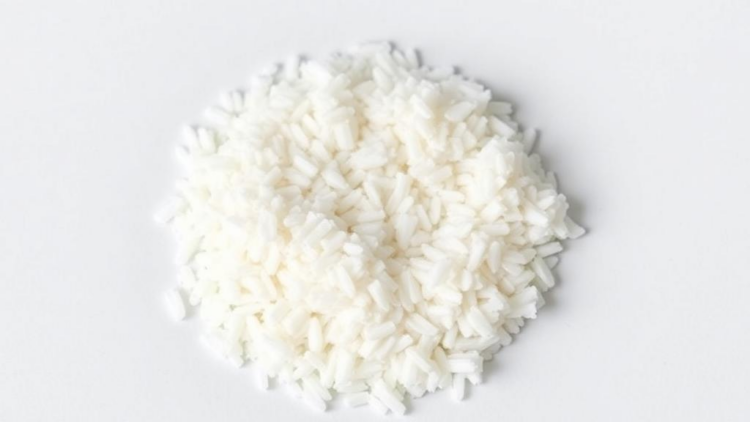
A humble variety of rice grown on the borderlands of Nepal and India has become the unlikely star of a pharmaceutical engineering study that could reshape how drug tablets are made. Researchers extracted starch from the Gorakhnath-509 rice cultivar, chemically crosslinked it with malonic acid in an almost entirely aqueous process, and found that the resulting material outperformed its native counterpart as a tablet binder. The work, published in Discover Chemistry, arrives at a moment when the pharmaceutical industry is under growing pressure to replace synthetic, petroleum-derived excipients with biodegradable, plant-based alternatives that do not compromise on performance.
Starch is one of the most abundant biopolymers on Earth, accumulated in granules within cereals, tubers, roots, and seeds. Each granule is built from two polysaccharides: amylose, a predominantly linear alpha-(1–4) linked glucan that tends to retrograde and form strong films, and amylopectin, a highly branched molecule that produces softer gels and weaker films. The ratio of these two components, along with the degree of crystallinity imparted by amylopectin’s short branches, determines how a given starch behaves under heat, pressure, and hydration. Native starches, however, suffer from well-known limitations, including poor thermal stability, syneresis, and retrogradation, which restrict their usefulness in demanding applications such as pharmaceutical formulations.
To overcome these weaknesses, the research team turned to chemical modification, specifically esterification with malonic acid, a dicarboxylic acid that can bridge adjacent starch chains through ester bonds. The process was deliberately designed to be environmentally benign: the reaction was carried out in water at 90 degrees Celsius, avoiding the organic solvents that typify conventional starch modification routes. Formaldehyde was used as a co-crosslinking agent, a detail the authors themselves flag as a limitation, noting that future work should confirm its complete removal and explore aldehyde-free alternatives. Nevertheless, the predominantly aqueous approach represents a meaningful step toward greener excipient manufacturing.
The chemical evidence for successful modification was compelling. Attenuated total reflectance Fourier transform infrared spectroscopy revealed a new carbonyl stretching peak near 1720 wavenumbers, the signature of ester bonds linking malonate groups to the starch backbone. Titrimetric analysis established a degree of substitution of 0.081 plus or minus 0.009, meaning roughly one in twelve anhydroglucose units carried a malonate substituent. While modest compared with some other carboxylic-acid-modified starches, this substitution level proved sufficient to disrupt the native hydrogen-bonding network and limit chain mobility, with measurable downstream consequences for water uptake, matrix integrity, and drug release.
X-ray diffraction provided structural confirmation of this disruption. Native Gorakhnath-509 starch displayed the characteristic A-type diffraction pattern typical of cereal starches, with reflections at 15, 17, 18, and 23 degrees two-theta. After modification, the intensities of these peaks were visibly attenuated, indicating a qualitative loss of the native semicrystalline order. The authors are careful to note that because the starch was pregelatinized before chemical treatment, thermal processing itself may have contributed to the loss of crystallinity, and a gelatinized but chemically unmodified control was not included in the experimental design. This is an honest caveat that tempers, but does not eliminate, the structural interpretation.
The functional payoff emerged most clearly in the tablet formulations. Using diclofenac sodium as a model drug, the team compressed tablets containing 1, 3, and 5 percent by weight of either native or modified starch as the binder. At the lowest binder level, the modified starch delivered harder tablets, 16.5 plus or minus 0.46 newtons versus 15.66 plus or minus 0.57 newtons for native starch, a statistically significant difference confirmed by one-way ANOVA with Tukey’s post hoc test. Friability, the tendency of tablets to crumble during handling, fell to 0.15 percent for the modified formulation compared with 0.37 percent for its native counterpart, and all six formulations remained comfortably below the pharmacopoeial acceptance threshold of 1.0 percent.
Intriguingly, the hardness advantage did not persist at higher binder concentrations. At 3 and 5 percent binder levels, the modified starch formulations were actually softer than their native counterparts, a concentration-dependent reversal the authors attribute, tentatively, to differences in the deformation and compaction behavior of the esterified matrix at higher loadings. The underlying mechanism was not directly probed in this study, but the finding underscores a broader lesson in excipient science: chemical modification does not produce uniform improvement, and formulation scientists must map performance across the full range of use concentrations before drawing conclusions about superiority.
The dissolution results may prove to be the study’s most consequential contribution. At every binder concentration, tablets containing modified starch released diclofenac sodium faster and more completely than those bound with native starch. The most striking contrast appeared at the 3 percent binder level, where the modified formulation achieved approximately 96 percent cumulative release compared with 77 percent for the native starch version. Kinetic modeling with the DDSolver software showed that the Korsmeyer-Peppas model provided the best fit across all six formulations, with correlation coefficients between 0.9897 and 0.9997. Release exponents greater than 1.0 pointed to Super Case-II transport, a mechanism in which drug release is governed not by simple Fickian diffusion but by the coupled processes of polymer swelling, chain relaxation, and matrix erosion.
This transport mechanism fits neatly with the swelling observations. When tablets were placed on agar gel plates, the modified starch formulations swelled more dramatically than their native counterparts, consistent with the enhanced water uptake expected from a more amorphous, esterified matrix. The combination of high release exponents, pronounced swelling, and XRD evidence for a lightly crosslinked, less crystalline structure paints a coherent mechanistic picture: water penetrates the tablet, the modified starch matrix hydrates and relaxes, and the gel layer gradually erodes, releasing drug in a sustained and predictable fashion. For a biodegradable, rice-derived excipient, this is precisely the kind of controlled-release behavior that formulators seek.
The study is not without limitations, and the authors acknowledge them candidly. The absence of scanning electron microscopy leaves the morphological changes of the modified starch unvisualized, the thermal confound in the modification process complicates attribution, and formal life-cycle assessment would be needed before making sweeping environmental claims. Yet the core achievement stands: a high-amylose rice starch from a regional cultivar, transformed through a largely solvent-free reaction into a pharmaceutical binder that improves tablet integrity at low concentrations and enables sustained, Super Case-II drug release. As the industry searches for biocompatible, biodegradable excipients, this work suggests that the answer may be growing in the paddy fields of the eastern Himalayas, waiting only for the right chemistry to unlock its potential.
Subject of Research: Chemical modification of Gorakhnath-509 rice starch with malonic acid for use as a pharmaceutical tablet binder and controlled-release excipient
Article Title: Structural and functional evaluation of modified native rice starch for tablet formulations
Article References: Structural and functional evaluation of modified native rice starch for tablet formulations. (n.d.). https://doi.org/10.1007/s44371-026-00953-6
Image Credits: AI Generated
DOI: 10.1007/s44371-026-00953-6
Keywords: rice starch, malonic acid, crosslinking, tablet binder, diclofenac sodium, drug release, Korsmeyer-Peppas, green chemistry, pharmaceutical excipient, X-ray diffraction, degree of substitution, biodegradable polymer
Cite Scienmag News
APA MLA Chicago
Copy citation Download RIS
Tags: biodegradable drug excipientsbiodegradable polymerbiopolymer-based tablet binderscrosslinkingdegree of substitutiondiclofenac sodiumdrug releaseenvironmentally friendly pharmaceutical excipientsgreen chemistrygreen chemistry in drug formulationKorsmeyer–Peppasmalonic acidmalonic acid crosslinked starchnatural starch derivatives for drug deliverypharmaceutical excipientplant-based pharmaceutical excipientsplant-derived sustained-release drug tabletsrice cultivar Gorakhnath-509rice starchrice starch as tablet binderstarch chemical modification for pharmaceuticalssustainable pharmaceutical manufacturingtablet binderX-ray diffraction