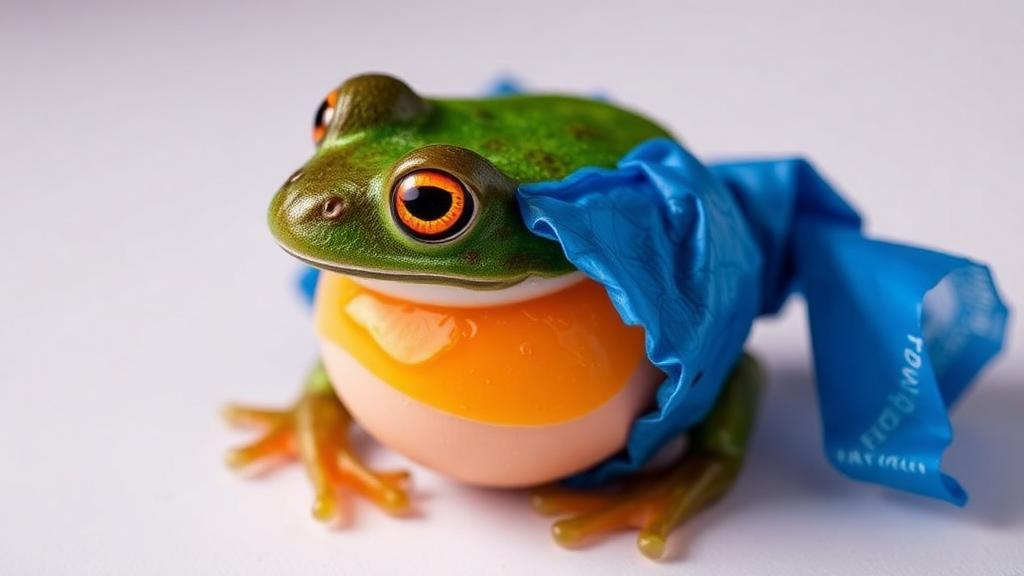
A food packaging film made almost entirely from natural ingredients can kill bacteria, block ultraviolet light, slow fat oxidation, and—most strikingly—change color as food spoils, according to a new study published in Food Chemistry: X. The material, developed by a team of researchers in China, weaves together a protein extracted from the eggs of the Rana chensinensis frog, xanthan gum, lemon essential oil, and anthocyanin pigments inside a sodium alginate matrix. In tests on banana slices and chilled pork, the film kept food fresher for days longer than untreated samples while doubling as a built-in freshness indicator that shifts from red to blue as meat degrades. The work offers a vivid example of how agricultural byproducts, long treated as waste, could be transformed into the backbone of a new generation of active and intelligent packaging.
The central challenge the researchers set out to solve is a familiar one in food science: how to deliver fragile, bioactive compounds—like antimicrobial essential oils—into a water-based packaging film without losing them. Lemon essential oil, rich in limonene, citral, and beta-pinene, has broad-spectrum antimicrobial power against foodborne pathogens, but when simply mixed into a hydrophilic film it evaporates quickly, leaks out, and disrupts the material’s structure. The team’s solution was to encapsulate the oil in a Pickering emulsion, a type of emulsion stabilized not by synthetic surfactants but by solid particles that anchor themselves at the oil-water interface. Pickering emulsions have become a darling of green chemistry precisely because their particle-based stabilization is robust, surfactant-free, and safe for food contact.
The stabilizer particles themselves are the study’s most unusual ingredient. The researchers used a protein isolate drawn from Rana chensinensis ova, a byproduct of processing Oviductus Ranae, a traditional Chinese medicinal product. This material, abbreviated RCOPI, is inexpensive, abundant, and would otherwise be discarded. Its proteins are highly amphiphilic, meaning they carry both water-loving and oil-loving regions, allowing them to coat oil droplets effectively. The protein also brings its own antioxidant activity and a distinctive amino acid profile. On its own, however, RCOPI forms emulsions that are vulnerable to environmental stresses like changes in pH and salt concentration, so the team paired it with xanthan gum, an anionic polysaccharide prized for its solubility in cold water and its stable viscosity across a wide range of conditions. When combined at a one-to-one weight ratio, the protein-polysaccharide complex produced the smallest droplets and the greatest physical stability in the team’s preliminary optimization experiments.
The emulsion itself proved impressively well-formed. Droplet sizes clustered between two and five micrometers in a narrow distribution, and confocal laser scanning microscopy showed oil droplets uniformly dispersed in a continuous water phase with no visible coalescence or flocculation. The droplets carried zeta potentials between minus 27 and minus 28 millivolts, comfortably above the minus 25 millivolt threshold generally considered sufficient for electrostatic stabilization. In practical terms, the droplets repel one another strongly enough to resist merging, which is exactly what a packaging additive needs to survive the drying process that turns a liquid film-forming solution into a solid sheet. When the team tried adding the same ingredients directly to the film solution without pre-emulsifying them, the lemon oil floated to the surface, left behind oily droplets and pores, and the resulting films fractured completely under a 500-gram load—a stark demonstration of why the emulsion route matters.
Blended into sodium alginate at volume fractions from 0.1 to 2 percent, the emulsion changed the films’ character in measurable ways. Thickness rose from 61.8 to 74.4 micrometers as droplets occupied space within the polymer network. Water content and moisture absorption both dropped significantly, because the hydrophobic oil component hinders water molecules from adsorbing into and penetrating the film. The water contact angle, a measure of surface wettability, climbed from about 50 degrees for pure alginate to 101.66 degrees at the highest emulsion loading, pushing the surface past the 90-degree threshold that separates hydrophilic from hydrophobic behavior. Mechanical properties followed a more nuanced curve: tensile strength and elongation both improved at low emulsion levels, where intact droplets act as physical crosslinking sites that transfer and dissipate stress, but fell at 2 percent loading, where crowded droplets destabilize the interface and introduce defects. Water vapor permeability, interestingly, increased with emulsion content, because the dispersed droplets disrupt the dense hydrogen-bonding network of the alginate chains and open low-resistance diffusion pathways—a reminder that in film design, surface chemistry and bulk microstructure can pull in opposite directions.
The films’ protective chemistry was equally striking. Pure alginate films scavenged only 3.91 percent of DPPH radicals and 2.16 percent of ABTS radicals in standard antioxidant assays, but the 2 percent emulsion film reached 61.84 and 81.58 percent respectively, a dose-dependent surge the authors attribute to synergy among anthocyanin phenolics, essential oil terpenoids, and the emulsion interface that stabilizes them. Against Escherichia coli and Staphylococcus aureus, the composite films showed strong inhibition that intensified with emulsion loading, with the highest concentration nearly eliminating Staphylococcus aureus growth. The researchers note that Gram-positive bacteria like Staphylococcus are especially vulnerable because their cell membranes are more accessible to hydrophobic essential oil components, whereas Gram-negative species like E. coli carry an outer lipopolysaccharide membrane that impedes penetration. Ultraviolet shielding also improved dramatically: while pure alginate films blocked little light above 400 nanometers, the 2 percent composite film blocked more than 80 percent across the 200-to-400-nanometer range and nearly all UV in the 200-to-300-nanometer band, thanks to multi-scale light scattering by the embedded particles.
The freshness-indicating function comes from the anthocyanins, plant pigments whose molecular structure shifts reversibly with pH. In acidic conditions they exist as protonated flavylium cations that absorb light to produce a red hue; as pH rises, deprotonation yields a quinonoidal base with a blue-violet color, and under alkaline conditions they transform through an alcohol-type pseudobase into a yellow chalcone. The composite film traced this full palette across buffer solutions from pH 2 to 11, moving from red through pale red, pale blue, and pale yellow to yellow. Fumigation tests with ammonia and hydrochloric acid vapors confirmed the response works with gases as well as liquids, which is critical because spoiling food releases volatile amines into the headspace of a package.
Real-food trials put the material through its paces. Banana slices wrapped in the 2 percent film showed only minimal browning over five days of room-temperature storage, while unwrapped controls darkened noticeably by day three; weight loss in wrapped samples averaged about 8.15 percent versus 15.66 percent for controls. Chilled pork told a similar story with harder numbers. Unwrapped pork lost 18.39 percent of its weight over ten days at 4 degrees Celsius, exceeded the spoilage pH threshold of 6.7 by day five, and surpassed the regulatory limit of 15 milligrams of total volatile basic nitrogen per 100 grams as early as day three. The film-wrapped pork lost only 7.36 percent of its weight, delayed the pH threshold to around day eight, and reached the TVB-N limit near day eight as well. Lipid oxidation, tracked by thiobarbituric acid reactive substances, climbed from 0.22 to 1.96 milligrams of malondialdehyde per kilogram in controls but reached only 0.83 in wrapped samples, and total viable bacterial counts on day ten were 5.69 log colony-forming units per gram for wrapped pork versus 8.01 for controls—below the national safety limit of 6.
Most compelling for consumers, the film’s color tracked spoilage quantitatively. Over ten days of pork storage the film shifted from blue-purple toward blue, its total color difference climbing to 17.70, and this color change correlated significantly with TVB-N levels, with a quadratic fitting curve achieving an R-squared of 0.9288. In other words, the wrapper is not merely decorative; it functions as a passive sensor whose hue encodes the chemical progress of protein breakdown. The authors are candid about remaining hurdles: anthocyanins are sensitive to light, heat, and oxidation, raw material composition varies between batches, and proteins in real food matrices can interfere with color accuracy. Questions of scale-up, batch consistency, and long-term storage stability also await systematic techno-economic evaluation. Still, the biodegradability results are encouraging—the films lost more than 60 percent of their mass in soil over four weeks—and the RCOPI supply requires no additional harvesting of frogs, since it valorizes an existing processing byproduct. If those engineering gaps close, the humble frog egg could find an unlikely second life keeping pork and bananas fresh on supermarket shelves.
Subject of Research: Development of a biodegradable, pH-responsive sodium alginate food packaging film reinforced with Pickering emulsions stabilized by Rana chensinensis ovum protein isolate and xanthan gum
Article Title: All-natural sodium alginate films reinforced with Rana chensinensis ovum protein isolate/xanthan gum-stabilized Pickering emulsions for active preservation and freshness indication
Article References: Zhang, M., Li, M., Li, H., Zhang, K., Jiao, Z., Xu, K., Wang, Z., Wang, Y., & Wang, S. (2026). All-natural sodium alginate films reinforced with Rana chensinensis ovum protein isolate/xanthan gum-stabilized Pickering emulsions for active preservation and freshness indication. Food Chemistry: X, Article 104563. https://doi.org/10.1016/j.fochx.2026.104563
Image Credits: AI Generated
DOI: 10.1016/j.fochx.2026.104563
Keywords: food packaging, Pickering emulsion, sodium alginate, Rana chensinensis, xanthan gum, lemon essential oil, anthocyanin, freshness indicator, antimicrobial film, antioxidant, pork preservation, biodegradable materials