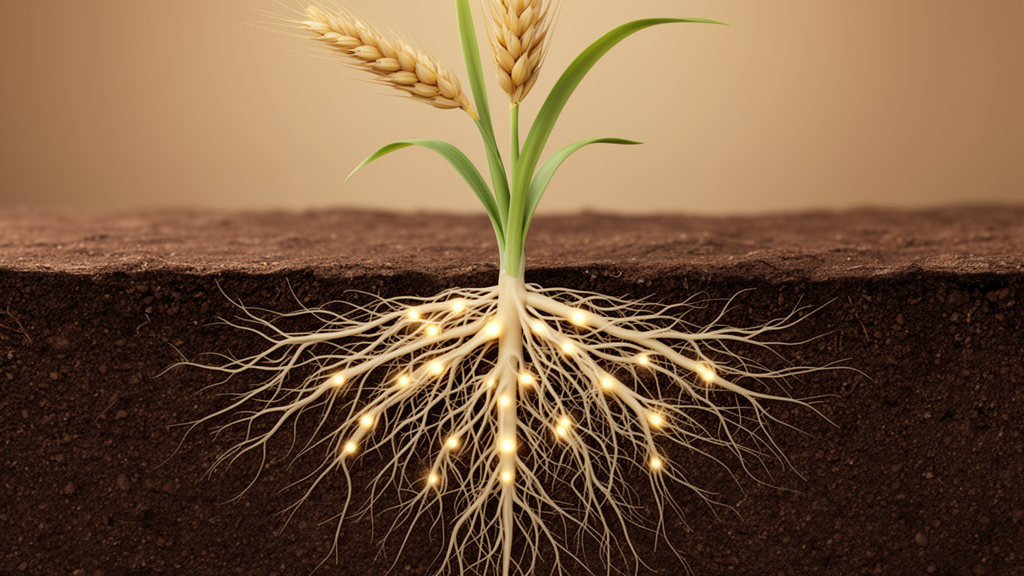
Deep inside the roots of every winter wheat plant lies a hidden world that scientists have largely overlooked. While arbuscular mycorrhizal fungi have long been celebrated as the star symbionts of cereal crops, a new field study from South Dakota State University reveals that another, more mysterious group of fungi may be quietly dominating the underground scene. Dark septate endophytes, a diverse assemblage of melanized root-colonizing fungi, were found to colonize more of the wheat root system than their famous mycorrhizal counterparts across nearly every production environment, nitrogen treatment, and crop stage tested. The finding, published in the journal Plant and Soil, challenges long-held assumptions about which fungi matter most in one of the world’s most important staple crops.
The research team, led by Romandeep Kaur and Keerthi Mandyam, set out to fill a conspicuous gap in agricultural science. Although dark septate endophytes have been repeatedly isolated from wheat roots and detected in DNA-based microbiome surveys, almost no study had quantitatively measured how extensively these fungi actually colonize wheat roots in the field, let alone compared them directly with arbuscular mycorrhizal fungi under identical conditions. The researchers argue that molecular detection alone cannot establish endophyte status, because the dark septate group comprises phylogenetically diverse fungi that cannot be reliably identified as a single functional guild from microbiome data. Microscopic assessment of percent root length colonization, by contrast, provides a direct and quantitative measure of fungal presence within root tissue.
To conduct the comparison, the team grew ten hard winter wheat genotypes across three production environments in South Dakota: a conventionally tilled research farm at Aurora, and two long-term no-tillage sites, the Dakota Lakes Research Farm near Pierre and Jorgensen Land and Cattle near Winner. Each environment hosted a split-plot randomized complete block design in which nitrogen fertilization was applied at two levels, one with no added nitrogen and one targeting 150 pounds of nitrogen per acre. Root and soil samples were collected at two critical developmental stages, Heading at Feekes 10.5 and Harvest at Feekes 11.4, yielding 360 paired soil and root samples in total.
The laboratory work involved a meticulous staining protocol. Root segments were cleared in potassium hydroxide, neutralized in acetic acid, and stained with Trypan Blue before microscopic examination at 400-fold magnification. Arbuscular mycorrhizal structures, including hyphae, arbuscules, vesicles, and coils, were scored using the gridline intersect method, while dark septate endophytes were identified by their characteristic naturally melanized septate hyphae and microsclerotia. Fifteen soil chemistry variables, from pH and organic matter to micronutrients such as iron, zinc, and copper, were quantified by a commercial laboratory, and grain yield was measured with a plot combine adjusted to thirteen percent moisture.
The results were striking. Dark septate endophyte colonization ranged from 8.6 to 73.2 percent of root length, while arbuscular mycorrhizal colonization spanned 4.7 to 68.5 percent. Averaged across all experimental factors, the dark septate fungi colonized 33.8 percent of root length compared with 23.5 percent for the mycorrhizal fungi, a statistically significant difference. The dark septate guild out-colonized the mycorrhizal guild in all three production environments, under both nitrogen treatments, at the Harvest stage, and in seven of the ten wheat varieties. Only at the Heading stage, and in a single variety, did the mycorrhizal fungi take the lead.
Perhaps the most intriguing pattern emerged from the temporal dynamics. The two fungal guilds moved in opposite directions across the growing season. Mycorrhizal colonization peaked at flowering, averaging 27.1 percent at Heading before declining to 20.3 percent at Harvest. The dark septate endophytes did the reverse, more than doubling from 22.3 percent at Heading to 47.5 percent at Harvest. The researchers suggest that senescing root cells, which accumulate as the wheat plant approaches maturity, may serve as preferred colonization sites for these facultative endophytes. This opposing developmental rhythm means the two guilds are not interchangeable, and that sampling at a single crop stage could paint a misleading picture of the root fungal community.
Nitrogen fertilization told an equally surprising story. Conventional wisdom holds that nitrogen inputs suppress mycorrhizal colonization, and indeed the mycorrhizal fungi showed a slight numerical decline under the high-nitrogen treatment, though the effect fell just short of statistical significance. The dark septate endophytes, contrary to the researchers’ own hypothesis, responded strongly and significantly, dropping from 37.5 percent colonization without added nitrogen to 30.2 percent under the 150-pound treatment. This divergence suggests that the two guilds respond to nutrient management through fundamentally different mechanisms, possibly reflecting the obligate biotrophic lifestyle of mycorrhizal fungi, which depend on living host tissue, versus the greater ecological flexibility of the facultative dark septate endophytes.
Tillage history also left its mark, though in unexpected directions. Mycorrhizal colonization was highest at the two long-term no-tillage sites, consistent with decades of evidence that soil disturbance disrupts mycorrhizal hyphal networks. The dark septate endophytes, however, were most abundant at the conventionally tilled Aurora site, reaching 39.6 percent colonization compared with 32.4 and 29.8 percent at the no-tillage locations. The authors caution that the production environments differed in soil type, rotation, and weather as well as tillage, so the pattern cannot be attributed to tillage alone. Still, the facultative lifestyle of dark septate endophytes may allow them to persist or disperse more readily after soil disturbance than their obligate biotrophic counterparts.
Soil chemistry, surprisingly, explained little of the variation in fungal colonization once the experimental design was accounted for. In exploratory analyses, dark septate colonization showed positive associations with iron and copper and a negative association with potassium, while no soil variable remained significantly associated with mycorrhizal colonization after correction for multiple comparisons. A sensitivity analysis revealed something even more important: when crop stage was excluded from the statistical models, thirteen of fifteen soil variables appeared associated with dark septate colonization, but after properly accounting for developmental timing, none survived. This finding carries a warning for the field, since apparent relationships between soil chemistry and root fungi measured at a single time point may simply reflect developmental covariation rather than genuine causal links.
Neither fungal guild was significantly associated with grain yield, which ranged from 44 to 82 bushels per acre and was driven primarily by environment, nitrogen rate, and variety. The only significant yield predictor was soil nitrate-nitrogen, which was negatively associated with yield. The authors emphasize that colonization extent does not equal functional importance, and that dark septate endophytes may benefit plants through pathways invisible to yield measurements, such as stress tolerance and disease protection. Indeed, recent greenhouse work has shown that the dark septate species Periconia macrospinosa can promote wheat seedling growth and suppress Fusarium crown rot by reprogramming host defenses. The researchers propose that these fungi may act as by-product mutualists, whose benefits to the host arise incidentally from their metabolic activities rather than through tightly reciprocal exchanges. As the first quantitative field comparison of its kind, this study establishes a benchmark for root fungal ecology in wheat and makes a compelling case that the dark septate endophytes deserve a seat at the table alongside mycorrhizae in future crop research.
Subject of Research: Comparative root colonization of dark septate endophytes and arbuscular mycorrhizal fungi in winter wheat production systems
Article Title: Dark septate endophyte colonization exceeds arbuscular mycorrhizal colonization across winter wheat production systems
Article References: Kaur, R., Koupal, D., Sehgal, S., & Mandyam, K. (2026). Dark septate endophyte colonization exceeds arbuscular mycorrhizal colonization across winter wheat production systems. Plant and Soil. https://doi.org/10.1007/s11104-026-09096-0
Image Credits: AI Generated
DOI: 10.1007/s11104-026-09096-0
Keywords: dark septate endophytes, arbuscular mycorrhizal fungi, winter wheat, root colonization, nitrogen fertilization, tillage, soil chemistry, crop stage, grain yield, plant microbiome, root endophytes, agricultural ecology