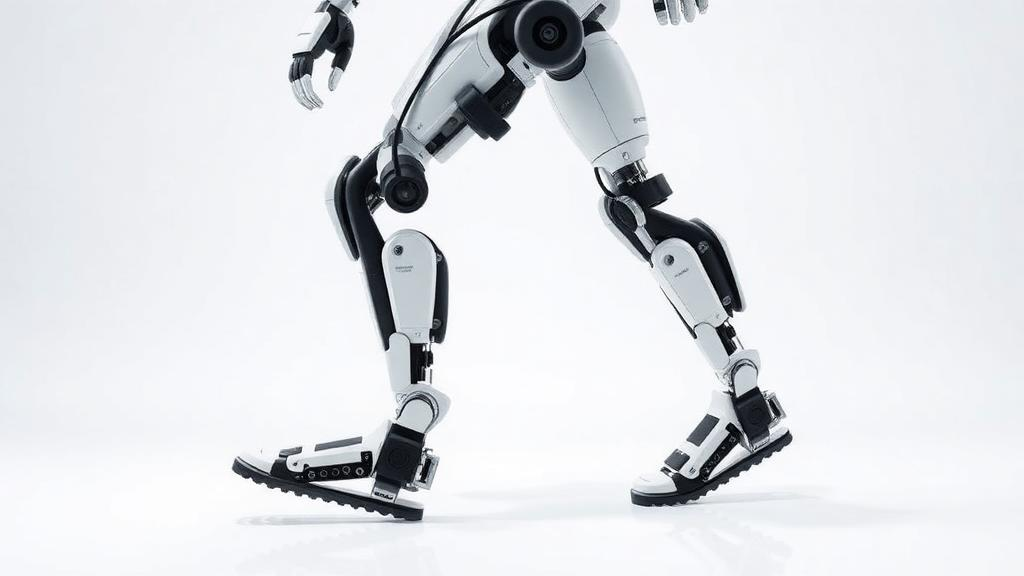
A pair of robotic hip assist devices may do more than make walking easier. A new randomized crossover trial from South Korea suggests that when people with type 2 diabetes take a 30-minute walk after a meal while wearing a lightweight hip exoskeleton, their blood sugar climbs less sharply and stays lower over the following two hours than when they walk unaided. The study, published in BMC Endocrine Disorders, offers one of the first controlled tests of whether wearable robotics can meaningfully sharpen a therapy as simple and familiar as the postprandial stroll.
The research team, led by Seung-Bo Park and Junggi Hong of CHA University’s Graduate School of Sports Medicine, recruited 14 adults with type 2 diabetes and asked each of them to complete three separate walking sessions. In one condition, participants walked normally with no robotic assistance. In the other two, they wore the Bot-Fit wearable hip exoskeleton, a Samsung Electronics-developed device that attaches around the hips and thighs and uses motorized assistance or resistance at the hip joints to alter how hard the muscles must work during each stride. The two robotic modes, called Aqua and Boost, were designed to impose different physiological demands.
The experimental design was deliberately rigorous for a proof-of-concept study. Because glucose responses vary widely from person to person and from day to day, the investigators used a randomized, partially counterbalanced crossover protocol, meaning every participant experienced all three walking conditions, with the order shuffled to cancel out carryover effects. Walking intensity was individualized by setting each person’s pace to elicit 40 percent of their heart rate reserve, a measure that accounts for resting and maximum heart rate, and that target was held constant across all three conditions. This ensured that any differences in blood sugar outcomes could be attributed to the robotic mode rather than to one group simply exercising harder.
Glucose was tracked with capillary blood samples taken at baseline and then every 10 minutes for a full 120 minutes after the walk began, allowing the team to construct a fine-grained picture of the post-meal glucose curve. Alongside the metabolic measurements, the researchers recorded heart rate, blood lactate concentrations, and each participant’s rating of perceived exertion, the subjective sense of how hard the effort felt. These secondary measures were critical to the study’s central question: whether robotic modes could change not just the glucose outcome but the physiological cost of achieving it.
The headline result was unambiguous. Compared with unassisted walking, both robotic modes significantly reduced total and incremental glucose exposure, mean blood glucose, peak glucose, and the magnitude of the glucose spike, all at statistical significance. The incremental area under the glucose curve, a standard summary of how much excess glucose circulates over time, fell from 6461 plus or minus 2477 mg·min/dL during unassisted walking to 4877 plus or minus 1946 under the Aqua mode and 5072 plus or minus 2339 under Boost, a reduction the authors report at P less than .001. For a population in which post-meal glucose excursions drive both daily symptom burden and long-term cardiovascular risk, a difference of that size from a single 30-minute walk is striking.
The two robotic modes, however, were not interchangeable, and the differences between them reveal an interesting physiological trade-off. The Aqua mode, which combines robotic assistance with elements of resistance, produced the strongest glycemic profile: it further reduced early glucose exposure and glucose variability compared with unassisted walking. But it came at a price. Mean heart rate during Aqua walking was 118.9 plus or minus 20.2 beats per minute, significantly higher than the 105.7 plus or minus 16.3 beats per minute recorded during unassisted walking, and peak blood lactate was also elevated, indicating greater metabolic strain.
The Boost mode told a different story. It delivered a glycemic benefit comparable to Aqua on the primary endpoints while keeping mean heart rate at 101.3 plus or minus 13.9 beats per minute, essentially indistinguishable from unassisted walking. More remarkably, participants rated the effort substantially lower: a perceived exertion score of 4.0 plus or minus 1.3 versus 5.2 plus or minus 2.3 for the unassisted condition, a difference that reached statistical significance. In other words, Boost allowed walkers to achieve better glucose control while feeling as though they were working less hard, a combination that could matter enormously for adherence in a disease where exercise prescriptions are notoriously difficult to sustain.
The mechanistic logic behind these findings rests on how hip-joint robotics reshape muscle recruitment during gait. Walking clears glucose from the bloodstream primarily through contraction-mediated uptake in the leg muscles, a pathway that operates partly independently of insulin and is therefore especially valuable in type 2 diabetes, where insulin resistance blunts the normal hormonal route. By assisting or resisting hip flexion and extension, the exoskeleton alters the pattern and intensity of muscle activation across the large muscle groups of the lower body. The Aqua mode’s higher heart rate and lactate values suggest it recruited more total muscle mass or drove greater metabolic turnover, plausibly explaining its superior effect on early glucose disposal and curve variability. Boost’s lower perceived exertion at equal heart rate suggests the device offloaded mechanical work from the walker, reducing the subjective cost of the same cardiovascular effort.
The study’s authors are careful to frame the work as an acute, proof-of-concept experiment rather than a demonstration of clinical benefit. Fourteen participants, a single post-meal session per condition, and no long-term follow-up leave open the most important questions: whether the glycemic advantage persists with repeated use, whether it translates into improvements in glycated hemoglobin or insulin sensitivity over weeks and months, and whether older adults or those with diabetic complications can tolerate the devices safely. The trial was retrospectively registered on ClinicalTrials.gov, and the funding came from Samsung Electronics, the device’s manufacturer, though the company reports no role in study design, data analysis, or the decision to publish, and the authors declare no other competing interests.
Even with those caveats, the findings point toward an intriguing convergence of rehabilitation robotics and metabolic medicine. Wearable exoskeletons have largely been developed for gait rehabilitation after stroke or spinal cord injury, and for industrial workers seeking to reduce fatigue. This study suggests a third application: precision tuning of a everyday behavior, the post-meal walk, that millions of people with diabetes are already told to perform. If larger trials confirm that robotic modes can deliver stronger glucose control at lower perceived effort, the postprandial walk could evolve from generic advice into a tunable, quantifiable intervention, with the mode selected to match an individual’s fitness, preferences, and glycemic profile. For now, the message from Seongnam is a tantalizing preview: the humble walk after dinner may have untapped potential, and a motor at the hip might be the key to unlocking it.
Subject of Research: Effects of wearable hip exoskeleton-assisted postprandial walking on glycemic responses in adults with type 2 diabetes
Article Title: Effects of wearable hip exoskeleton-assisted postprandial walking on glycemic responses in patients with type 2 diabetes: a randomized crossover study
Article References: Park, S.-B., Yang, G., & Hong, J. (2026). Effects of wearable hip exoskeleton-assisted postprandial walking on glycemic responses in patients with type 2 diabetes: a randomized crossover study. BMC Endocrine Disorders. https://doi.org/10.1186/s12902-026-02519-0
Image Credits: AI Generated
DOI: 10.1186/s12902-026-02519-0
Keywords: type 2 diabetes, wearable robot, hip exoskeleton, postprandial glucose, glycemic response, exercise, blood lactate, perceived exertion, crossover trial, glucose variability, heart rate reserve, Bot-Fit