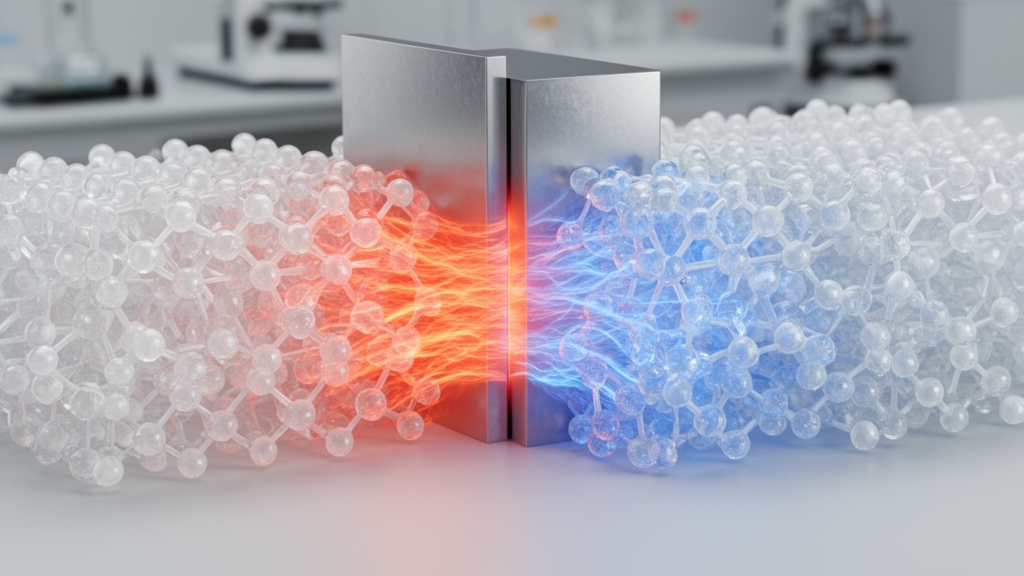
Refrigeration is one of the quiet giants of global energy consumption, and the refrigerants at its heart are among the most potent greenhouse gases humanity has ever released. As demand for cooling surges in a warming world, researchers have been hunting for materials that can pump heat without any fluid at all. A new study published in the Journal of Materials Science by Sol Geo Lim, Hye Rim Choi, Ji-Ho Yoon and colleagues at Korea Maritime and Ocean University now delivers one of the most complete pictures yet of how a humble organic crystal called pentaglycerine turns mechanical pressure into a striking cooling effect, combining laboratory measurements with atomistic simulations in a way that few previous studies have managed.
The phenomenon at the center of the work is the barocaloric effect, the pressure-driven cousin of the magnetocaloric, electrocaloric and elastocaloric effects that have energized the field of solid-state cooling. When a material sits near a phase transition, applying pressure can shift the transition temperature and drive the material from one thermodynamic state to another. Because the two states carry very different amounts of entropy, squeezing the material and then releasing it forces heat to be absorbed or dumped, effectively pumping thermal energy with nothing more than a mechanical push. If the process is reversible and the entropy change is large, the material becomes a candidate for refrigerators and heat pumps that contain no volatile liquids whatsoever.
Pentaglycerine belongs to a family of substances known as plastic crystals, organic molecular solids that undergo dramatic order–disorder transitions. Below the transition, the molecules sit in a well-ordered crystal lattice, locked into position by a network of hydrogen bonds between their hydroxyl groups. Above it, the molecules remain in the solid but begin to rotate and tumble around their lattice sites, a state that behaves in some ways like a crystalline liquid. This molecular liberation absorbs an enormous amount of entropy, which is precisely what makes plastic crystals so attractive for barocaloric applications. The transition temperature is also unusually sensitive to pressure, meaning modest mechanical forces can switch the material back and forth.
To characterize pentaglycerine rigorously, the team deployed an unusually broad experimental arsenal. Temperature-dependent synchrotron X-ray diffraction, performed at the Pohang Light Source, tracked how the crystal structure evolves through the transition, while Raman spectroscopy probed the vibrational fingerprints of the molecular ordering. High-pressure micro-differential scanning calorimetry measured the heat flows associated with the transition under applied pressures, revealing how the transition temperature climbs as the sample is squeezed. Together these techniques pinned down the ordered-crystal to plastic-crystal transformation across a temperature window of roughly 353 to 363 kelvin, accompanied by a discontinuous jump in specific volume of 0.05 cubic centimeters per gram, a substantial structural breathing that accompanies the molecular disordering.
The calorimetry established the key numbers that define the material’s cooling credentials. At ambient pressure, the transition occurs at 357 kelvin on heating and 347 kelvin on cooling, a hysteresis that reflects the first-order nature of the transformation. Most importantly, the transition temperature shifts by 0.13 kelvin per megapascal of applied pressure. That pressure sensitivity is the engine of the barocaloric effect: it dictates how far a given pressure can push the material through its transition. Under an applied pressure of 80 megapascals, pentaglycerine delivered a peak isothermal entropy change of 476 joules per kelvin per kilogram and an adiabatic temperature change of 9.3 kelvin, figures that place it firmly among the leading barocaloric materials reported to date.
What distinguishes this study is that the measurements did not stop at the macroscopic level. The researchers paired their experiments with molecular dynamics simulations of the two phases, equilibrating the ordered crystal and the plastic crystal independently and comparing them at the experimentally determined transition temperature. The simulated volume difference between the phases matched the measured discontinuity from X-ray diffraction, a satisfying cross-validation that suggests the simulations capture the essential physics. The simulations also revealed the microscopic origin of the entropy change: the plastic-crystal state exhibits lower hydrogen-bond connectivity and a less favorable hydrogen-bond environment than the ordered phase, meaning the transition is fundamentally a story about the breaking and rearranging of the hydroxyl network that glues the molecules together.
Pressure, it turns out, does more than simply shift the transition temperature. By comparing the two phases across a range of applied pressures, the team found that the difference in total Coulombic interaction energy between the ordered and plastic states grows from 8.3 kilojoules per mole at ambient pressure to 12.1 kilojoules per mole at 160 megapascals. Expressed relative to the simulated phase enthalpy difference, that electrostatic contribution rises from roughly 58 percent to 81 percent. In other words, compression does not just squeeze the lattice; it progressively reshapes the energetic balance of the transition, making electrostatic interactions an increasingly dominant player. This pressure-resolved energetic picture had never been drawn for pentaglycerine before, and it offers a mechanistic explanation for why the material’s barocaloric response behaves the way it does under load.
To close the loop between simulation and experiment, the researchers constructed two independent thermodynamic estimates of the transition entropy from their simulated enthalpy and volume differences and compared them directly with the calorimetric measurements across the full pressure range from 0.1 to 160 megapascals. The agreement between the computational and experimental entropy estimates provides a template for how future barocaloric materials should be evaluated: not with isolated measurements or isolated simulations, but with a pressure-resolved framework in which each validates the other. Such cross-checked frameworks are essential if the field is to move from serendipitous discoveries to rational materials design.
The broader context makes the work timely. Previous studies have documented colossal barocaloric effects in related plastic crystals such as neopentyl glycol, and recent reports have extended the concept to organic ionic plastic crystals, metal-organic frameworks, zeolitic imidazolate frameworks and even n-alkanes undergoing liquid–solid transitions. Machine learning approaches are now being used to screen candidate materials at scale, and barocaloric composites have been fabricated by 3D printing for practical thermal management. Yet the microscopic question of exactly what pressure does to the intermolecular forces that drive the transition has often been left unanswered. By tying the macroscopic entropy change of pentaglycerine to its hydrogen-bond network and its evolving electrostatic energy landscape, the Korean team has supplied precisely that missing link.
There are, of course, practical hurdles before pentaglycerine cools your kitchen. Its transition temperature near 350 kelvin positions it for heat-storage and waste-heat recovery applications rather than room-temperature refrigeration, and operating pressures on the order of tens to hundreds of megapascals demand robust mechanical engineering. But the study’s framework applies to the whole plastic-crystal family, and the insight that hydrogen-bond connectivity governs the entropy change gives chemists a concrete design lever: tune the hydroxyl network, and you tune the cooling power. As global cooling demand is projected to climb steeply toward mid-century, materials that can move heat with a squeeze instead of a polluting gas are no longer a laboratory curiosity. Pentaglycerine, probed with synchrotron light, calorimeters and supercomputers alike, has just shown how far that idea has come.
Subject of Research: Pressure-dependent barocaloric cooling effect and phase transition mechanisms of the plastic crystal pentaglycerine
Article Title: Experimental and molecular dynamics investigation of the pressure-dependent barocaloric response of pentaglycerine
Article References: Experimental and molecular dynamics investigation of the pressure-dependent barocaloric response of pentaglycerine. (n.d.). https://doi.org/10.1007/s10853-026-13872-9
Image Credits: AI Generated
DOI: 10.1007/s10853-026-13872-9
Keywords: barocaloric effect, pentaglycerine, plastic crystals, solid-state cooling, phase transition, molecular dynamics, hydrogen bonding, high-pressure calorimetry, X-ray diffraction, entropy change, thermal energy storage, refrigerants