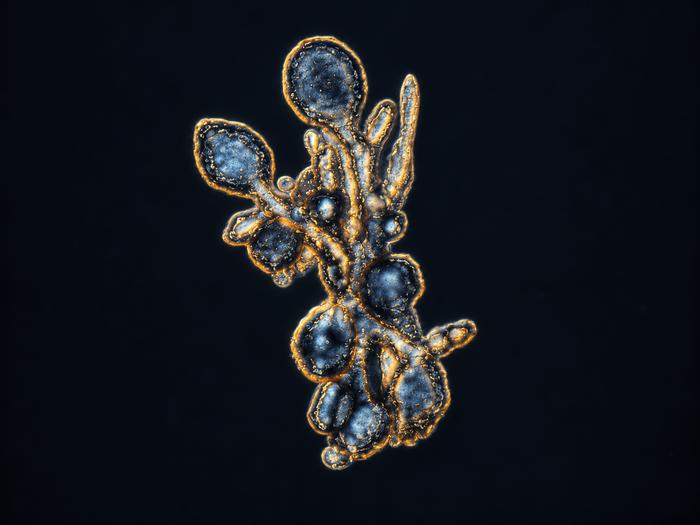
A breast tissue organoid that has been artificially colored. [The Kuperwasser Lab]
The results of a preclinical study by researchers at Tufts University School of Medicine and at Boston University suggest that exposure to some common chemicals—particularly multiple bisphenols at once—may alter how normal human breast tissue develops. Findings from the study using human breast organoids suggest that such exposures may lead to molecular changes in breast tissue that could influence susceptibility to breast disease later in life.
The results lay the groundwork for scientists to investigate whether these molecular changes persist in human tissues, contribute to disease later in life, and could yield biomarkers to help assess breast cancer risk. “If these results are validated by additional studies, they could change how we think about cancer prevention,” said Charlotte Kuperwasser, PhD, a professor of developmental, molecular, and chemical biology at Tufts University School of Medicine. Kuperwasser is senior corresponding author of the team’s published paper in PNAS, titled “Environmental chemical mixtures reprogram mammary epithelial development to epigenetic states associated with breast cancer.” The study’s co-first authors are Meadow Parrish and Meloryn Seraj, both PhD students in genetics, molecular, and cellular biology at Tufts Graduate School of Biomedical Sciences.
A growing body of research has raised questions about whether exposure to endocrine-disrupting chemicals—substances that can interfere with the body’s hormones—may contribute to breast cancer risk. “Endocrine-disrupting chemicals (EDCs) are pervasive contaminants in air, water, food, and consumer products, and human exposure to these agents begins in utero and continues throughout life,” the authors wrote. “A growing body of epidemiologic and experimental evidence suggests that developmental exposure to EDCs may contribute to the rising incidence of hormone-sensitive cancers, including breast cancer, in young women.” However, much of what scientists know about how chemicals affect breast tissue comes from animal models or laboratory-grown cells that cannot fully reproduce the complexity of human tissue.
“The breast also is unusual in that it undergoes major developmental changes well after birth, including during puberty and pregnancy,” said Kuperwasser. “And the concern is that breast tissue cells may be highly sensitive to environmental cues, such as chemical exposure, during critical windows of mammary gland development.”
To better capture this complexity, the researchers used three-dimensional breast organoids, grown from breast tissue donated by 13 healthy young women. The organoids contain multiple types of breast cells and can reproduce some aspects of how human breast tissue actually develops.
As the organoids developed over about three weeks, the researchers exposed them to a panel of individual chemicals and mixtures, including endocrine-disrupting chemicals, chemicals that affect metabolism, and known or suspected carcinogens. They then analyzed molecular changes, including changes in gene activity and DNA modifications. “… we developed an AI-assisted 3D human breast organoid high-content screening (3D-HCS) platform capable of quantitatively measuring developmental disruption and morphogenetic alterations across organoids exposed to chemicals,” they explained.
The results indicated that different chemicals affected tissue development in different ways, but the most striking finding involved three common bisphenols: BPA, BPS, and BPF. Individually, the chemicals produced relatively few changes in the organoids. But when combined at very low concentrations—comparable to levels detected in human blood and urine—the mixture of BPA, PBS and BPF disrupted normal breast development in organoids from most of the donors.
“Focusing on bisphenols, we show that a low-dose mixture (BPA, BPS, and BPF; 3BPX) disrupts organoid development and induces transcriptional programs characterized by extracellular matrix remodeling, epithelial plasticity, and partial epithelial–mesenchymal transition, accompanied by widespread DNA methylation remodeling.”
Kuperwasser added, “We intentionally used concentrations of chemicals that were relevant to real-world exposure rather than the very high doses sometimes used in toxicology studies. We also tested a mixture of these because people are typically exposed to multiple chemicals at the same time.”
The team then compared the molecular changes associated with the bisphenol mixture with molecular data from human breast cancers. The exposure-associated pattern was most strongly represented in data from patients with invasive lobular carcinoma—a type of breast cancer that may not cause a detectable lump and can be difficult to detect with a mammogram. “We identify conserved, exposure-induced transcriptional signatures as well as DNA methylation fingerprints that mirror patterns detectable in human breast cancers, suggesting that developmental exposures may leave durable molecular fingerprints that create cancer-relevant tissue states,” they concluded.
The finding does not establish that the chemicals cause cancer or show how the observed molecular changes might contribute to breast disease. Instead, the researchers say the work demonstrates a new way to study how environmental exposures may affect normal human tissue before cancer develops.
“Historically, we have thought about cancer risk largely in terms of inherited mutations, lifestyle factors, and exposures that directly damage DNA,” said Kuperwasser. “These findings raise another possibility: Environmental exposures may subtly alter how normal tissues develop, leaving behind molecular changes that do not cause cancer by themselves but may make the tissue more permissive to cancer many years later.”
She noted that such persistent molecular changes could eventually serve as a kind of biological record—like a “scar” of past exposure. If validated in people, such a marker could potentially help identify individuals at higher risk and inform earlier or more targeted screening.
Future studies involving larger and more diverse groups of donors, as well as a broader range of chemicals and mixtures, are needed to determine how widely the findings apply and if molecular changes observed in organoids are associated with breast disease in people.