Deep in the forests of the Korean Peninsula, a small yellowish fly has been quietly ambushing its prey on the surfaces of low-growing herbaceous leaves — and until now, science had no idea it was there. Researchers have reported the genus Cephalispa, a group of predatory flies in the family Muscidae, from Korea for the first time, based on specimens of the species Cephalispa acerca. The discovery, published in the Biodiversity Data Journal, marks not only the first national record of the genus but also the easternmost record of the species, extending its known range from central China to the edge of temperate East Asia.
Cephalispa is a genus of flies in the subfamily Coenosiinae, currently comprising 32 valid species worldwide. The group is primarily distributed in the Oriental and Afrotropical Regions, with the majority of species concentrated in southern China — particularly Guizhou and Yunnan — and Southeast Asia, including Malaysia and Indonesia. Only a handful of records exist from the Palaearctic Region, and the genus has long been considered a denizen of warm, humid tropical and subtropical environments. Its appearance in temperate Korean forests therefore comes as a surprise, though the authors note that the absence of earlier records was likely attributable to insufficient sampling rather than true absence, given the proximity of the Korean Peninsula to known localities in north-eastern China and Japan.
The specimens were collected across four years and five mountain localities in the Republic of Korea. A single female was taken on Mt. Sageum in Gangwon-do in August 2018, followed by larger series from Mt. Geomang in Gyeongsangnam-do in July 2022, Mt. Muhak in June 2024, Mt. Gujeol in August 2024, and a female from Mt. Cheorambagi in Jeollanam-do in September 2022. In total, the material comprises 12 males and 24 females, all deposited in the collection of the Department of Plant Medicine at Kyungpook National University in Daegu. The spread of collection sites across three provinces suggests the species may be more widely established on the peninsula than the record count alone implies.
Taxonomically, the study provides a detailed re-description of the male of C. acerca and, for the first time, a description of the female. The male measures 4.5 to 6.2 millimetres in body length with a wing length of 4.0 to 5.3 millimetres. Its ground colour is yellow to beige, with a black thoracic dorsum covered in yellowish-white pruinosity and three indistinct longitudinal brown vittae along the rows of acrostichal setulae and dorsocentral setae. The frons is narrow — approximately one-fourth of head width at the vertex — ocellar setae are absent, and the arista is shortly plumose. Acrostichal setae are represented only by fine setulae, dorsocentral setae number one or two presutural and three postsutural, and katepisternal setae are arranged 1:1:1. The fore tibia lacks a submedian posterior or posteroventral seta, while the mid-tibia bears two posterodorsal setae — a combination that reliably separates Cephalispa from the superficially similar genus Lispocephala. The female, at 4.8 to 5.0 millimetres, resembles the male in general appearance but has an entirely yellow abdomen and spherical spermathecae bearing numerous internal spinule-like projections.
Because many Cephalispa species have been described primarily from male specimens, the inclusion of female characters — external morphology and the structure of the abdominal terminalia — represents an important contribution to the taxonomy of the genus. These data will facilitate more reliable identification in future faunistic and ecological studies, particularly when male specimens are unavailable. The authors also provide an identification key to the males of 20 East Asian species, modified from earlier works by Cui and colleagues and by Yoshizawa and Tachi, which will allow researchers across the region to distinguish C. acerca from its relatives using characters such as thoracic coloration, sternite 5 shape, and postpedicel proportions.
Perhaps the most striking finding, however, is ecological. During the study, predatory behaviour was repeatedly observed under natural conditions — the first ecological information ever reported for the genus. Individuals were found resting on the surfaces of low-growing herbaceous leaves in forested habitats, from which they appeared to ambush potential prey. When small insects landed on adjacent or overlying leaves, the flies rapidly leapt upward to capture them. Predation on small nematocerous flies — members of the nematocerous Diptera — was directly observed, indicating that these insects constitute at least part of the prey spectrum.
The observed ambush strategy likely represents an adaptation to structurally complex understorey environments, where vertical movement between leaves may enhance prey detection and capture efficiency. Such behaviour is consistent with a sit-and-wait predatory mode combined with short-distance pursuit. Predatory behaviour is well known within Coenosiinae, a subfamily characterised by diverse hunting strategies and habitat use; larvae of many coenosiine species develop in substrates such as moss, decaying vegetation, or moist sand, reflecting broader ecological tolerance compared to other muscid groups. In this context, the predatory behaviour observed in C. acerca is consistent with the ecological versatility of the subfamily, but the present observations provide the first evidence of such behaviour in Cephalispa itself, suggesting the genus functions as an active predator within forest ecosystems.
The discovery also reshapes the biogeographic picture of the genus in temperate East Asia. C. acerca was previously known only from Liaoning, Shaanxi, and Shanxi Provinces in China. Together with records of other Cephalispa species from Japan — including C. triquetra and C. xanthogaster — the Korean finding indicates that the genus is more widely distributed in temperate East Asia than previously recognised. While many Cephalispa species are restricted to tropical regions, including island systems such as Palau, Papua New Guinea, and Madagascar, C. acerca appears to be associated with temperate forest habitats on the East Asian mainland. The geographic proximity of Liaoning to the Korean Peninsula suggests the species may have a continuous distribution across north-eastern Asia that has simply remained undocumented due to insufficient sampling.
Molecular data for Cephalispa remain strikingly scarce. Searches of BOLD Systems and GenBank, accessed 13 July 2026, found no publicly available sequence linked to a species-level identification. BOLD contains 180 public specimen records representing 181 sequences from Malaysia, Indonesia, and Thailand, all identified only to genus, whereas GenBank contains five loci — 28S, 12S, 16S, COI, and CYTB — from a single voucher identified as Cephalispa sp. SNK-2014. Species-level molecular identification therefore cannot yet be reliably assessed, and the authors emphasise that broader sampling, voucher-based identification, and validated reference sequences are needed for future molecular and integrative studies of the genus.
In sum, the addition of Cephalispa to the Korean fauna — accompanied by the first description of the female, a re-description of the male, an identification key to East Asian species, and the first ecological observations for the genus — expands current knowledge of the diversity, distribution, taxonomy, and biology of Cephalispa in East Asia. The Korean vernacular names newly coined in the study — 노랑범집파리 for the genus and 연노랑범집파리 for the species — reflect the fly’s yellowish appearance and predatory habits. Further studies integrating broader geographic sampling with morphological and molecular data will be important for clarifying species boundaries, evolutionary relationships, and the biogeographic history of a genus that, until now, has remained largely hidden in the understorey of East Asian forests.
Subject of Research: First record of the fly genus Cephalispa in Korea, with new descriptions and first ecological observations of Cephalispa acerca
Article Title: First record of the genus Cephalispa Malloch ( Diptera , Muscidae ) in Korea, with an identification key to East Asian species
Article References: KIM, D., & Suh, S. J. (2026). First record of the genus Cephalispa Malloch (Diptera, Muscidae) in Korea, with an identification key to East Asian species. Biodiversity Data Journal, 14, Article e195650. https://doi.org/10.3897/bdj.14.e195650
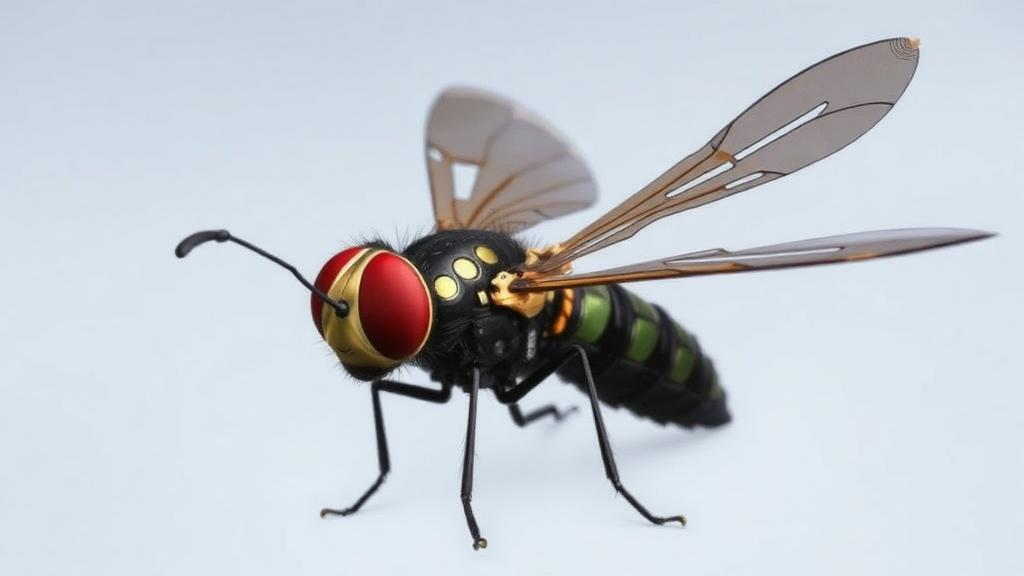
Image Credits: AI Generated
Keywords: Cephalispa, Muscidae, Diptera, Korea, taxonomy, predatory behaviour, biogeography, Coenosiinae, First, record, genus, Malloch