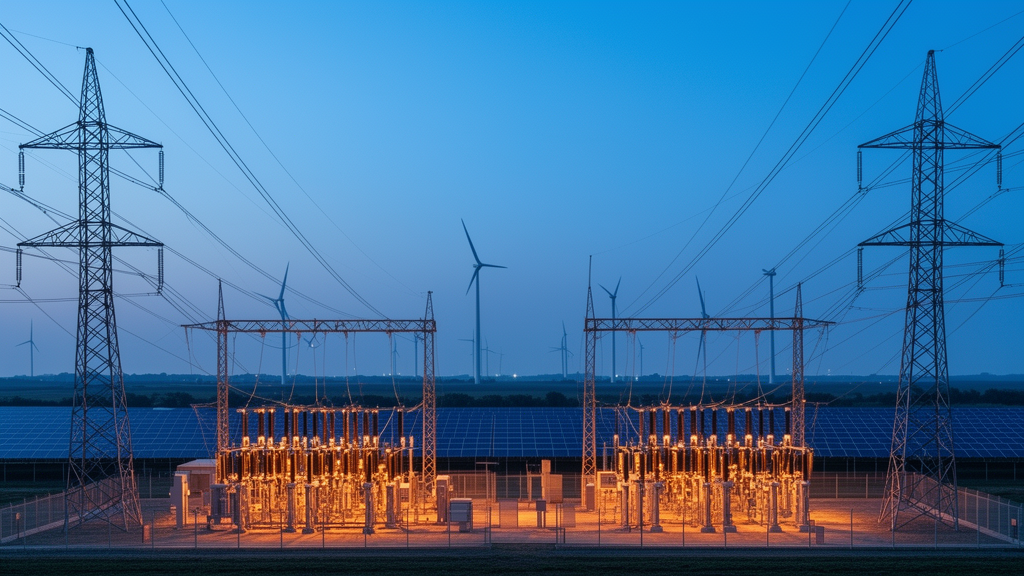
As wind turbines and solar panels replace spinning synchronous generators on modern power grids, engineers are racing to solve an uncomfortable truth: the very converters that make renewable energy possible can also make the grid shakier. A new study published in Results in Engineering by Tao Cheng, Haiyun Wang, and Xiaochen Su offers an elegant fix. The researchers have developed a dynamic active-power compensation method that suppresses transient oscillations in DC-coupled renewable energy systems without disturbing the steady-state behavior that grid operators depend on. The work, validated through both a 30 kW simulation and a 2 kW hardware prototype, could make inverter-dominated grids far more resilient to the sudden power swings that wind, sun, and grid disturbances inevitably deliver.
The heart of the problem lies in how renewable plants connect to the grid. In a DC-coupled architecture, wind generation, photovoltaic arrays, and battery storage all feed into a common DC bus, and a single grid-side converter then delivers the aggregated power to the AC network. This arrangement is efficient and flexible, but it creates a direct dynamic pathway: any instantaneous mismatch between the power flowing in from the sources and the power flowing out to the grid must be absorbed by the DC-link capacitor. The capacitor’s stored energy changes, its voltage deviates, and that deviation ripples straight into the active-power dynamics of the grid-side converter. In other words, a gust of wind or a passing cloud is felt almost immediately at the grid interface.
To keep such systems stable, many modern converters use grid-forming control, and in particular the virtual synchronous generator, or VSG. This control strategy makes an inverter behave like a traditional spinning generator, emulating its rotor inertia and damping so that the converter can establish its own voltage and frequency reference rather than merely following the grid. VSG control is widely seen as a key technology for grids with declining numbers of synchronous machines, because it provides the virtual inertia and frequency support that physical generators once supplied for free. But the new study highlights a fundamental constraint baked into the conventional VSG design.
That constraint is a hidden coupling between two quantities that engineers would prefer to tune separately. In a conventional VSG, the virtual damping coefficient and the active-power droop coefficient jointly form an equivalent frequency-regulation coefficient, which determines both how quickly oscillations die out and how the converter’s steady-state power output responds to grid-frequency deviations. Crank up the damping to suppress a transient oscillation, and you silently change the plant’s steady-state power-frequency characteristic. The study’s mathematical analysis shows this explicitly: under a grid-frequency disturbance, the steady-state power deviation is proportional to the equivalent regulation coefficient, so any attempt to improve transient behavior by increasing fixed damping inevitably distorts the frequency-support contract the plant has with the grid.
The researchers’ solution is a compensation branch with zero steady-state gain, inserted into the VSG active-power loop. It works by filtering the measured grid-side active power through a low-pass filter and using the rapidly varying component, the difference between the actual power and its filtered value, to generate a transient compensation signal. During a disturbance, this signal is strong and provides extra damping exactly when it is needed. Once the system settles into a new steady state, the filtered power catches up with the actual power, the DC-link voltage returns to its reference, and the compensation signal decays automatically to zero. The original power-frequency relationship remains untouched.
The genuinely novel ingredient, however, is what the authors call DC-link voltage-assisted compensation. Rather than adding a separate control parameter, the same compensation gain is applied to the DC-link voltage deviation, feeding information about source-side power imbalance directly into the grid-side active-power regulation. Because the DC-link voltage is a physical barometer of the instantaneous mismatch between what the wind turbines and solar arrays are producing and what the grid converter is delivering, this single gain coordinates the suppression of both source-side fluctuations and grid-frequency disturbances. The researchers show that earlier transient damping methods, which used only active-power differential feedback, can be viewed as a special case of their broader structure.
To understand and tune the method, the team derived a third-order small-signal model of the compensated active-power loop and analyzed how the compensation gain and filter time constant reshape the closed-loop poles. Using the Routh-Hurwitz criterion, they proved that the system remains asymptotically stable across the practical parameter range, but they emphasized that stability alone is not enough: poles can be stable yet poorly damped. Their pole-locus analysis revealed that increasing the compensation gain drives the dominant pole pair toward the real axis, boosting equivalent damping, while the filter time constant should be kept small so that an additional pole stays far from the imaginary axis. They packaged these insights into a step-by-step tuning procedure that starts from the steady-state frequency-support requirement, selects the inertia, and then screens candidate compensation parameters against damping targets, settling times, and hardware constraints such as DC-link voltage limits and measurement noise.
The validation results are striking. In a 30 kW simulation of a DC-coupled wind-PV-storage system subjected to combined wind-speed and solar-irradiance disturbances, the proposed method cut the active-power overshoot from 0.20 per unit with a conventional VSG to just 0.02 per unit, a reduction of about 90 percent, while shortening the settling time from 0.33 seconds to 0.08 seconds. Against a high fixed-damping VSG, the overshoot was still 75 percent lower and the settling time half as long. Under a grid-frequency step of 0.2 Hz, the method reduced overshoot from 0.11 to 0.05 per unit and settling time from 0.37 to 0.09 seconds compared with the conventional controller, and it dramatically outperformed a competing transient damping scheme, cutting overshoot by roughly 58 percent and settling time by 87 percent.
The 2 kW experimental prototype, built around a two-level grid-forming inverter with a digital control system, confirmed the simulation findings on real hardware. During bidirectional active-power reference steps between 1.5 and 2.0 kW, the proposed method reduced overshoot to 0.04 per unit and settling time to 0.32 seconds, improvements of about 20 and 27 percent over the existing transient damping method. Under grid-frequency steps, the advantage grew even larger: peak deviation fell from 0.27 to 0.07 per unit, roughly a 74 percent reduction, and settling time dropped from 1.27 to 0.37 seconds. Across all tested conditions, the steady-state errors of the proposed method were zero at the reported precision, confirming that the compensation truly exits once the transient is over.
The implications extend beyond a single control loop. As grids move toward inverter-dominated operation, the coordination between DC-side energy balance and AC-side synchronization is becoming a central stability question, and this work demonstrates that the DC-link voltage itself can serve as a fast, physically meaningful feedback signal for grid-forming control. The authors caution that their validation covers specific operating points and disturbance ranges, and that future work must address current and power limits, battery state of charge, DC-side nonlinearities, digital control delays, and the interaction of multiple grid-forming converters sharing a grid. Still, the core message is compelling: by letting the DC bus speak directly to the grid-side controller, renewable plants can absorb the chaos of wind and sun and deliver steady, well-damped power, all without rewriting their steady-state commitments to the grid.
Subject of Research: Dynamic active-power compensation for transient oscillation suppression in DC-coupled renewable energy grid-forming converter systems
Article Title: Dynamic active-power compensation for transient oscillation suppression in DC-coupled renewable energy grid-forming systems
Article References: Cheng, T., Wang, H., & Su, X. (2026). Dynamic active-power compensation for transient oscillation suppression in DC-coupled renewable energy grid-forming systems. Results in Engineering, 32, Article 113467. https://doi.org/10.1016/j.rineng.2026.113467
Image Credits: AI Generated
DOI: 10.1016/j.rineng.2026.113467
Keywords: grid-forming converters, virtual synchronous generator, DC-link voltage, transient damping, renewable energy integration, power system stability, active-power compensation, inverter-based resources, wind-solar-storage systems, small-signal modeling, oscillation suppression, frequency regulation