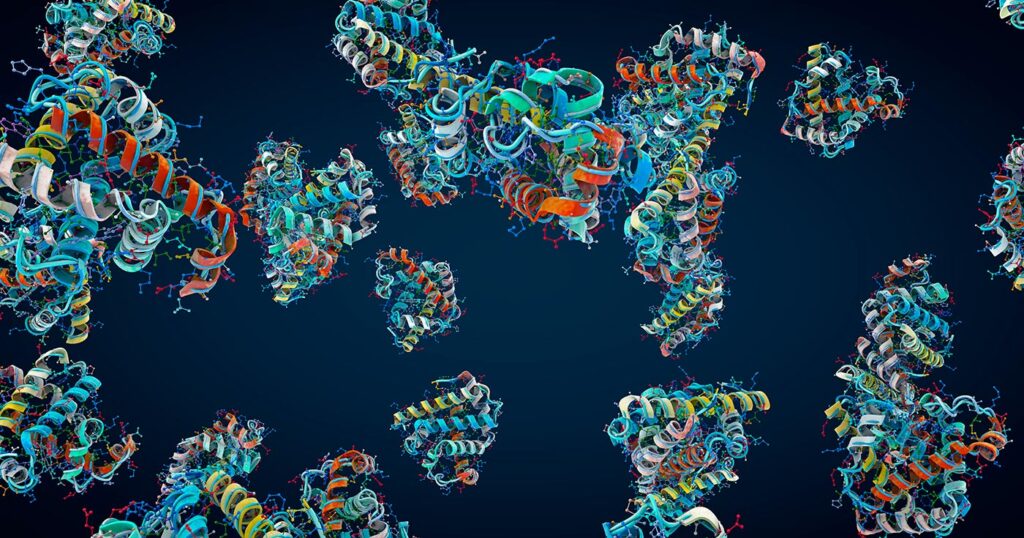

The University of Washington (UW) School of Medicine Institute for Protein Design (IPD) has partnered with Nvidia to develop an open, generative model that uses biomolecular reasoning designed to improve how well researchers can design new proteins with specific functions.
RFD4-Proteina is an open model based on Nvidia’s NVIDIA BioNeMo™ artificial intelligence (AI) platform for chemistry and biology that combines programmable protein design with search capabilities. According to its developers, RFD4-Proteina generates targeted protein designs, enabling scientists and agents to search and refine those designs using molecular inputs, constraints, and scoring objectives. Potential applications include designing proteins to interrupt disease processes or detect signs of disease in diagnostic tests.
RFD4-Proteina concurrently refines a protein’s sequence and structure alongside the structures of interacting molecules, so that a change in one effortlessly leads to changes in the others. RFD4-Proteina has achieved five-fold to 10-fold higher design success rates while generating protein candidates five to 10 times faster than previous models, the developers said.
Lab bench tests showed that RFD4-Proteina achieved higher computational design success rates and generation throughput than the evaluated baselines across four benchmark suites: protein binding, small-molecule binding, enzyme scaffolding, and DNA binding, Nvidia said.
The model helps researchers explore and prioritize candidates for laboratory testing. And by remaining open, UW and Nvidia added, RFD4-Proteina will enable investigators to build on its capabilities by exploring more potential protein designs and advancing promising drug candidates into lab testing faster.
“We are moving from an era of discovering the proteins nature has made to one in which we can design entirely new ones,” Nobel laureate David Baker, PhD, IPD’s director and a professor of biochemistry at UW Medicine, said in a statement. “RFD4-Proteina expands what scientists can create, from proteins that could advance drug discovery to enzymes that break down pesticides.”
‘New solutions’
“RFD4-Proteina will open the door to new solutions in medicine, sustainability, materials and biotechnology,” Baker added. “I think with these improved generative AI methods, we’ll see better medicines … and applications more broadly outside of medicine and sustainability, new ways of breaking down polymers, new ways of making bioplastics.”

RFD4-Proteina derives its name from the IPD’s RosettaFold Diffusion, a guided diffusion model for generating new proteins, and Nvidia’s Proteina-Complexa, a generative model for protein binder design for protein and small molecule targets. Proteina-Complexa combines inference-time optimization with a pretrained flow-based generative model built on Nvidia’s La-Proteina AI model developed for atomistic protein design.
RFD4-Proteina is available through partners that include Amazon Bio Discovery, Anthropic’s Claude Science, Benchling, Databricks, Google Cloud, Hugging Face, Nebius, OpenAI, and Tamarind Bio. The partners enable researchers and developers to integrate the open protein design model into agent, cloud, and scientific computing workflows.
At IPD, researchers who have applied the model to their novel protein design challenges reported that RFD4-Proteina represented an improvement over past methods’ efficacy and speed.
“We were able to precisely control what types of glycans (sugars important for immune-system recognition) are attached to proteins in ways past models haven’t been able to achieve, and to do so in under just a week rather than months,” said Meg Lunn-Halbert, a UW PhD candidate in biochemistry and in biological physics, structure and design.
From months to days
Added Seth Woodbury, a UW bioengineering predoctoral candidate and National Science Foundation fellow: “In just a few days we designed a pesticide-degrading enzyme that performs many fold better than my previous best, which took months to design.”
RFD4-Proteina arose from a collaboration between IPD and Nvidia researchers and is immediately available for use as an open-source resource hosted through Berkeley Software Distribution (BSD-3).
IPD leaders of the project were three UW PhD students—Nathaniel Corley, Maxwell Kazman, and Rafi Brent—as well as Kieran Didi, a visiting student from the University of Oxford.
The development of RFD4-Proteina was funded by the Howard Hughes Medical Institute, Gates Foundation (INV-092109), Grantham Foundation, Fund for Science and Technology, Schmidt Sciences, OpenFold consortium (part of OMSF), Rosetta Commons, and additional supporters of the IPD. According to its website, the Gates Foundation committed $25,748,619 through a grant dated November 2025.
The Jen-Hsun and Lori Huang Foundation provided a computational grant that was critical to RFD4-Proteina’s development, UW stated in announcing the introduction of RFD4-Proteina.
Baker is a Howard Hughes Medical Institute Investigator and one of three winners of the 2024 Nobel Prize in Chemistry “for computational protein design,” along with Sir Demis Hassabis, PhD, and John Jumper, PhD.
Hassabis is a co-founder of Google DeepMind who is now chief scientist of Google parent Alphabet and the founder/CEO of Google-co-owned Isomorphic Labs. Jumper announced plans in June to leave Google DeepMind for Anthropic, the AI giant that has filed for an initial public offering (IPO) that would value the company at an eye-popping $2 trillion.