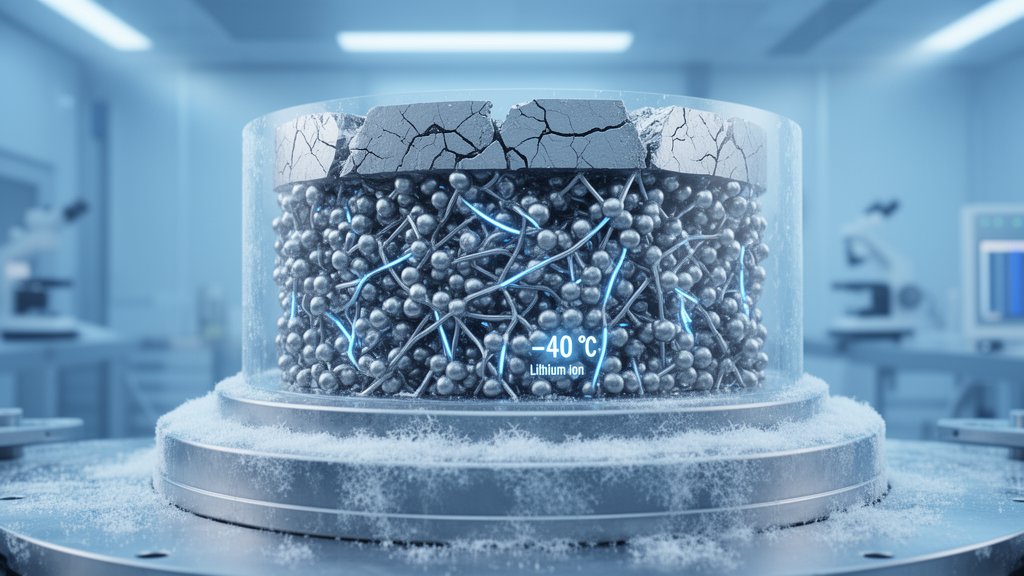
A laboratory composite anode combining silicon oxide, carbon and a tin-antimony alloy retained approximately 1,000 milliamp-hours per gram after 500 charge-discharge cycles and continued to store lithium at temperatures as low as −40 °C. The optimized material, designated SSNC-10, therefore combined long-cycle performance with low-temperature adaptability in electrode-level tests reported in the Journal of Materials Science.
Silicon oxide, or SiOx, has attracted attention as an anode material because of its high theoretical specific capacity. Its practical deployment, however, is constrained by low initial Coulombic efficiency, poor electronic conductivity and unsatisfactory rate capability. The researchers addressed these limitations by fabricating a hierarchical SiOx/C-SnSb@NC composite through in situ alloying and nitrogen-doped carbon encapsulation. Its design combines a homogeneously dispersed SnSb bimetallic-alloy network with a protective carbon layer in an attempt to modify both the electrical and structural behavior of the electrode.
According to the study, the SnSb network improves electronic conductivity and alleviates electrode polarization. The researchers also report that the stepwise lithiation behavior of SiOx and SnSb works collaboratively to buffer volume expansion and suppress structural pulverization and interfacial side reactions. Together, these effects are credited with producing the composite’s improved cycling performance. SSNC-10 maintained a reversible capacity of about 1,000 mAh g−1 after 500 cycles at a current density of 0.5 A g−1, demonstrating sustained lithium storage under the reported laboratory test conditions.
The same optimized electrode also showed measurable performance in cold environments. It maintained a stable reversible capacity of 450 mAh g−1 after 100 cycles at −20 °C. It delivered considerable capacities of 300 mAh g−1 and 190 mAh g−1 at −30 °C and −40 °C, respectively. These results establish that SSNC-10 remained electrochemically active across the reported subzero range, although the supplied abstract does not specify details such as the corresponding current densities for each low-temperature measurement. The work is an electrode-material study rather than a demonstration in a complete commercial battery cell, and the available evidence does not provide full-cell energy density, calendar-aging performance, temperature-cycling results or manufacturing-scale assessment. Within that scope, the authors present the composite as a feasible structural design for high-capacity, low-temperature-tolerant and long-cycle silicon-based anodes intended for lithium-ion battery applications.
Subject of Research: Laboratory development of a SnSb-decorated SiOx/C@NC anode for long-cycle and low-temperature lithium storage.
Article Title: SnSb alloy decorated SiOx/C@NC anodes for robust lithium storage and low-temperature adaptability
Article References: Xu, X., Tu, W., Xu, S., Sun, S., Ruan, X., Yu, S., Zhang, H., & Wang, Y. (2026). SnSb alloy decorated SiOx/C@NC anodes for robust lithium storage and low-temperature adaptability. Journal of Materials Science, 61(40), 31097-31114. https://doi.org/10.1007/s10853-026-13642-7
Image Credits: AI Generated
DOI: 10.1007/s10853-026-13642-7
Keywords: lithium-ion batteries, silicon oxide anode, SnSb alloy, nitrogen-doped carbon, low-temperature operation, lithium storage, electrode materials, cycling stability, SnSb, alloy, decorated, SiOx