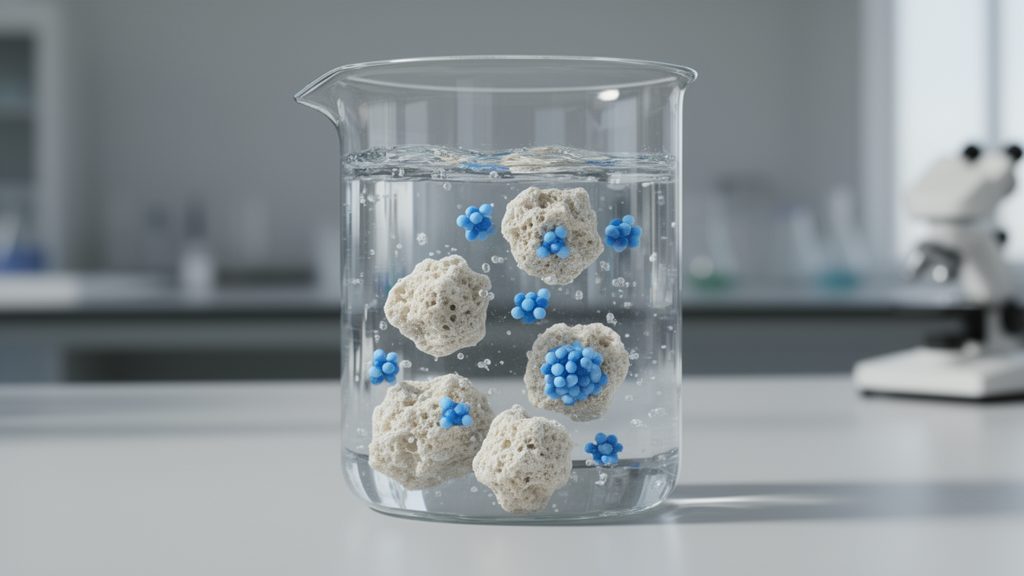
A particle-level natural zeolite modified with sodium acetate and sodium 2-ethylhexyl sulfate removed more than 90% of ammonia nitrogen from wastewater under optimal experimental conditions in a laboratory study. Designated SS@PNZ, the double-modified material also reached a maximum adsorption capacity of 9.40 mg/g, according to the reported results. The findings indicate that chemical modification can improve the material’s ability to capture ammonia nitrogen, with ion exchange identified as the dominant adsorption mechanism.
The researchers prepared SS@PNZ and evaluated its adsorption and recovery performance for ammonia nitrogen, or NH₃-N, in wastewater. An orthogonal experiment found that pH was the primary factor influencing removal efficiency. They linked this effect to pH-dependent changes in ammonia nitrogen speciation, material surface charge and ion-exchange equilibrium.
SS@PNZ’s adsorption data were consistent with the Langmuir adsorption model, and the study reported a maximum adsorption capacity of 9.40 mg/g. This fitted capacity describes the material’s performance in the tested adsorption system; it does not by itself demonstrate treatment performance in a full-scale installation. Particle-level characterization also showed that modification increased the zeolite’s specific surface area by 73% compared with unmodified particle-level natural zeolite.
Surface impurities were significantly reduced, and the pore structure became more even. The researchers associated these changes with the material’s enhanced adsorption capacity. Fourier-transform infrared spectroscopy and X-ray photoelectron spectroscopy supported a mechanism dominated by exchange between Na⁺ ions in the modified material and NH₄⁺ ions in solution.
Electrostatic adsorption involving sulfonate groups provided a supplementary contribution. The material also showed selective adsorption capacity for ammonia nitrogen when coexisting cations were present, showing that its performance was assessed beyond solutions containing ammonia nitrogen alone. After ten adsorption–regeneration cycles, the adsorption capacity remained above 60%, although the supplied findings do not clearly define that percentage against a specific reference value.
The cycle result nevertheless supports retained adsorption performance during repeated reuse. The results present SS@PNZ as a potentially useful material for ammonia-nitrogen pollution treatment because it combined high removal efficiency under the reported conditions, a maximum capacity of 9.40 mg/g, selectivity in the presence of competing cations and performance above 60% after ten regeneration cycles. The authors also characterized the material as having stability, recyclability and low economic cost.
However, the evidence is limited to a prepared material tested under defined laboratory conditions. The central measured result is that double modification altered the zeolite’s surface properties and strengthened adsorption, principally through Na⁺/NH₄⁺ ion exchange with an additional electrostatic contribution from sulfonate groups.
Subject of Research: Adsorption of ammonia nitrogen by chemically modified natural zeolite
Article Title: Adsorption mechanism of ammonia nitrogen by green-modified zeolite: a particle-Level investigation
Article References: Liu, Z., Zhang, X., Xu, N., Li, L., Shen, C., Zheng, C., & Qian, Y. (2026). Adsorption mechanism of ammonia nitrogen by green-modified zeolite: a particle-Level investigation. Journal of Materials Science, 61(40), 30631-30650. https://doi.org/10.1007/s10853-026-13630-x
Image Credits: AI Generated
DOI: 10.1007/s10853-026-13630-x
Keywords: ammonia nitrogen, natural zeolite, water treatment, adsorption, ion exchange, sodium acetate, sodium 2-ethylhexyl sulfate, surface modification, wastewater, regeneration, mechanism, ammonia