
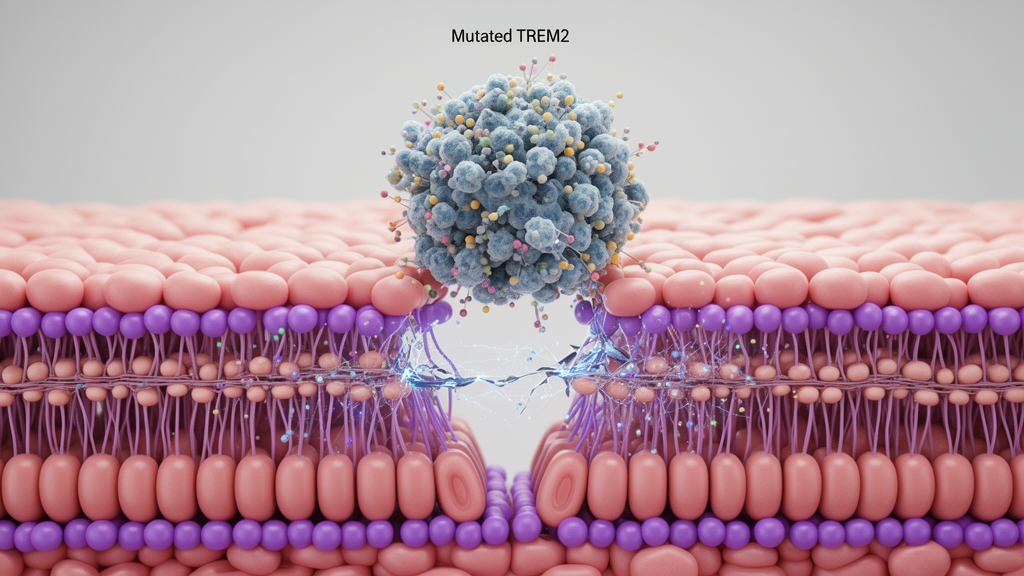
A research study published in Molecular Neurodegeneration has identified a novel genetic alteration within the TREM2 gene, designated as TREM2c·3G>A. This start-codon mutation causes an M1I substitution that leads directly to the complete loss of functional TREM2 protein expression. In human clinical assessments, the presence of this loss-of-function mutation is closely associated with early-onset Alzheimer’s disease, providing critical insight into the genetic drivers of early neurodegenerative pathology.
The study demonstrated that the TREM2c·3G>A mutation triggers profound blood-brain barrier impairment across both human subjects and mouse models. While vascular compromise has often been characterized as a secondary consequence of ongoing dementia, these findings show that barrier breakdown occurs directly alongside TREM2 deficiency. These comparative observations across species confirm that the loss of barrier integrity represents a primary defect, positioning vascular disruption as an early mechanistic trigger rather than a downstream byproduct of neurodegeneration in Alzheimer’s disease.
At the cellular level, the investigators uncovered the signaling pathway through which the absence of TREM2 damages cerebral vessels. In microglia lacking functional TREM2 expression, the nuclear factor kappa B (NF-κB) transcription factor pathway undergoes aberrant activation. This NF-κB-driven cascade causes marked upregulation of microglial CCL2, instigating abnormal chemical signaling between resident brain immune cells and surrounding vascular structures.
This elevated microglial CCL2 release directly targets brain endothelial cells by binding and activating endothelial CCR2 receptors. Receptor stimulation initiates an intracellular process that induces the internalization of tight junction proteins within the vascular endothelium. Because these tight junction complexes are essential for preserving the physiological seal of cerebral blood vessels, their internalization compromises the structural integrity of the blood-brain barrier.
The resulting breakdown of the vascular barrier permits the leakage of peripheral pathological proteins into the brain parenchyma. The research identified that circulating molecules, including β2-microglobulin, pass through the permeable barrier into cerebral tissue. This influx accelerates the accumulation and formation of amyloid plaques and promotes premature Tau pathology, connecting microglial and vascular dysfunction directly to hallmark Alzheimer’s disease aggregates.
To determine whether targeting this signaling axis could reverse the damage, the researchers tested interventions in experimental models. Both pharmacological inhibition of CCR2 and endothelial cell-specific Ccr2 knockdown successfully restored blood-brain barrier function. In addition to repairing barrier integrity, blocking the pathway led to a marked reduction in amyloid plaque burden, demonstrating that interrupting aberrant microglial-endothelial communication can alleviate pathogenic protein buildup.
Overall, the findings establish a direct mechanistic sequence linking microglial dysfunction, blood-brain barrier impairment, and pathogenic protein accumulation. By identifying how loss of TREM2 drives vascular permeability and accelerates amyloid and Tau pathology, the investigation redefines the vascular role of TREM2 in neurodegeneration and highlights the microglial CCL2 and endothelial CCR2 pathway as a tractable therapeutic target in Alzheimer’s disease.
Subject of Research: TREM2 start-codon mutation and microglial-mediated blood-brain barrier impairment in Alzheimer’s disease
Article Title: TREM2c·3G>A promotes aberrant microglial-endothelial signaling, impairs BBB integrity, and enhances Aβ and Tau accumulation
Article References: Yang, H.-C., Tan, C. X., Chen, O., Zhang, J., Deng, Y.-S., Wang, Z., Sun, L., Liang, Y., Wei, Y., Yin, Y., Zhang, Y., He, B.-D., Li, R.-Y., Di, R., Jiang, C., Wang, M., Xu, Z.-Q. D., Liu, C.-M., Xing, Y., … Tang, Y. (2026). TREM2c·3G>A promotes aberrant microglial-endothelial signaling, impairs BBB integrity, and enhances Aβ and Tau accumulation. Molecular Neurodegeneration. https://doi.org/10.1186/s13024-026-01016-1
Image Credits: AI Generated
DOI: 10.1186/s13024-026-01016-1
Keywords: TREM2, TREM2c·3G>A, M1I mutation, early-onset Alzheimer’s disease, blood-brain barrier, microglial-endothelial signaling, microglia, endothelial cells, NF-κB, CCL2, CCR2, tight junction internalization, β2-microglobulin, amyloid plaque accumulation, Tau pathology, Ccr2 knockdown, neurodegeneration

