Researchers at the University of Rochester and Cornell University have developed a low-cost 3D bioprinter capable of fabricating complex, free-standing living materials using standard hardware. Led by Anne S. Meyer, a professor in the Department of Biology at the University of Rochester, the team modified an inexpensive commercial plastic printer into a functional bioprinting platform. Published in the journal ACS Applied Polymer Materials under the title “3D Bioprinting of Engineered Living Materials in Support Slurries for Complex Free-Standing Structures,” the study details a method that overcomes longstanding economic and physical barriers in the production of functional engineered living materials.
Engineered living materials created through 3D bioprinting share similarities with living tissues, offering researchers precise control over the cellular composition and the final spatial geometry of the printed construct. By selecting specific strains of bacteria to embed within the printed matrix, scientists can design materials capable of performing targeted environmental functions, such as breaking down plastic waste or removing contaminants from polluted water. Despite these promising applications, widespread adoption has been severely limited by equipment costs, as commercial 3D bioprinters capable of manufacturing these structures often cost upwards of $100,000. Furthermore, soft printed bio-inks frequently collapse under their own weight before they can properly solidify.
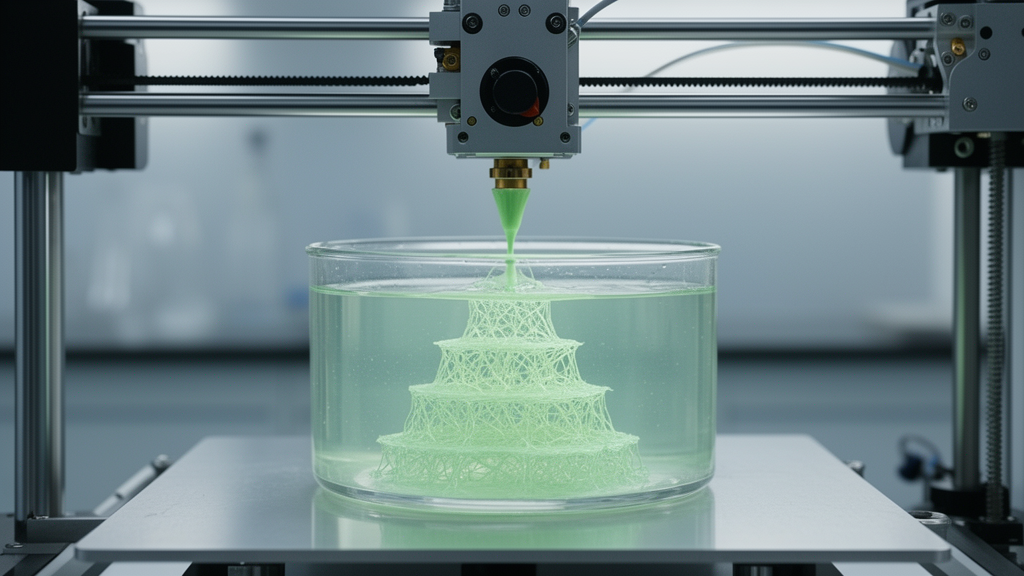
To address both financial and technical challenges, Meyer and her colleagues developed an affordable do-it-yourself system by retrofitting a standard plastic 3D printer. The researchers removed the printer’s original plastic filament extruder and installed a specialized syringe pump designed to dispense bio-ink. This bio-ink consists of a liquid formulation that combines living bacterial cells with a polymer solution that cures into a resilient gel after extrusion. The entire customized printer was assembled at a total cost of $450 using easily obtainable components, and the research team has made complete assembly instructions publicly accessible on the GitHub platform so other laboratories can replicate the apparatus.
A key mechanical feature of the retrofitted syringe pump is its ability to perform both positive extrusion and active retraction during printing. This dual-action mechanism prevents excess bio-ink from oozing at the boundaries of the construct, allowing the system to print crisp shapes with sharply defined edges. While previous DIY 3D bioprinters were limited to printing structures of less than 20 layers, the upgraded DIY printer can print living materials with more than 100 layers.
The expanded vertical capability allows the modified printer to fabricate intricate geometries, including complex objects containing internal hollow cavities. According to the researchers, constructing tall objects with internal voids dramatically increases the overall surface-to-volume ratio of the engineered living material. A higher surface-to-volume ratio ensures that bacteria embedded within the interior of the material can efficiently access nutrients and chemical signals from their surrounding environment.
To prevent tall and delicate structures from collapsing prior to gelation, the research team developed a specialized support gel referred to as a slurry. During the fabrication process, the printer deposits the bio-ink directly into this surrounding support bath. The slurry physically suspends the soft material in place, maintaining the intended three-dimensional shape while facilitating rapid solidification at any height.
The investigation yielded two distinct formulations of the support slurry to serve different operational purposes. The first slurry is optimized for the clean and simple removal of the finished print following solidification. The second formulation is tailored for long-term incubation, maintaining microbial viability within the bioprinted structures for four weeks or more. This represents a substantial improvement over previous bioprinting techniques, in which printed bacterial populations typically began to die after approximately nine days.
The ability to sustain living bacterial cultures within tailored slurries opens new opportunities for research into biofilms, which are three-dimensional microbial communities that adhere to surfaces and exhibit both beneficial and detrimental effects on human health. Meyer noted that employing distinct incubation conditions allows scientists to create engineered biofilm materials optimized for specific goals. Researchers can either cultivate materials with authentic biological biofilm characteristics to study and test medically relevant biofilms, or adjust incubation parameters to produce constructs with enhanced mechanical strength suitable for robust technological applications.
Subject of Research: Low-cost 3D bioprinting of engineered living materials
Article Title: Bioprinting on a budget
Article References: Bioprinting on a budget. Original publication (Bibliographic details unavailable.)
Image Credits: AI Generated
DOI: Not provided
Keywords: 3D bioprinting, engineered living materials, support slurry, bio-ink, syringe pump, Anne S. Meyer, University of Rochester, Cornell University, biofilms, bacterial viability, polymer solution, low-cost bioprinters, extrusion and retraction, surface-to-volume ratio, ACS Applied Polymer Materials, living tissues