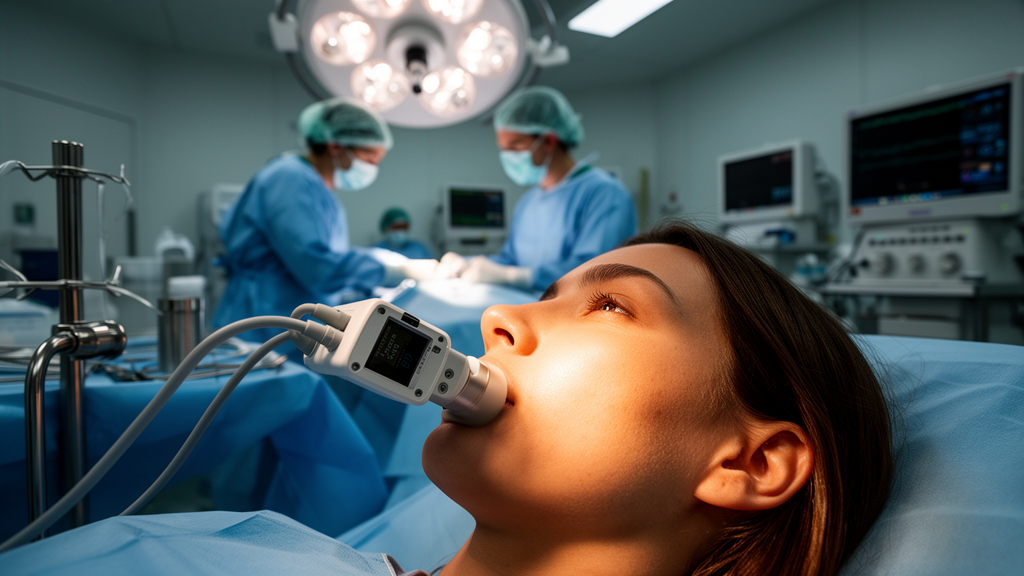
A prospective observational pilot study conducted during abdominal laparotomy has demonstrated that intraoperative facial flushing can be objectively quantified using a handheld color sensor, offering a standardized approach to assessing mesenteric traction syndrome. The investigation, carried out by anesthesiology researchers across two surgical centers, evaluated whether measuring cutaneous erythema with a portable colorimeter could match traditional bedside clinical evaluations. Mesenteric traction syndrome represents a well-recognized intraoperative phenomenon characterized by sudden vasomotor changes, yet its clinical identification has historically depended on visual inspection by operating room personnel. By measuring changes in facial redness alongside hemodynamic fluctuations in adult patients undergoing open pancreatectomy, the study established that objective colorimetry successfully differentiates between patients who develop the syndrome and those who do not. The findings confirm that portable optical instruments can track acute microvascular shifts in surgical settings, providing an empirical foundation for refining diagnostic consistency during major abdominal interventions.
Mesenteric traction syndrome is defined clinically by a classic triad consisting of arterial hypotension, sinus tachycardia, and cutaneous facial flushing triggered by mechanical manipulation or traction of the bowel mesentery. Across abdominal surgery literature, the reported incidence of the syndrome varies widely, spanning from thirty percent to eighty-five percent of surgical cohorts.
Despite its clinical importance, diagnosing mesenteric traction syndrome remains challenging because visual inspection of patient skin tone lacks standardized criteria and suffers from substantial inter-observer variability. Definitive biochemical confirmation relies on measuring serum concentrations of 6-keto-prostaglandin F1alpha, the stable downstream metabolite of prostacyclin, but this laboratory assay requires specialized processing that cannot provide immediate intraoperative feedback. Previous efforts to introduce objective monitoring explored laser speckle contrast imaging to track facial microvascular perfusion in real time. Although laser speckle contrast imaging can visualize tissue perfusion changes, the required equipment is bulky, weighing approximately 2,300 grams, and exceptionally costly at around 58,000 dollars, while recording perfusion units rather than direct blood flow. These logistical and financial barriers prompted investigators to explore whether an inexpensive, lightweight colorimeter could serve as a practical alternative.
To assess this objective approach, the research team conducted a prospective trial between June 2023 and October 2024 following formal ethical approvals from Nagoya University Hospital and Handa City Hospital, with clinical trial registration in the University Hospital Medical Research Network under identifier UMIN000051642. The study protocol enrolled adult surgical patients aged twenty years or older who were scheduled to undergo open laparotomy for either pancreaticoduodenectomy or distal pancreatectomy. Eligible participants were restricted to American Society of Anesthesiologists physical status classifications of I or II. To avoid pharmacological interference with prostacyclin synthesis and vasomotor reactivity, patients scheduled to receive intraoperative non-steroidal anti-inflammatory drugs were excluded, as were individuals with chronic use of non-steroidal anti-inflammatory agents or antihistamines, and those with a diagnosed history of systemic lupus erythematosus. Out of thirty-nine screened candidates, one patient was excluded due to active antihistamine therapy, leaving thirty-eight patients who completed the formal experimental protocol.
Anesthesia management followed a standardized clinical framework across all surgical cases to ensure physiological stability and comparable baseline conditions. Patients received thoracic epidural catheter placement between the sixth and twelfth thoracic vertebrae, supplemented in select cases by rectus sheath or transversus abdominis plane blocks, followed by epidural test dosing with one percent lidocaine prior to general anesthesia induction. General anesthesia was induced using propofol, fentanyl, remifentanil, and rocuronium, and maintained through continuous infusions of remifentanil combined with volatile inhalational anesthetics. Hemodynamic management incorporated vasoactive support, using phenylephrine, ephedrine, or noradrenaline titrated by the attending anesthesiologist to maintain mean arterial pressure above sixty-five millimeters of mercury. Routine clinical data collection captured comprehensive demographic parameters, body mass index, surgical metrics, and automated vital sign logs directly through electronic medical record interfaces and operating room recording systems.
Objective skin color measurements were performed using the Nix Spectro 2 color sensor, a compact, battery-powered optical device measuring six by six by five centimeters and weighing approximately two hundred grams. Originally utilized in environmental and agricultural sciences, the sensor seals flush against the skin surface, completely shielding its internal optical chamber from external operating room lighting. The device measures chromaticity in the three-dimensional CIELab color space, transmitting digital readouts via Bluetooth to a paired smartphone within approximately one second. Within this coordinate framework, the a-value specifically denotes the color spectrum along the green-to-red axis, ranging from negative sixty for pure green to positive sixty for intense red, where progressively higher positive values reflect deeper erythema. Measurements were obtained across four distinct anatomical facial locations: the central forehead, the nasal bridge, the left cheek, and the right cheek.
To eliminate diagnostic bias, the study maintained strict functional separation between clinical care and objective data acquisition. The attending anesthesiologist managed patient care, documented subjective flushing on a three-point ordinal scale (level zero indicating no flushing, level one denoting slight flushing, and level two representing complete flushing), and rendered the clinical diagnosis of mesenteric traction syndrome based on overall vital sign patterns. Concurrently and independently, a separate anesthesiologist operated the color sensor. Data collection occurred prior to initial skin incision and at five, ten, fifteen, twenty, twenty-five, thirty, thirty-five, forty, forty-five, fifty, fifty-five, sixty, seventy-five, and ninety minutes following incision. Baseline values were established by averaging measurements taken immediately before incision and five minutes post-incision, capturing hemodynamic stability prior to peritoneal entry while minimizing transient fluctuations related to surgical incision or initial shifts in anesthetic depth.
Because baseline skin tone and absolute a-values vary substantially across different individuals, the researchers analyzed the proportional change ratio for each parameter rather than relying on unadjusted absolute numbers. For facial redness and heart rate, the ratio of change was calculated as the peak measurement minus the baseline value, divided by the baseline value. For mean arterial blood pressure, the ratio reflected the minimum recorded value minus baseline, divided by the baseline value. To maintain rigorous temporal alignment, hemodynamic and colorimetric parameters were analyzed strictly within identical five-minute measurement intervals where all three values were simultaneously available. For facial redness, the change ratio was calculated independently across all four measured anatomical facial regions, and the median of these four regional ratios was designated as the definitive representative colorimetric shift for each patient.
Among the thirty-eight analyzed patients, fourteen were clinically diagnosed with mesenteric traction syndrome, establishing an observed study incidence of thirty-six point eight percent, while twenty-four patients were classified into the non-syndrome cohort. Baseline demographic variables, including age, biological sex, body weight, height, and body mass index, exhibited no statistically significant differences between the two groups. However, patients in the syndrome cohort required significantly higher total intraoperative doses of ephedrine, which the authors interpreted as an active therapeutic countermeasure administered in response to acute vasodilatory hypotension. Overall hemodynamic comparisons demonstrated marked circulatory divergence: the mesenteric traction syndrome group exhibited a significantly greater median decrease in mean arterial pressure of minus twenty-six percent compared to minus fourteen percent in the control group, alongside a median heart rate acceleration of forty-five percent compared to twenty-three percent.
Analysis of facial colorimetry revealed a clear, statistically significant distinction between the clinical cohorts that mirrored their systemic hemodynamic changes. Patients diagnosed with mesenteric traction syndrome exhibited a median ratio of change in facial redness a-value of zero point forty-five, with an interquartile range from zero point forty-three to zero point forty-nine. In contrast, the non-syndrome cohort showed a median change ratio of zero point twenty-five, with an interquartile range spanning from zero point twelve to zero point fifty-five, representing a statistically significant difference with a p-value of zero point zero two. Furthermore, subjective flushing scores strongly correlated with objective colorimetric measurements. Patients assessed as level zero exhibited a median redness change ratio of zero point one hundred fifty-eight, which was significantly lower than the ratios observed in patients classified as level one (zero point five hundred fifty-four) and level two (zero point four hundred thirty-six).
To evaluate potential diagnostic cutoffs, the researchers performed receiver operating characteristic curve analyses to identify thresholds maximizing the sum of sensitivity and specificity within the syndrome group. The optimal threshold for heart rate change was identified at zero point two hundred eighty-seven, yielding a sensitivity of one point zero zero zero, a specificity of zero point eight hundred thirty-three, and an area under the curve of zero point eight hundred ninety-six. For mean arterial pressure, a change ratio threshold of minus zero point twenty-one demonstrated a sensitivity of zero point seven hundred forty-one, a specificity of zero point seven hundred, and an area under the curve of zero point seven hundred forty-one. For median facial redness a-value, the threshold was established at zero point three hundred fifty-three, demonstrating a sensitivity of one point zero zero zero, a specificity of zero point five hundred thirty-eight, and an area under the curve of zero point seven hundred twenty.
Applying these derived objective thresholds back to the twenty-four patients in the non-syndrome group revealed that ten patients exceeded the redness threshold, five met the heart rate criterion, and seven satisfied the blood pressure drop criterion. Notably, exactly one patient in the non-syndrome group met all three objective threshold parameters simultaneously despite receiving a subjective visual assessment below level two, suggesting that unrecognized or subclinical presentations of mesenteric traction syndrome occur rarely under attentive clinical oversight. The authors observed that while the Nix sensor reliably mirrored visual assessments and separated flushing from non-flushing states, it did not reveal a large pool of missed clinical diagnoses. This consistency indicates that experienced anesthesiologists rarely overlook clinically significant mesenteric traction syndrome when actively monitoring facial skin changes.
The authors outlined several important methodological limitations that contextualize their conclusions. The study population was strictly limited to patients undergoing elective open pancreatectomy, leaving the generalizability of these colorimetric thresholds to other major open abdominal procedures unconfirmed. Additionally, the portable color sensor has not been formally standardized for human dermal intraoperative monitoring, meaning variations in epidermal pigmentation, sensor contact pressure, and peripheral perfusion dynamics could influence optical readings. The protocol also lacked simultaneous biochemical validation via serum 6-keto-prostaglandin F1alpha quantification, precluding verification against the true biochemical gold standard. Furthermore, extended surgical duration introduces confounding influences on hemodynamics, including insensible fluid shifts, ongoing blood loss, and changing anesthetic depth, which complicate physiological interpretation beyond the initial forty-five minutes of surgery.
In conclusion, this pilot investigation confirms that objective quantification of facial flushing using a handheld, cost-effective color sensor is technically feasible and correlates well with clinical bedside assessments during major open abdominal surgery. While portable colorimetry did not significantly expand case detection beyond vigilant subjective evaluation in this cohort, the device provides an objective, transparent, and reproducible measurement tool that eliminates the subjective ambiguity inherent in visual inspection. By establishing verified numerical thresholds for facial redness, tachycardia, and mean arterial pressure declines, this work provides a practical physiological framework for future multi-center clinical studies. Integrating portable optical sensors alongside prospective biochemical assays holds strong promise for standardizing intraoperative diagnostics, improving resident education, and refining hemodynamic management protocols across surgical operating suites.
Subject of Research: Objective intraoperative colorimetric evaluation of facial flushing in mesenteric traction syndrome
Article Title: Objective evaluation of facial flushing for mesenteric traction syndrome diagnosis during laparotomy: a prospective observational pilot study
Article References: Ikki, Y., Negita, T., Nishiwaki, K., & Tamura, T. (2026). Objective evaluation of facial flushing for mesenteric traction syndrome diagnosis during laparotomy: a prospective observational pilot study. JA Clinical Reports, 12(1), Article 6. https://doi.org/10.1186/s40981-025-00843-3
Image Credits: AI Generated
DOI: 10.1186/s40981-025-00843-3
Keywords: mesenteric traction syndrome, laparotomy, pancreatectomy, facial flushing, colorimetry, Nix color sensor, intraoperative monitoring, anesthesiology, hypotension, tachycardia, prostacyclin, CIELab color space, hemodynamic changes, clinical pilot study, mean arterial pressure, vital sign monitoring