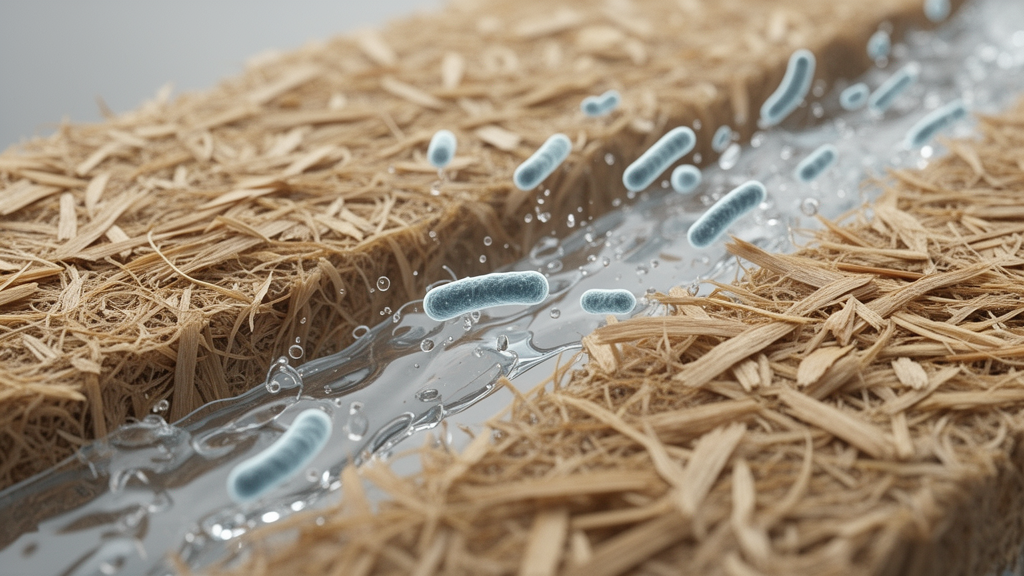
Researchers have developed a sustainable, binder-free composite water-filtration membrane derived from agricultural rice husk waste that eliminates 95.25 percent of Enterobacter bacteria when combined with low-pressure filtration and iron salt feed conditioning. Fabricated from an 80 to 20 dry-weight ratio of cellulose nanofibers and activated carbon from Oryza sativa IRRI-6 rice husk, the membrane achieved a 1.324-log reduction under an operating pressure of 0.6 bar. Experimental results demonstrated that while the bio-based membrane captured 86.67 percent of bacterial cells on its own, adding ferric chloride promoted cell aggregation by neutralizing the negative surface charge of the Gram-negative bacteria, significantly enhancing mechanical retention in the porous matrix without synthetic binders.
The development addresses public health and environmental challenges associated with deteriorating freshwater resources and agricultural residue management. Urbanization and industrial growth have intensified water contamination through untreated municipal wastewater, chemical effluents, and agricultural runoff, while climate-induced heatwaves and prolonged droughts diminish river flows and raise water temperatures. Traditional water treatment methods, including physical straining, adsorption, and natural disinfection, frequently fail against modern microscopic and anthropogenic pollutants introduced by industrialization and synthetic chemistry. Meanwhile, open burning of discarded rice husk generates substantial air pollution. By valorizing Oryza sativa IRRI-6 waste into functional filtration media, this research supports United Nations Sustainable Development Goals, specifically SDG 3 for good health and well-being, SDG 6 for clean water and sanitation, and SDG 12 for responsible consumption and waste utilization.
To extract pure cellulose from agricultural residue, bulk rice husk was collected from local mills in Lahore, Pakistan, and washed to eliminate dirt and debris. The husk was sun-dried, ground, and sieved through an 80-mesh screen to yield a fine powder. This powder underwent alkaline digestion using 10 percent sodium hydroxide heated and stirred at 80 degrees Celsius for three hours, breaking down hemicellulose, lignin, and silica into a dark solution. After neutralizing the solid pulp with repeated washings, the material was bleached using 5 percent hydrogen peroxide at 80 degrees Celsius for 1.5 hours to remove residual non-cellulosic components. The washed pulp was dried at 90 degrees Celsius for 24 hours and subjected to acid hydrolysis with 10 percent hydrochloric acid at 45 to 60 degrees Celsius for one to two hours, degrading amorphous cellulose to yield crystalline nanofibers.
In parallel, activated carbon was prepared from the same rice husk waste to provide complementary adsorptive properties. Cleaned rice husk was oven-dried at 105 degrees Celsius for 24 hours and carbonized in a sealed furnace at 400 to 650 degrees Celsius for one to two hours to yield black char. This char was chemically activated by blending with a 50 percent aqueous solution of potassium hydroxide and heating in a furnace at 450 to 700 degrees Celsius for one to two hours. The reaction developed extensive internal porosity, after which the material was washed repeatedly to remove ash and chemical residues until reaching neutral pH 7. The resulting activated carbon exhibited surface pores of 2 to 5 micrometers and an average particle size of 115 plus or minus 6.7 micrometers, designed to capture dissolved pollutants, facilitate fluid flow, and mitigate fouling.
The composite filtration membrane was assembled on a standardized dry-weight basis without synthetic binders or chemical crosslinkers. Cellulose nanofibers were dispersed in deionized water to produce a suspension of 0.5 to 1 weight percent, to which activated carbon was added at 0.25 grams per gram of dry cellulose mass to reach an 80:20 ratio. After vigorous stirring, the slurry was cast onto a 0.22-micrometer filter paper support within a vacuum filtration apparatus. Removing water under vacuum formed a cohesive wet sheet, which was dried under light pressure at 60 degrees Celsius. The resulting membrane had a mean thickness of 210 plus or minus 9 micrometers and a dry loading of 59.07 plus or minus 5 grams per square meter. Dead-end filtration of deionized water across an effective area of 0.002827 square meters yielded a pure-water flux of 158 plus or minus 9 liters per square meter per hour and a hydraulic permeability of 264.4 plus or minus 15 liters per square meter per hour per bar at 0.60 plus or minus 0.02 bar.
Microscopic and crystallographic analyses confirmed the structural integration of the membrane components. Scanning electron microscopy revealed that cellulose nanofibers formed an entangled network surrounding activated carbon particles within a single matrix. Fiber dimensions averaged 10.8 plus or minus 1.4 nanometers in width and 428.1 plus or minus 43.2 nanometers in length, characteristic of web-like nanofibers rather than shorter rod-like nanocrystals. X-ray diffraction revealed crystalline cellulose peaks at 2 theta angles of approximately 15.0 to 16.0 degrees, 16.5 to 16.8 degrees, and 22.5 to 22.8 degrees, corresponding to the (1-10), (110), and (200) planes. Activated carbon showed broad graphitic reflections at 22 to 26 degrees and 43 to 45 degrees for the (002) and (100) planes. Crystallite size was estimated at 6 nanometers using the Scherrer equation, and the Segal crystallinity index reached 72 percent, with no crystalline silica detected.
Spectroscopic and thermal analyses confirmed component purity and high stability. Fourier-transform infrared spectroscopy identified broad hydroxyl stretching at 3420 reciprocal centimeters in raw cellulose, shifting to 3410 reciprocal centimeters in the composite due to hydrogen bonding with oxygenated groups on the activated carbon. Carbonyl stretching appeared at 1725 to 1730 reciprocal centimeters, with crystalline methylene bands at 1420 reciprocal centimeters. Thermogravimetric and derivative thermogravimetric analyses documented five thermal stages up to 800 degrees Celsius: initial moisture loss of 5.5 to 6.0 percent from cellulose between 25 and 150 degrees Celsius, minor depolymerization of 3.0 percent between 150 and 250 degrees Celsius, primary cellulose pyrolysis of 58.0 percent centered at a sharp derivative peak of 358 degrees Celsius, char oxidation of 6.0 percent between 380 and 500 degrees Celsius, and a final plateau yielding 22 percent cumulative residue consisting of thermally stable activated carbon and non-volatile char.
Porous characteristics and wettability were examined via nitrogen adsorption-desorption at 77 Kelvin and static sessile-drop contact angle testing. The composite membrane displayed a Type IV isotherm with an H3 hysteresis loop, indicative of interconnected slit-shaped mesopores formed by the cellulose network and activated carbon. Brunauer-Emmett-Teller analysis demonstrated a specific surface area of 620 square meters per gram, with an R-squared value of 0.9999 over relative pressures of 0.05 to 0.30 and a BET constant of 150. Nitrogen gas uptake reached 142.4 cubic centimeters per gram at standard temperature and pressure. Barrett-Joyner-Halenda desorption showed a total pore volume of 0.392 cubic centimeters per gram and an average pore diameter of 4.2 nanometers, while the four-volume-to-area method yielded 2.53 nanometers. Sessile-drop contact angle measurements with deionized water gave an average angle of 50.5 plus or minus 2.7 degrees, confirming a uniform hydrophilic surface.
Antimicrobial performance was challenged using Enterobacter sp. NB-1, a Risk Group 2 clinical isolate maintained under Biosafety Level 2 conditions. The organism was identified as a Gram-negative, rod-shaped bacterium measuring 0.6 to 1.0 micrometers in width and 1.2 to 3.0 micrometers in length, confirmed by biochemical tests and API 20E profiling showing motility, citrate utilization, negative indole production, and glucose-lactose fermentation with gas. In water supplies, Enterobacter species frequently indicate post-treatment contamination and often exhibit multidrug resistance. Because these bacteria carry a negative surface charge at neutral pH that causes electrostatic repulsion, feed water was conditioned with ferric chloride at 3.5 milligrams per 100 milliliters. Flocculation at 50 revolutions per minute for 20 minutes followed by one hour of gravity settling neutralized surface charges, causing bacteria to aggregate into larger flocs that could be trapped by microfiltration.
Systematic control experiments assessed the individual and combined contributions of chemical conditioning and membrane filtration against an initial concentration of 30,000 colony-forming units per 100 milliliters. Pretreatment with ferric chloride alone reduced bacterial counts to 20,000 colony-forming units per 100 milliliters prior to filtration, representing a 33.33 percent reduction and a 0.176-log reduction, while a freestanding ferric chloride control without filtration yielded 18,000 colony-forming units per 100 milliliters, corresponding to 40.00 percent removal. When unconditioned bacterial suspension was filtered, the membrane-only control reduced counts to 4,000 colony-forming units per 100 milliliters, achieving 86.67 percent removal and a 0.875-log reduction. When ferric chloride conditioning was combined with membrane filtration, bacterial concentration dropped to 1,425 colony-forming units per 100 milliliters, delivering 95.25 percent overall removal and a 1.324-log reduction. During filtration after pretreatment, counts decreased from 20,000 to 1,425 colony-forming units per 100 milliliters, demonstrating an incremental 92.88 percent reduction.
Although achieving a 95.25 percent bacterial reduction demonstrates practical utility for low-pressure microfiltration, the authors emphasize that this performance does not achieve the six-log reduction required for complete potable water sterilization. Instead, the bio-based membrane provides a low-cost, sustainable solution suited for pre-treatment stages within multi-barrier purification systems or for applications requiring moderate microbial reduction to mitigate health risks. Comparative benchmarks indicate that while functionalized nanocellulose, graphene oxide composites, and bacterial-cellulose nanonets can achieve higher clearance, they often require chemical modifications or elevated operating pressures. Crucially, the researchers noted that biofilm formation and extracellular polymeric substance production were not quantified in this study. Future work should evaluate membrane performance across varying feed concentrations and pressures, establish cleaning protocols and long-term reusability over repetitive filtration cycles, and validate efficiency using real municipal wastewater and environmental samples.
Subject of Research: Rice husk composite membranes for bacterial water filtration
Article Title: Preparation, characterization and potential application of FeCl₃ infused Oryza sativa IRRI-6 CNF: RHAC (80:20) composite membrane to trap Enterobacter spp . by low-pressure filtration
Article References: Nisar, N., Abbas, M., Mirza, S. S., Masood, R., & Arshad, M. (2026). Preparation, characterization and potential application of FeCl₃ infused Oryza sativa IRRI-6 CNF: RHAC (80:20) composite membrane to trap Enterobacter spp. by low-pressure filtration. Results in Engineering, 32, Article 114323. https://doi.org/10.1016/j.rineng.2026.114323
Image Credits: AI Generated
DOI: 10.1016/j.rineng.2026.114323
Keywords: rice husk, cellulose nanofibers, activated carbon, Enterobacter, low-pressure filtration, ferric chloride, membrane technology, water purification, waste valorization, Oryza sativa IRRI-6, adsorption, microfiltration, flocculation, surface wettability, mesoporous materials, sustainable development goals, water contamination, multidrug-resistant bacteria