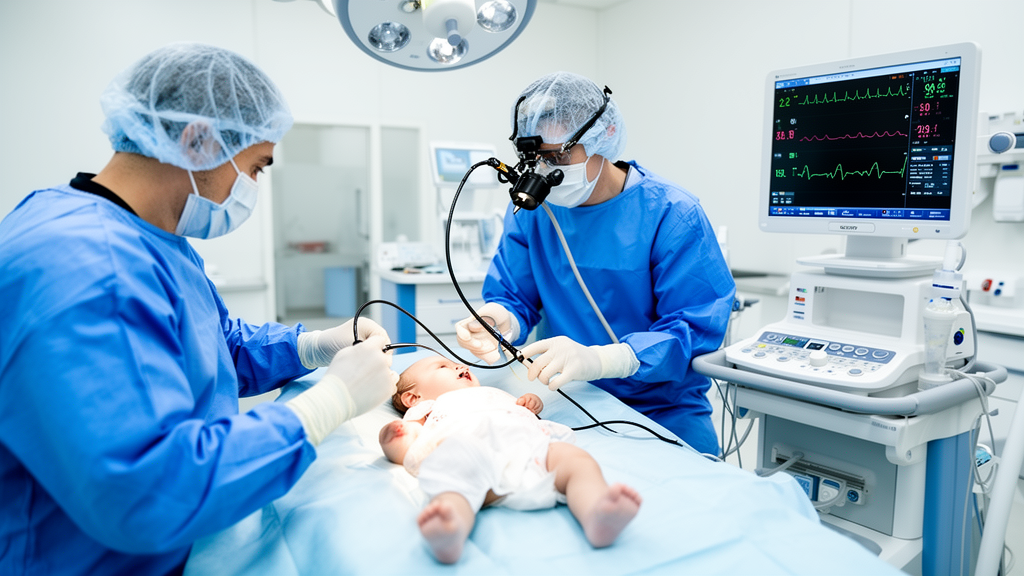
Propofol provides effective sedation with procedural completion rates approaching 99 percent for flexible bronchoscopy in children, though its dose-dependent respiratory and cardiovascular effects demand precise age-stratified administration and vigilant physiological monitoring, according to a comprehensive evidence review published in Frontiers in Pediatrics. Flexible bronchoscopy serves as an indispensable tool in pediatric pulmonology for evaluating stridor, persistent pneumonia, chronic wet cough, and suspected foreign-body aspiration, as well as for executing bronchoalveolar lavage and microbiological sampling across diverse age groups. Because the procedure stimulates the airway of a spontaneously breathing child while the operator and sedation provider share that same anatomical passage, clinicians must establish deep, easily titratable, and rapidly reversible sedation to blunt cough, prevent laryngospasm, and avert hypoxemia. Investigators from The First People’s Hospital of Jiashan reviewed pharmacological data, randomized trials, and multicenter observational cohorts to evaluate propofol monotherapy and multi-agent combinations across neonatal, infant, and older pediatric populations.
Pharmacologically, propofol is a highly lipophilic intravenous hypnotic formulated as a one percent oil-in-water emulsion containing soybean oil, glycerol, and egg lecithin, which requires rigorous aseptic handling and prompt disposal of opened vials because the nutrient-rich matrix readily supports microbial proliferation. The drug functions primarily as a positive allosteric modulator of gamma-aminobutyric acid type A receptors in the central nervous system, binding transmembrane beta-subunit domains distinct from the endogenous transmitter site. At therapeutic clinical concentrations, propofol potentiates gamma-aminobutyric acid-evoked chloride currents, whereas higher concentrations activate the receptor directly. Laboratory studies in beta-3 knock-in mice show that mutation of these subunits abolishes propofol-mediated suppression of noxious movement, demonstrating that beta-3-containing assemblies represent the principal physiological target. Secondary targets include potentiation of glycine receptors in the spinal cord and brainstem, inhibition of voltage-gated sodium channels, and competitive inhibition of fatty acid amide hydrolase, which elevates brain anandamide content and contributes to antiemetic properties, though the molecule lacks intrinsic analgesic activity.
The clinical pharmacokinetics of propofol undergo dramatic maturation during childhood, preventing clinicians from simply extrapolating adult weight-based dosing regimens to pediatric cohorts. In children between three and eleven years of age, weight-normalized clearance reaches approximately 34 milliliters per kilogram per minute, nearly double typical adult values, and central volume of distribution is substantially expanded, demanding higher weight-based infusion rates to maintain target plasma concentrations. Furthermore, effect-site concentration peaks later in children than in adults, taking 132 seconds compared to 80 seconds, an offset that requires prolonged intervals between boluses to avoid drug stacking and inadvertent overshoots in spontaneously breathing patients. In neonates, hepatic glucuronidation pathways remain profoundly immature, and clearance scales with postmenstrual age through a steep maturation coefficient, reaching only 92 percent of adult values around six months of life, which creates a substantial risk of progressive systemic accumulation during continuous infusions or repeated bolus administrations.
Because metabolic clearance and volume of distribution shift so markedly across developmental stages, clinical dosing requirements must follow precise age-stratified schedules. Neonates between zero and twenty-eight days of life represent an absolute research gap with no published bronchoscopy-specific trials, where pharmacokinetic simulations suggest maintaining steady-state targets of three micrograms per milliliter through a two milligram per kilogram loading dose followed by infusions tapering from nine down to five milligrams per kilogram per hour. Toddlers aged one to three years possess the highest weight-normalized clearance at approximately 53 milliliters per kilogram per minute and the largest central volume of distribution at one liter per kilogram, requiring induction doses of 2.5 to 3.5 milligrams per kilogram and maintenance infusions between nine and fifteen milligrams per kilogram per hour. Beyond early childhood, requirements decrease progressively with age by 0.11 milligrams per kilogram per year for induction and 0.36 milligrams per kilogram per hour per year for maintenance, tapering toward adolescent induction doses of 1.5 to 2.5 milligrams per kilogram and infusions of six to nine milligrams per kilogram per hour.
Clinical trials investigating propofol monotherapy demonstrate reliable procedural success, rapid induction, and prompt patient discharge, although single-agent administration exhibits identifiable limitations in blunting vigorous airway stimulation. An additional series of 103 children receiving propofol monotherapy with an average induction dose of 2.8 milligrams per kilogram documented mean induction times of 4.6 minutes, operative durations of 6.2 minutes, and discharge within 80 minutes, while diagnostic inspection revealed abnormalities in 90 percent of subjects and altered management in two-thirds. In a randomized comparison with fentanyl, propofol achieved a Ramsay sedation score of three in 15.7 seconds compared to 206 seconds, resulting in less supplemental midazolam and higher physician satisfaction. However, monotherapy provides incomplete cough suppression, yielding 1.98 coughing episodes per minute compared to 0.73 episodes when paired with remifentanil.
The adverse-event profile of single-agent propofol primarily involves dose-dependent cardiorespiratory depression, characterized by systemic vasodilation, transient arterial hypotension, alveolar hypoventilation, and episodic hypoxemia. In the 458-procedure outpatient cohort, transient hypotension occurred in 24 percent of cases, though it rarely required active pharmacologic intervention, and transient hypoxemia was documented in eight percent of examinations. Detailed physiological monitoring using transcutaneous carbon dioxide measurement during 95 uniform propofol bronchoscopies demonstrated that median carbon dioxide levels rose by 17 millimeters of mercury, with 55 percent of children experiencing increases of 15 millimeters of mercury or greater. Children receiving cumulative doses exceeding 3.5 milligrams per kilogram exhibited significantly higher peak carbon dioxide levels of 57.6 compared to 47.1 millimeters of mercury, demonstrating that clinically meaningful alveolar hypoventilation frequently develops during spontaneous breathing even when supplemental oxygen preserves peripheral saturation readings above 90 percent.
To mitigate the respiratory depression associated with high-dose propofol monotherapy and to provide necessary analgesia during intense airway stimulation, clinicians frequently combine propofol with adjunctive short-acting opioids. In a double-blind randomized trial of 50 pediatric patients aged 1 to 17 years, co-administering remifentanil significantly suppressed coughing from 1.98 episodes per minute down to 0.73 episodes per minute and shortened post-procedure recovery from 21.0 minutes to 13.5 minutes without altering the overall propofol dose or elevating total complications. Case series evaluating single-syringe remifentanil-propofol mixtures demonstrated successful examination completion using only 1.2 milligrams per kilogram of propofol for induction, with zero hypoxemic episodes and complete recovery within 13 minutes. However, opioid additions contribute respiratory depression of their own; in a randomized trial of 84 children, propofol combined with fentanyl produced transient hypoxemia in 35.7 percent of subjects, alongside coughing in 28.6 percent, highlighting the delicate balance between reflex suppression and spontaneous ventilatory preservation.
Combining propofol with ketamine or its S-enantiomer, esketamine, provides an alternative pharmacological profile that leverages complementary sympathomimetic mechanisms to preserve upper-airway tone and central ventilatory drive. In a randomized trial enrolling 72 children undergoing flexible bronchoscopy with spontaneous ventilation, adding a subanesthetic dose of esketamine to a propofol-remifentanil regimen reduced oxygen desaturation from 36.1 percent in control subjects to 8.3 percent, while stabilizing hemodynamics, decreasing anesthetic consumption, and lowering cough scores. A subsequent randomized trial comparing propofol-esketamine against propofol-fentanyl demonstrated that esketamine cut transient hypoxemia from 35.7 percent to 14.3 percent and reduced coughing episodes from 28.6 percent to 9.5 percent, accompanied by shorter recovery intervals and greater operator satisfaction.
Studies examining other multi-agent strategies, such as propofol paired with midazolam or dexmedetomidine, illustrate persistent trade-offs between procedural condition improvements and protracted post-anesthesia recovery intervals. In a trial of 118 children evaluating propofol-midazolam against dexmedetomidine-midazolam under controlled ventilation with a laryngeal mask airway, propofol-midazolam matched awakening times but caused greater hemodynamic fluctuation, higher peak circuit pressures, and elevated post-procedure agitation. In pediatric flexible bronchoscopy, dexmedetomidine-propofol established faster sedation onset than dexmedetomidine-remifentanil, achieving target depth in 8.2 minutes versus 12.3 minutes, yet provoked higher cough frequencies, greater patient movement, and reduced bronchoscopist satisfaction. Furthermore, dexmedetomidine exhibits an extended elimination half-life and bradycardic profile that prolongs post-anesthesia care unit stays, making it less suitable for brief outpatient diagnostic sessions, whereas propofol-remifentanil and propofol-esketamine offer superior alignment with the demands of rapid-turnaround diagnostic bronchoscopy suites.
Broader registry data from the Pediatric Sedation Research Consortium, encompassing 49,836 propofol administrations across diverse pediatric procedural settings, contextualize the incidence of rare but severe clinical safety events. Within this extensive multi-institutional cohort, central apnea or airway obstruction was documented at a rate of 575 per 10,000 administrations, desaturation below 90 percent persisting longer than 30 seconds occurred in 154 per 10,000 cases, and laryngospasm arose in 96 per 10,000 sedations, with zero recorded fatalities and cardiopulmonary resuscitation required in only two instances. In a specific subset of 7,313 ketamine-propofol sedations, procedural completion reached 99.8 percent, overall adverse events totaled 9.79 percent, and serious events accounted for 3.47 percent. In elective bronchoscopy series, major complications average 1.7 percent, predominantly consisting of desaturations below 90 percent with or without transient laryngospasm, while post-procedural events occur in approximately 25.8 percent of patients, dominated by transient oxygen dependency and post-lavage fever.
Across all published cohorts, patient age under two years, former prematurity, pre-existing cardiovascular conditions, and active upper respiratory tract infections consistently emerge as independent predictors of procedural respiratory complications. Retrospective analyses indicate that children under two years exhibit odds ratios of 1.84 for any complication and 2.48 for severe adverse events during airway endoscopy. In infants, high metabolic oxygen consumption, reduced functional residual capacity, and narrow baseline airway caliber dramatically accelerate desaturation whenever hypoventilation occurs. Severe systemic concerns such as propofol infusion syndrome, characterized by refractory bradycardia, metabolic acidosis, rhabdomyolysis, hyperlipidemia, and hepatomegaly, remain linked to prolonged high-dose infusions exceeding four milligrams per kilogram per hour beyond 48 hours in critical care units. Because diagnostic flexible bronchoscopy involves brief procedural exposures lasting minutes and low cumulative doses, propofol infusion syndrome represents an understood biological caution that restricts protracted infusions rather than an observed clinical complication of procedural bronchoscopy.
To safeguard patient welfare, international standards from the European Respiratory Society, American Thoracic Society, and American Academy of Pediatrics mandate rigorous structural environments, specialized personnel, and objective continuous monitoring. Guidelines require dedicated presedation evaluations, strict adherence to fasting intervals of two hours for clear liquids, four hours for breast milk, and six hours for formula or light meals, and the physical presence of a dedicated monitoring clinician trained in advanced airway rescue whose sole responsibility is patient observation. Continuous pulse oximetry and real-time capnography represent essential monitoring baselines, with capnographic waveform tracing serving as the primary modality to identify hypoventilation and airway obstruction before severe hypoxemia ensues. The review authors conclude that while future prospective research must address lingering gaps in neonatal dosing, long-term neurocognitive tracking, and standardized caregiver-reported recovery metrics, propofol administered alone or within tailored combination regimens under organized institutional sedation frameworks provides an efficacious, titratable, and safe sedation modality for pediatric flexible bronchoscopy.
Subject of Research: Safety and clinical efficacy of propofol-based sedation for flexible bronchoscopy in pediatric patients
Article Title: Safety and efficacy of sedation with propofol for flexible bronchoscopy in children
Article References: Zhang, Y., Shen, W., Yu, H., & Chen, G. (2026). Safety and efficacy of sedation with propofol for flexible bronchoscopy in children. Frontiers in Pediatrics, 14, Article 1982692. https://doi.org/10.3389/fped.2026.1982692
Image Credits: AI Generated
DOI: 10.3389/fped.2026.1982692
Keywords: propofol, pediatric flexible bronchoscopy, procedural sedation, airway management, remifentanil, esketamine, hypoxemia, respiratory depression, age-stratified dosing, capnography, transcutaneous carbon dioxide, pharmacokinetics, pediatric pulmonology, bronchoalveolar lavage, GABA-A receptor, Pediatric Sedation Research Consortium, propofol infusion syndrome