
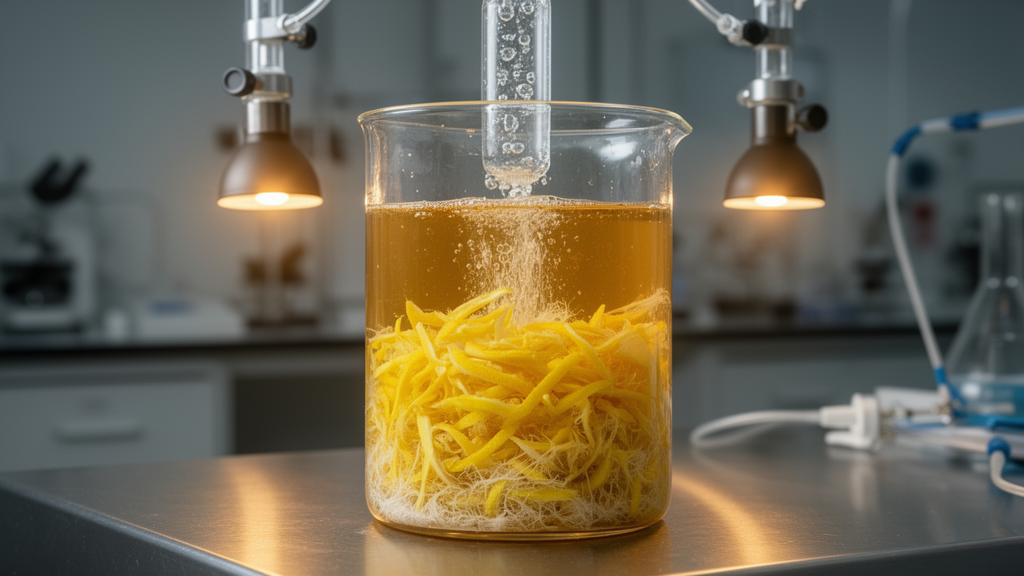
Biological pretreatment of lemon peel waste using specific fungal strains significantly enhances fermentative biohydrogen generation while bypassing the inhibitory chemical byproducts typical of conventional conditioning methods. In an experimental investigation published in the Brazilian Journal of Chemical Engineering, researchers demonstrated that subjecting pulverized lemon peel biomass to solid-state fungal hydrolysis with Alternaria alternata increased cumulative hydrogen yield during subsequent dark fermentation by sixty-nine percent relative to an untreated control. A parallel treatment using Fusarium oxysporum enhanced overall hydrogen output by thirty-six percent, whereas pretreatments employing Phytophthora sp. and Colletotrichum gloeosporioides yielded lower cumulative hydrogen volumes than raw, untreated substrate. Across all experimental trials, the biological conversion process relied primarily on microbial degradation through the acetate and butyrate metabolic pathways. The findings indicate that tailored fungal hydrolysis can effectively deconstruct the resistant structural polysaccharides found within citrus processing residues, making accessible fermentable soluble sugars without generating chemical inhibitors that conventionally halt downstream anaerobic fermentation.
Agro-industrial activities generate massive quantities of organic byproducts annually, creating substantial disposal challenges that can lead to severe environmental hazards including soil degradation, water body contamination, and methane and greenhouse gas emissions when handled improperly. Among these residual streams, citrus waste constitutes an exceptionally abundant organic volume, with lemon processing residues specifically accounting for between fifty and sixty-five percent of the total raw fruit weight handled by industrial juicing facilities. Lemon peels represent an organic biomass rich in dietary fibers, essential oils, pectin, carotenoids, and flavonoids, possessing low lignin concentrations alongside high carbohydrate potential that make them theoretically well suited for clean energy recovery routes such as bioethanol, biogas, and biohydrogen synthesis. However, direct microbial digestion of raw citrus residues faces severe biochemical barriers due to the protective architecture of the plant cell wall matrix and the natural presence of antimicrobial compounds, most notably essential oils such as limonene and diverse extractable phenolic molecules that frequently suppress anaerobic microbial consortia.
To overcome the structural recalcitrance of the lignocellulosic matrix in citrus peels, researchers have explored a variety of physical, chemical, and biological conditioning approaches. Conventional thermochemical processing strategies, such as hydrothermolysis, dilute acid hydrolysis, and alkaline extraction, have been widely demonstrated to disrupt cellular packaging and promote the release of simple monomeric sugars. Despite their physical effectiveness, these aggressive physicochemical methods routinely degrade carbohydrate fractions into potent microbial inhibitors, notably furfural, 5-hydroxymethylfurfural, and secondary phenolic degradation derivatives. The accumulation of these chemical toxins severely suppresses fermentative bacteria, requiring elaborate and expensive secondary detoxification washing steps that diminish the energetic and economic viability of biohydrogen systems. In contrast, biological hydrolysis utilizing filamentous fungi exploits native enzymatic machinery to deconstruct structural polymers under mild operating conditions. Fungi secrete complex cocktails of extracellular enzymes, including cellulases, hemicellulases, and pectinases, which cleave structural bonds without generating high concentrations of inhibitory dehydration artifacts, thereby offering a sustainable pathway for biomass valorization within the circular bioeconomy.
The experimental feedstock evaluated in the study consisted of raw lemon peel waste collected from a dining establishment in Querétaro, Mexico. Approximately ten kilograms of the collected peels were transported to the laboratory, homogenized, and finely processed using an industrial blender to achieve an average particle size of less than 0.5 millimeters before being preserved at minus twenty degrees Celsius. Comprehensive compositional characterization of the raw homogenized peel revealed a total chemical oxygen demand of 521 ± 13.38 grams per kilogram of total solids, a total solids content of 197.7 ± 1.2 grams per kilogram, a volatile solids concentration of 189.5 ± 1.3 grams per kilogram, and total carbohydrate content measuring 110 ± 1.8 grams per kilogram of total solids. Mineral analysis of the raw feedstock detected potassium at 15.9 milligrams per gram of dry solids, magnesium at 1.92 milligrams per gram, and manganese at 0.17 milligrams per gram, whereas potentially toxic heavy metals such as chromium, lead, and nickel were entirely absent from the matrix. The anaerobic inoculum used to drive subsequent dark fermentation consisted of granular sludge obtained from a wastewater treatment installation at a wheat flour processing facility, which was thermal-shock pretreated in an oven at 105 degrees Celsius for twenty-four hours to suppress hydrogen-consuming methanogens and enrich endospore-forming acidogenic bacteria.
Biological pretreatment was carried out via solid-state fermentation using four fungal strains obtained from the culture collection of the Faculty of Chemistry at the Autonomous University of Querétaro: Alternaria alternata, Fusarium oxysporum, Colletotrichum gloeosporioides, and Phytophthora sp. Each fungal strain had been maintained on agar media containing two percent glucose and one percent yeast extract at four degrees Celsius before activation on potato dextrose agar at thirty-seven degrees Celsius for seven days. For the biomass hydrolysis trials, five-hundred-milliliter glass bioreactors were packed with one hundred grams of processed lemon peel and inoculated with fifteen milliliters of homogenized mycelial suspension containing approximately one million mycelial propagules per strain. The solid-state hydrolysis vessels were incubated at thirty degrees Celsius for fifteen consecutive days to capture the complete kinetic trajectory of enzymatic polymer degradation, sugar release, and fungal carbohydrate assimilation. Daily aliquots were extracted across the incubation window to track soluble carbohydrate liberation and total phenolic compound dynamics, while overall chemical oxygen demand was recorded at the onset and conclusion of the conditioning period.
Over the fifteen-day pretreatment duration, marked kinetic divergences emerged among the four fungal strains regarding carbohydrate solubilization. During the initial forty-eight hours of solid-state cultivation, all inoculated systems displayed comparable soluble carbohydrate baseline levels ranging between twenty and twenty-five milligrams per gram. As incubation advanced, Alternaria alternata demonstrated the most consistent and effective hydrolytic performance, maintaining high soluble carbohydrate availability throughout the entire trial and achieving a net increase of 2.74 milligrams per gram to reach a final concentration of 25.07 ± 0.01 milligrams per gram at day fifteen. In sharp contrast, Colletotrichum gloeosporioides and Phytophthora sp. exhibited severe net carbohydrate depletion, finishing the incubation phase with soluble sugar concentrations of only 0.81 ± 0.01 milligrams per gram and 8.83 ± 0.01 milligrams per gram, representing net decreases of 19.98 and 12.87 milligrams per gram from their initial values, respectively. Fusarium oxysporum displayed intermediate solubilization capacity, ending the treatment period with 12.10 ± 0.01 milligrams per gram of soluble carbohydrates. Substrate mass loss analyses further supported these trends: while Fusarium oxysporum, Phytophthora sp., and Colletotrichum gloeosporioides reduced volatile solids by 25.9 percent, 26.6 percent, and 26.6 percent, Alternaria alternata exhibited a modest volatile solids reduction of 14.1 percent alongside an increase in total chemical oxygen demand to 257 milligrams per gram, confirming that its vigorous hydrolytic depolymerization released soluble organics into the medium while consuming relatively little of the liberated sugar pool.
The temporal evolution of total phenolic compounds throughout the solid-state hydrolysis period provided critical insight into fungal tolerance and cell wall deconstruction mechanics. During the first seventy-two to ninety-six hours of treatment, phenolic concentrations exhibited only subtle variations across all reactors, reflecting the gradual enzymatic cleavage of ester and ether linkages binding phenolic molecules to structural polysaccharides. In cultures of Alternaria alternata, total extractable phenolics rose steadily from day seven onward, culminating in a peak concentration of 2.92 ± 0.06 milligrams per gram at the conclusion of the fifteen-day run. Despite this accumulation of phenolic moieties, the hydrolytic activity of Alternaria alternata remained entirely uninhibited, as evidenced by uninterrupted carbohydrate solubilization and stable organic matter retention. In reactors inoculated with Fusarium oxysporum, phenolic concentrations initially dipped to 0.54 ± 0.10 milligrams per gram during the first two days before rising progressively to 1.58 ± 0.07 milligrams per gram at the end of pretreatment. Colletotrichum gloeosporioides exhibited an early phenolic rise to 2.09 ± 0.06 milligrams per gram at twenty-four hours followed by a gradual reduction down to 1.22 ± 0.15 milligrams per gram, suggesting active fungal assimilation or secondary biotransformation. For Phytophthora sp., phenolic levels remained relatively stable before terminating at 1.61 ± 0.06 milligrams per gram, demonstrating that none of the fungal pretreatments generated phenolic concentrations high enough to suppress their own enzymatic machinery under the tested solid-state parameters.
Following fungal conditioning, the hydrolyzed lemon peel substrates were transferred directly into anaerobic batch digestion reactors without centrifugation, filtration, or biomass separation to assess biochemical hydrogen potential using an Automatic Methane Potential Test System. Experimental gas production curves showed high mathematical agreement when fitted to a modified Gompertz model, displaying determination coefficients exceeding 0.98. Alternaria alternata and Colletotrichum gloeosporioides generated monophasic kinetic trajectories indicative of homogeneous substrate accessibility, whereas Fusarium oxysporum and Phytophthora sp. displayed diauxic, two-stage production profiles reflecting sequential consumption of readily available soluble sugars followed by slower fermentation of depolymerized structural fractions. Alternaria alternata produced the highest cumulative gas volume at 223.5 ± 67.6 milliliters of hydrogen, outperforming the untreated double-control system which yielded 131.7 milliliters. Specific hydrogen yields corroborated this superiority, with Alternaria alternata achieving 62.0 ± 18.9 milliliters of hydrogen per gram of volatile solids, significantly exceeding the yields achieved by the control and the underperforming strains.
Detailed monitoring of chemical species during the dark fermentation stage revealed distinct metabolic patterns governed by the initial fungal conditioning. Substrates pretreated with Alternaria alternata exhibited the greatest carbohydrate consumption, with soluble sugar levels falling from an initial 4.68 ± 0.74 grams per liter down to 2.11 ± 0.09 grams per liter by the end of fermentation, representing a 54.8 percent removal efficiency that aligned with elevated gas output. Substrates conditioned with Fusarium oxysporum showed a 41.7 percent carbohydrate reduction, decreasing from 3.33 ± 0.56 to 1.94 ± 0.46 grams per liter, while the untreated control displayed a 43.54 percent removal. In contrast, Colletotrichum gloeosporioides and Phytophthora sp. yielded minimal substrate consumption, registering carbohydrate declines of only 16.30 percent and 21.43 percent. Chromatographic metabolite profiling revealed that Alternaria alternata generated an intensely acidogenic environment conducive to hydrogen evolution, displaying high initial acetic acid levels of 1073.5 milligrams per liter and modest ethanol concentrations of 138.6 milligrams per liter immediately following solid-state hydrolysis. After dark fermentation, this system sustained an acidogenic signature dominated by 1062.5 milligrams per liter of acetic acid and 500.2 milligrams per liter of butyric acid, with ethanol increasing to 754.2 milligrams per liter alongside trace propionic acid. Systems treated with Fusarium oxysporum likewise formed substantial acetic acid (1246.9 milligrams per liter) and butyric acid (537.6 milligrams per liter), but diverted greater reducing equivalents into ethanol production (884.3 milligrams per liter), explaining its intermediate hydrogen production.
While biological hydrolysis with saprophytic fungi demonstrates significant potential as an environmentally benign pretreatment strategy, several practical constraints and technical considerations must be addressed before commercial implementation. The experimental evaluations were conducted exclusively under closed batch reactor conditions using four isolated fungal strains, leaving unexplored the potential synergies that could emerge from multi-strain fungal consortia or continuous feeding regimes. Because peak soluble carbohydrate concentrations were observed between the fourth and fifth days of solid-state incubation, commercial configurations operating under continuous or fed-batch substrate feeding could shorten processing intervals and prevent unwanted sugar consumption by fungal metabolism. Future research must focus on quantifying specific cellulolytic, pectinolytic, and hemicellulolytic enzyme activities, testing semi-continuous reactor configurations, and conducting comprehensive techno-economic assessments to evaluate the energetic balance and economic feasibility of scaling fungal hydrolysis for sustainable citrus waste valorization.
Subject of Research: Biological fungal pretreatment of citrus waste for fermentative biohydrogen production
Article Title: Effect of fungal hydrolysis of lemon peels on biohydrogen production
Article References: Sánchez-Valeriano, N., Moreno-Andrade, I., Arriaga-González, V., & Zapata-Morales, A. L. (2026). Effect of fungal hydrolysis of lemon peels on biohydrogen production. Brazilian Journal of Chemical Engineering. https://doi.org/10.1007/s43153-026-00729-6
Image Credits: AI Generated
DOI: 10.1007/s43153-026-00729-6
Keywords: Biohydrogen Production, Dark Fermentation, Lemon Peel Waste, Fungal Hydrolysis, Alternaria alternata, Fusarium oxysporum, Colletotrichum gloeosporioides, Phytophthora sp, Citrus Residues, Soluble Carbohydrates, Phenolic Compounds, Acetic Acid Pathway, Volatile Fatty Acids, Agro-industrial Waste, Circular Bioeconomy, Lignocellulosic Biomass, Biochemical Hydrogen Potential

