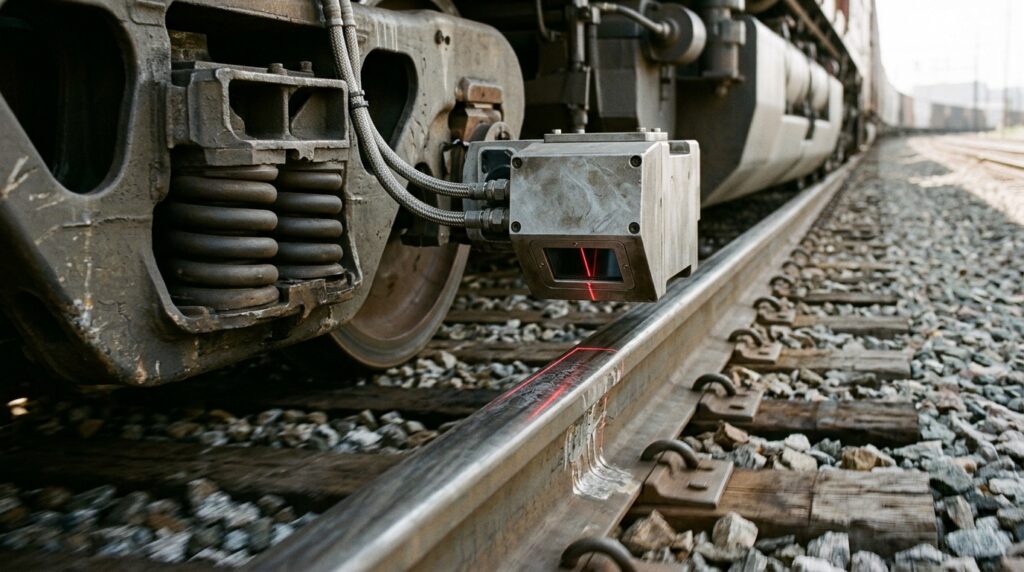
Field evaluations conducted along a 450-meter test alignment demonstrated that data-driven vibrational analyses accurately differentiated damaged track segments from nominal infrastructure while remaining sensitive to the physical severity of individual rail anomalies. Rather than relying on simulated dynamic models or pristine high-speed rails, the investigation confirmed that strategic sensor layouts combined with unsupervised learning can isolate critical structural flaws amidst ambient noise generated by heavy axle loads and aging track components. This real-world implementation provides a practical framework for continuous, autonomous infrastructure surveillance across extensive commercial rail networks.
Maintaining modern railway infrastructure presents significant logistical challenges as freight networks experience increasing traffic frequencies, heavier cargo loads, and severe weather events driven by climate change. Traditional track maintenance depends heavily on manual visual inspections or specialized track recording vehicles; however, specialized inspection cars incur substantial capital costs and cannot be deployed frequently enough across expansive networks to catch rapidly propagating defects before critical failures occur. Consequently, vehicle-assisted onboard monitoring utilizing operational rolling stock has emerged as an attractive alternative capable of delivering high-frequency asset evaluations during daily commercial runs. Nevertheless, transitioning onboard diagnostic technologies into commercial freight corridors remains challenging due to complex suspension filtering, variable operating speeds, and harsh environmental factors. In the studied freight corridor, structural damage signatures were heavily masked by high baseline vibrations, yielding an average signal-to-noise ratio of merely 3.9 decibels under severe damage scenarios.
The locomotive possesses a gross power rating of 1,650 horsepower, delivering 1,500 horsepower available for traction, with an operational top speed of 68 kilometers per hour. Fully fueled, the four-axle machine carries a total operating mass of 80,000 kilograms, evenly distributed at 20,000 kilograms per axle across a 1.00-meter narrow track gauge. The locomotive’s mechanical running gear incorporates a two-stage suspension system designed to isolate dynamic impacts. The primary suspension stage, positioned between the wheelset axle boxes and the bogie frame, utilizes two sets of nested helical springs of differing diameters. The secondary suspension stage, placed between the bogies and the carbody, consists of a single set comprising three helical springs.
The dynamic behavior of the vehicle-track interaction was captured through a strategic layout of twelve uniaxial accelerometers aligned vertically across key mechanical stages of the locomotive’s transmissibility chain. Sensor placement prioritized areas exhibiting high modal amplitudes while ensuring that hardware installation never interfered with standard railway maintenance routines. Four accelerometers were installed on the vehicle carbody, four were mounted across the two bogies with two units per bogie, and four were positioned alternately along the wheelset axle boxes. Axle-box sensors proved particularly vital because their position beneath the primary suspension minimized mechanical filtering, capturing unattenuated vibrations directly from the rail interface. High-sensitivity Kistler 8315A sensors rated at 1,200 millivolts per gravity and 250 millivolts per gravity were deployed alongside BDI accelerometers rated at 160 and 200 millivolts per gravity. The sensors were secured within custom carbon-steel angle brackets welded to structural elements, sealed inside galvanized sheet enclosures, and locked with high-torque thread-locking fluid.
Onboard signal acquisition was managed by four interconnected BDI STS4-4 measurement modules, providing sixteen channels operating at a maximum sampling frequency of 1 kilohertz. Power distribution and device synchronization were handled via Power over Ethernet cabling linked to a Phoenix Contact industrial computer running Windows 8 and STS Core software. The acquisition hardware was housed in a ventilated fiberglass-reinforced plastic cabinet installed inside the cabin, powered by direct current converters drawing from the vehicle’s 220-volt air conditioning inverter. To overcome storage limitations during prolonged idling and shunting operations, the engineering team designed an autonomous dual-triggering mechanism combining ultra-high-frequency radio-frequency identification with global positioning system virtual fences. A Control iD iDUHF reader antenna mounted to the locomotive’s front pilot communicated across 860 to 960 megahertz with passive RFID tags bolted to track sleepers, triggering five-volt recording relays upon vehicle entry.
The field trial was carried out on a straight 450-meter track segment situated along a freight railway in southern Brazil dedicated primarily to coal transport. The track infrastructure consists of standard TR45 rails weighing 45 kilograms per meter fastened directly to timber sleepers via bolted steel tie plates without elastomer rail pads. The rails are connected by mechanical joint bars that incorporate expansion gaps, introducing substantial baseline vibrations and geometric discontinuities even along nominal track sections. Permitted train speeds are capped at 40 kilometers per hour, with typical operations fluctuating between 20 and 40 kilometers per hour. Prior to testing, comprehensive trackside inspections established the longitudinal defect inventory. The section incorporates nominal baseline track from 0 to 323.0 meters, interrupted by two 5-meter bridge spans. A localized squat accompanied by surface flaking appears at 323.0 meters, followed by a spalling defect at 325.7 meters and a 12.6-meter stretch exhibiting severe wear, plastic deformation, and shelling.
Between December 12, 2024, and March 27, 2025, the instrumented locomotive completed 52 revenue transits across the designated test section, comprising 39 movements in one direction and 13 in the reverse orientation. To train and evaluate the unsupervised defect detection algorithms without risking model overfitting, the operational dataset was divided into distinct spatial and temporal partitions. Healthy baseline dynamic data from the initial 0 to 200 meters across 70 percent of transits were reserved for model training. Ten percent of transits across an adjacent, previously unencountered sound segment from 200 to 250 meters were allocated for model validation. The remaining 20 percent of transits spanning the full 450-meter length served as a testing dataset encompassing unseen operational days, varied speeds, and thermal rail dilation. Continuous sensor signals were segmented using a sliding window of 4 meters, associating computed dynamic indicators with window center points, thereby providing linear defect localization within a highly practical 4-meter operational tolerance.
The first evaluated anomaly detection framework utilized a continuous wavelet transform-based methodology operating on acceleration signals gathered from the four axle-box sensors. Raw vibration time series underwent linear detrending and spatial synchronization to account for the physical spacing between wheelsets as they traversed identical track coordinates. Time-frequency representations were generated using a continuous wavelet transform configured with an analytical Morse mother wavelet and 48 voices per octave, discarding distorted edge coefficients within the transform’s cone of influence. The resulting scalograms were resampled into standardized 256-by-256 pixel matrices to preserve spatial consistency independent of varying locomotive transit speeds. Deep convolutional autoencoders incorporating batch normalization and five percent dropout regularization were trained over 500 epochs with the Adam optimizer using a loss function based on the Structural Similarity Index Measure.
The second analytical approach implemented a deep autoencoder-based feature learning methodology designed to detect track defects using exclusively a single accelerometer mounted on the front-left axle box of the leading bogie. Raw acceleration windows were normalized via min-max scaling into 1,173-dimensional numerical vectors and processed through a deep dense autoencoder trained to reconstruct baseline operational signals. To eliminate heuristic design choices, Bayesian optimization employing a Gaussian process surrogate model evaluated 100 hyperparameter configurations, optimizing layer unit counts, depth, and activation functions against validation mean absolute error. The optimal architecture utilized the Nesterov-accelerated adaptive moment estimation optimizer with a learning rate of 0.0001 and a batch size of 16. To quantify structural anomalies, the reconstruction mean absolute error distributions across 20 independent model runs were evaluated using the Kullback-Leibler divergence between test segments and the healthy baseline. This statistical divergence was transformed into an intuitive logarithmic damage index that penalized transient outliers while highlighting persistent structural deterioration.
Both unsupervised frameworks successfully detected the localized rail defects and accurately differentiated them from nominal track, joint bars, and structural bridge spans under challenging operational conditions. Importantly, the calculated damage indicators exhibited distinct sensitivity to defect severity: the severe plastic deformation and wear zone between 338.9 and 351.5 meters produced substantially higher damage peaks than the localized squat and spalling recorded near 325 meters. Integrating both approaches through feature fusion yielded minor improvements in baseline normalization while reducing indicator discrepancy across passages. In terms of computational efficiency, offline training on a modern GPU workstation required 5,068 seconds per sensor for the wavelet convolutional model and 2,379 seconds for the dense autoencoder; once trained, online inference consumed only 0.0234 seconds and 0.0104 seconds per 4-meter window, supporting real-time processing speeds up to 171 and 384 meters per second, respectively. The authors plan to extend validation across longer network alignments and establish open-access benchmark datasets to support widespread adoption of automated rolling-stock monitoring.
Subject of Research: Onboard railway infrastructure monitoring and automated track anomaly detection
Article Title: Onboard monitoring system for railway infrastructure: design, implementation, and anomaly detection
Article References: Bragança, C., Hune, R., Fernandes, T., Ribeiro, D., Lopez, R., & Bittencourt, T. (2026). Onboard monitoring system for railway infrastructure: design, implementation, and anomaly detection. Railway Engineering Science. https://doi.org/10.1007/s40534-026-00442-7
Image Credits: AI Generated
DOI: 10.1007/s40534-026-00442-7
Keywords: railway infrastructure monitoring, onboard sensor system, track anomaly detection, axle box acceleration, continuous wavelet transform, convolutional autoencoders, structural similarity index, Kullback-Leibler divergence, Bayesian optimization, freight locomotive instrumentation, rail surface defects, plastic deformation and wear, rail spalling detection, UHF RFID triggering, Ferrovia Tereza Cristina, unsupervised damage detection, G12M locomotive