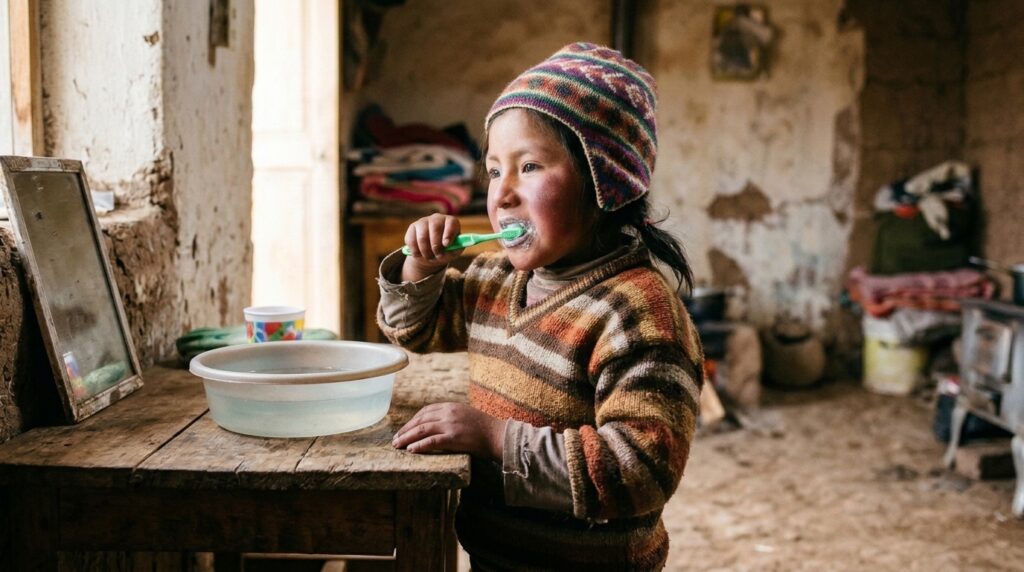
A repeated cross-sectional analysis of Peruvian survey data found that documented preventive oral hygiene among children aged 1 to 4 years increased between 2022 and 2024, even as socioeconomic inequalities persisted each year. Researchers analyzed nationally representative ENDES data to assess recent population-level changes and examine disparities across early childhood.
The investigation evaluated nationally representative ENDES 2022 to 2024 data from 52,614 Peruvian children aged 1 to 4 years. From this total sample, 52,517 children had complete records and entered Poisson regression models. The authors used survey-weighted analyses to estimate annual prevalence, evaluate associated factors, and calculate age-standardized socioeconomic inequalities alongside formal tests of change over time.
Primary preventive oral hygiene prevalence increased significantly over the three surveyed years. Documented practice stood at 34.1 percent, with a 95 percent confidence interval from 33.2 to 35.1, in 2022. It rose to 37.2 percent in 2023 and reached 38.2 percent, with an interval from 37.1 to 39.3, in 2024. This represented an overall increase of 4.1 percentage points, with a 95 percent confidence interval of 2.6 to 5.6 and a p-value below 0.001.
Secondary prevalence also improved during the observation window, rising from 26.2 percent in 2022 to 29.9 percent in 2024. When examining individual oral hygiene components, the researchers identified distinct patterns of behavioral change. Documented fluoride use increased among the children, while reported daily brushing practices changed very little across the same period.
Multivariable Poisson models identified several factors associated with documented hygiene practice. Four-year-olds demonstrated an adjusted prevalence ratio of 2.77 compared to one-year-olds, with a 95 percent confidence interval from 2.61 to 2.93. Higher education showed an adjusted prevalence ratio of 1.77 relative to no or preschool education, with a 95 percent confidence interval spanning 1.42 to 2.20. Previous dental attendance was associated with an adjusted prevalence ratio of 1.21, with a 95 percent confidence interval between 1.17 and 1.25.
Inequality assessments revealed differing trajectories across absolute and relative measures. Age-standardized slope indices of inequality registered at 16.3 percentage points in 2022, 19.9 percentage points in 2023, and 22.0 percentage points in 2024. The estimated change from 2022 to 2024 was 5.7 percentage points, with a 95 percent confidence interval from 0.7 to 11.5. Age standardization changed these inequality estimates only slightly.
In contrast to absolute measures, relative indices of inequality were 1.62 in 2022, 1.71 in 2023, and 1.77 in 2024, with changes that were not statistically distinguishable based on a p-value of 0.218. Documented practice improved overall, but socioeconomic differences persisted each year. Because absolute inequality measures increased while relative indices and omnibus interaction tests did not establish uniform widening, the authors noted that interpretation depended directly on the analytical measure and scale.
Subject of Research: Preventive oral hygiene practices and socioeconomic inequalities among Peruvian children aged 1 to 4 years
Article Title: Trends and socioeconomic inequalities in documented oral hygiene practice among Peruvian children aged 1–4 years: repeated cross-sectional analysis of ENDES, 2022–2024
Article References: Moreno-Prieto, V., & Roncal-Espinoza, R. J. (2026). Trends and socioeconomic inequalities in documented oral hygiene practice among Peruvian children aged 1–4 years: repeated cross-sectional analysis of ENDES, 2022–2024. BMC Public Health. https://doi.org/10.1186/s12889-026-30556-w
Image Credits: AI Generated
DOI: 10.1186/s12889-026-30556-w
Keywords: Peruvian children, oral hygiene practice, preventive oral hygiene, socioeconomic inequalities, ENDES, early childhood, fluoride use, daily brushing, dental attendance, slope index of inequality, relative index of inequality, Poisson regression, prevalence ratio, cross-sectional analysis, age standardization, pediatric oral health, survey-weighted analysis