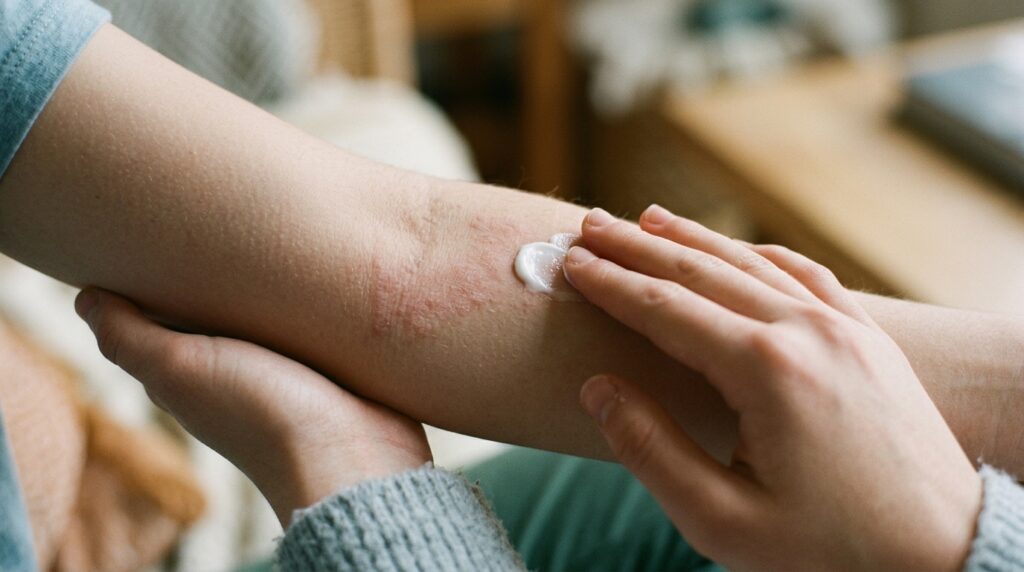
A 52-week open-label phase III clinical trial has demonstrated that twice-daily application of 1.5% ruxolitinib cream provides sustained disease control and maintains a favorable safety profile in adolescent patients aged 12 to 17 years suffering from mild-to-moderate atopic dermatitis. Conducted across 25 investigative sites located throughout the United States and Canada under clinical trial registry identifier NCT05456529, the single-arm investigation evaluated the long-term clinical safety, tolerability, pharmacokinetic characteristics, and exploratory therapeutic efficacy of the topical formulation. Investigators sought to provide dedicated pediatric evidence regarding whether adolescents, whose disease is frequently persistent and challenging to manage without long-term topical steroids, can attain rapid clearance of inflammatory skin lesions and pruritus through continuous daily dosing followed by an as-needed maintenance schedule.
Atopic dermatitis represents a chronic, pruritic, and inflammatory cutaneous disorder that typically commences in childhood and frequently persists into adolescence and adult life. Consequently, clinicians have identified a pronounced unmet medical need for nonsteroidal, corticosteroid-free therapeutic options that yield extended clinical remission without causing local skin atrophy, striae, or unwanted systemic drug absorption. Ruxolitinib functions as a selective inhibitor of Janus kinase 1 and Janus kinase 2 enzymes, and its 1.5% topical cream formulation had previously secured regulatory approvals from the United States Food and Drug Administration and Health Canada for patients aged 2 years and older based upon pivotal randomized controlled trials.
The study protocol instituted a structured two-phase intervention strategy designed to reflect acute control followed by realistic chronic disease management. During the initial 8-week continuous treatment period, all enrolled adolescents applied 1.5% ruxolitinib cream twice daily to all anatomical areas bearing active atopic dermatitis lesions at baseline, irrespective of whether individual lesions cleared early. Following the completion of week 8, participants transitioned into a 44-week long-term safety evaluation period spanning through week 52, during which the cream was applied twice daily solely on an as-needed basis to active lesions exhibiting an Investigator’s Global Assessment score of 1 or higher. Under this proactive maintenance regimen, participants were instructed to continue twice-daily application for exactly three additional days following complete clinical lesion clearance, defined as achieving an Investigator’s Global Assessment score of 0, while emerging lesions could be managed provided the total affected body surface area remained at or below 20%.
Patient selection criteria mandated enrollment of adolescents aged 12 to 17 years who had a documented medical history of atopic dermatitis for at least 2 years, baseline Investigator’s Global Assessment scores of 2 or 3, and affected body surface area involvement between 3% and 20%, excluding the scalp. Enrolled candidates were required to have disease that was inadequately managed by prior prescription topical therapies, or for whom such treatments were medically unadvised. Investigators excluded individuals displaying unstable or rapidly fluctuating disease trajectories over the preceding 4 weeks, documented immunocompromised conditions, recent systemic corticosteroid exposure within 4 weeks, biologic therapy administration within 12 weeks or five drug half-lives, and any non-emollient topical therapies within 1 week of baseline. The final evaluated intention-to-treat cohort comprised 103 adolescent patients with a median age of 14 years, of whom 54.4% were female, 44.7% were White, and 30.1% were Black. Baseline disease severity was substantial: 59.2% presented with a total body Investigator’s Global Assessment score of 3, 48.5% exhibited moderate facial involvement with scores of 2 or 3, the mean affected body surface area was 8.9%, and the mean baseline Eczema Area and Severity Index score was 6.4.
Out of 103 enrolled patients, 95 participants completed the initial 8-week continuous treatment phase, reflecting an early completion rate of 92.2%. A total of 92 patients subsequently initiated as-needed treatment during the 44-week long-term safety period, with 67 patients successfully completing the full 52-week study duration. Discontinuations occurred primarily due to patients being lost to follow-up, which accounted for 4 withdrawals during the continuous treatment period and 9 withdrawals during the long-term safety extension. Only a single patient discontinued therapy as a result of a treatment-emergent adverse event, involving an atopic dermatitis flare occurring during the long-term safety period that was formally documented as a voluntary patient withdrawal.
Assessment of the trial’s primary safety endpoint indicated that 1.5% ruxolitinib cream was well tolerated across 52 weeks of observation, with no new or unexpected safety signals emerging during prolonged as-needed administration relative to continuous use. Across the full 52-week duration, 42 patients experienced at least one treatment-emergent adverse event, representing an overall incidence of 40.8%. Incidences were 20.4% during the initial continuous phase and 32.6% across the substantially longer 44-week extension, an increase researchers directly attributed to the extended observation timeline rather than cumulative drug toxicity. Severe grade 3 or higher treatment-emergent adverse events developed in only 3 individuals and were judged by investigators to be entirely unrelated to study drug application: one facial eczema exacerbation, one instance of worsening depression in a patient possessing a documented psychiatric history, and a concurrent episode of mycoplasma pneumonia and asthmatic crisis in an adolescent with pre-existing asthma.
Local cutaneous tolerability was favorable, particularly in sensitive anatomical zones. Among the 60 participants presenting with baseline facial involvement, application-site reactions were limited to three individuals, consisting of transient grade 1 application-site pain that resolved following brief treatment interruption, grade 1 periorbital hyperpigmentation that was resolving without dosage modification, and grade 2 application-site acne that persisted without necessitating drug discontinuation. Investigator-assessed treatment-related adverse events across the entire 103-patient cohort were confined to four participants who each experienced mild or moderate isolated events: application-site pain, application-site acne, a skin pustule, and a localized staphylococcal infection. Furthermore, monitoring revealed no documented cases of contact dermatitis, skin atrophy, striae, folliculitis, herpes zoster, eczema herpeticum, cytopenia, liver enzyme elevation, major adverse cardiovascular events, thromboembolism, malignancies, or mortality.
Pharmacokinetic monitoring provided a biological explanation for the benign safety profile, establishing that topical application produced minimal systemic exposure. Blood samples obtained at weeks 2 and 4 revealed a geometric mean steady-state ruxolitinib plasma trough concentration of 14.2 nM, accompanied by a geometric coefficient of variation of 169%. Crucially, every individual plasma concentration value remained well below the 281 nM threshold established in human adult whole-blood in vitro assays for Janus kinase-mediated myelosuppressive activity. Pharmacokinetic values showed no drug accumulation between week 2 and week 4 and exhibited comparable distributions across age subsets (12–15 years versus 16–17 years) and baseline severity strata. Laboratory assessments confirmed that systemic exposure was insufficient to induce systemic Janus kinase inhibition, demonstrating an absence of clinically meaningful alterations or trends in longitudinal hematologic parameters.
Exploratory efficacy endpoints demonstrated rapid initial cutaneous improvement during continuous application that was successfully maintained through long-term as-needed usage. The mean affected body surface area decreased from 8.9% at baseline to 4.9% by week 2 and 2.5% by week 8, ultimately reaching 1.3% at week 52 under flexible dosing. Similarly, achievement of a 75% or greater reduction in Eczema Area and Severity Index scores occurred in 40.2% of patients by week 2, rising to 68.1% at week 8 and reaching 87.0% at week 52. Clear or almost clear skin status, defined as an Investigator’s Global Assessment score of 0 or 1, was attained at week 2 by 51.0% of patients for total body assessments and 65.3% for facial regions; these proportions increased by week 8 to 80.0% and 83.7%, respectively, and persisted through week 52 at 82.6% across the total body and 91.4% on the face among patients who began the trial with facial lesions.
Rapid antipruritic activity was also observed, with a 4-point or greater improvement on the daily itch Numerical Rating Scale achieved by 34.7% of qualifying patients by day 7 and 59.3% by day 28, remaining broadly stable throughout the 44-week maintenance phase. Authors acknowledged study limitations, emphasizing its single-arm, open-label design, the modest cohort size of 103 individuals, the restriction of recruitment to North American clinical centers, and the absence of granular daily logging for as-needed tube usage. Nevertheless, the investigators concluded that 1.5% ruxolitinib cream delivers prompt, comprehensive symptom relief and reliable long-term disease control, offering adolescents with mild-to-moderate atopic dermatitis an effective, well-tolerated, corticosteroid-free therapeutic management strategy.
Subject of Research: Safety, pharmacokinetics, and long-term efficacy of 1.5% ruxolitinib cream in adolescents with mild-to-moderate atopic dermatitis
Article Title: Safety and Tolerability of Ruxolitinib Cream in Adolescents with Mild-to-Moderate Atopic Dermatitis: Results From a 1-Year, Phase III, Open-Label Study
Article References: Joyce, J. C., Hong, H. C.-H., Siri, D. D., Toth, D., Kallender, H., Kuo, Y., Stefani-Hunyady, D., & Papp, K. A. (2026). Safety and Tolerability of Ruxolitinib Cream in Adolescents with Mild-to-Moderate Atopic Dermatitis: Results From a 1-Year, Phase III, Open-Label Study. American Journal of Clinical Dermatology, 27(4), 841-849. https://doi.org/10.1007/s40257-026-01043-0
Image Credits: AI Generated
DOI: 10.1007/s40257-026-01043-0
Keywords: ruxolitinib cream, atopic dermatitis, adolescent dermatology, Janus kinase inhibitor, phase III trial, open-label study, Investigator’s Global Assessment, Eczema Area and Severity Index, itch Numerical Rating Scale, long-term safety, topical therapy, skin clearance, pharmacokinetics, corticosteroid-free treatment, pruritus relief, pediatric dermatology, treatment-emergent adverse events