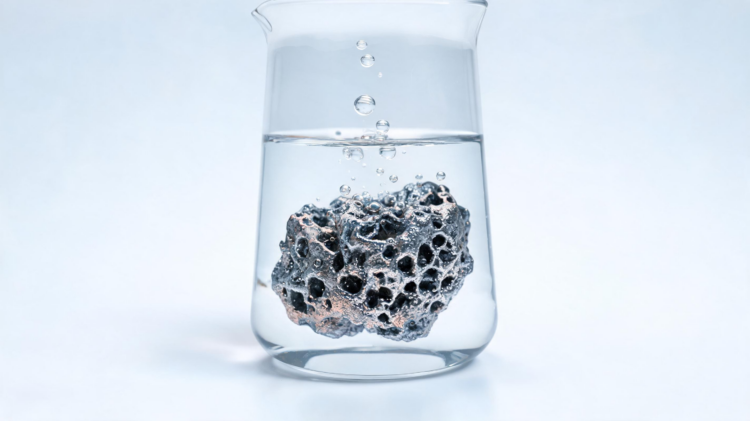
A self-supporting alloy made from five relatively abundant metals has delivered efficient hydrogen evolution in a strongly acidic electrolyte, pointing to a possible route toward electrodes that are simpler, more durable and less dependent on platinum. The material, a high-entropy alloy containing manganese, iron, cobalt, nickel and copper, was engineered with an interconnected network of pores and then electrochemically etched to roughen its surface. In tests, the optimized electrode required an overpotential of 76.7 millivolts to reach a current density of −10 milliamperes per square centimetre and 173.8 millivolts at −50 milliamperes per square centimetre. It also operated for 100 hours in 0.5-molar sulfuric acid while retaining its porous framework. The findings, reported in Advances in Industrial and Engineering Chemistry, highlight a central challenge in catalyst design: creating more surface area is not enough. The pathways through a porous electrode must remain connected, while the metal skeleton must stay sufficiently continuous to conduct electricity and withstand gas production.
Hydrogen production by water electrolysis is attractive because renewable electricity can be converted into high-purity hydrogen without directly emitting carbon during the electrochemical step. Acidic electrolysis offers an important technical advantage: the abundance of protons can support rapid hydrogen evolution at the cathode. But acidic conditions are also harsh on many non-precious materials, accelerating corrosion, dissolution or changes in surface chemistry. Platinum remains the benchmark catalyst because it binds hydrogen near the balance required for fast adsorption and release, but its cost and limited availability complicate large-scale deployment. Researchers have therefore explored high-entropy alloys, materials containing several principal elements rather than one dominant metal. Their atoms create a broad range of local environments, lattice distortions and electronic interactions, potentially producing multiple types of catalytic site and improving the ability to tune hydrogen binding. The new study addresses another practical limitation: many high-entropy alloy catalysts are powders that need binders, conductive additives and separate supports, all of which can add resistance and create mechanically weak interfaces.
The team instead designed the alloy as a self-supported electrode, so the catalyst also serves as its own electrically conductive framework. Elemental powders of manganese, iron, cobalt, nickel and copper, each with a reported purity of 99.9 percent, were mixed in approximately equal proportions and mechanically alloyed in a planetary ball mill for 10 hours at 200 revolutions per minute. X-ray diffraction showed that the separate elemental reflections gradually disappeared during milling and were replaced by the characteristic reflections of a face-centered cubic alloy. After 10 hours, the main diffraction peaks appeared at 43.4, 50.4 and 74.2 degrees, corresponding to the alloy’s (111), (200) and (220) planes. The broadened reflections were consistent with refined crystallites and lattice distortion generated by mechanical alloying. Electron microscopy and elemental mapping further indicated that manganese, iron, cobalt, nickel and copper were broadly distributed through the particles rather than forming obvious segregated regions. Measured contents were close to equiatomic, at 19.62 weight percent manganese, 18.61 percent iron, 19.64 percent cobalt, 19.66 percent nickel and 20.90 percent copper.
To create the pores, the researchers mixed the alloy powder with particles of poly(methyl methacrylate), or PMMA. The polymer acted as a sacrificial space holder: the mixture was pressed into pellets and sintered at 1,000 degrees Celsius for 10 minutes in a hydrogen atmosphere, causing the PMMA to be removed while the alloy particles consolidated into a continuous metallic body. Three alloy-to-PMMA volume ratios were examined: 3:1, 2:1 and 1:1. Increasing the amount of polymer increased overall porosity, but the resulting structures behaved differently. At 3:1, the pores created during polymer removal were mostly isolated, limiting the movement of electrolyte and the escape of hydrogen bubbles. At 1:1, the larger polymer fraction encouraged pores to merge, producing large interconnected voids and thinner metal walls. That structure had the highest porosity, but the coalesced pores reduced the available pore-wall area and weakened the framework. The 2:1 composition provided the most useful compromise, combining a connected pore network with enough continuous metal to preserve mechanical and electrical integrity.
The researchers then used electrochemical etching to activate the pore walls. The porous electrodes were subjected to 500 consecutive linear-sweep scans in 0.5-molar sulfuric acid, across a potential range of −0.5 to 0 volts relative to the reversible hydrogen electrode. This treatment left the bulk face-centered cubic structure intact but visibly roughened the surfaces inside and around the pores. Transmission electron microscopy indicated a more open and irregular internal morphology after etching, while high-resolution images continued to show the alloy lattice, including an interplanar spacing of 0.18 nanometres associated with the (200) plane. Elemental mapping showed that the five metals remained broadly distributed. X-ray photoelectron spectroscopy revealed changes in near-surface chemical states, including lower relative contributions from metallic cobalt, nickel and iron and a more prominent metallic copper contribution after etching. The measurements indicated surface chemical redistribution, but they did not by themselves prove that one element had selectively dissolved or that the surface had become enriched in copper. That distinction matters because the treatment improved the surface without producing a detectable bulk phase transformation.
Electrochemical measurements showed why the architecture mattered. At −10 milliamperes per square centimetre, the etched 2:1 electrode needed an overpotential of 76.7 millivolts. The corresponding values were 83.4 millivolts for the 1:1 porous electrode, 83.9 millivolts for the 3:1 version and 114.7 millivolts for a dense alloy pellet subjected to the same etching treatment. The porous electrode also produced the lowest Tafel slope among the high-entropy alloy samples, 76.1 millivolts per decade, compared with 95.3 for the 1:1 structure, 93.1 for the 3:1 structure and 126.4 for the dense pellet. A commercial platinum-on-carbon electrode recorded 28.7 millivolts per decade under the study conditions, confirming that platinum remained kinetically superior in the comparison. Still, the results showed that the 2:1 architecture substantially improved the non-precious alloy’s reaction kinetics. Electrochemical impedance measurements found that it had the lowest fitted charge-transfer resistance among the porous samples, while capacitance measurements indicated a larger electrochemically accessible interface.
The capacitance results help explain why the dense pellet, despite having a lower fitted charge-transfer resistance than the optimized porous electrode, performed less well overall. The electrochemical double-layer capacitance values were 35.2 millifarads per square centimetre for the etched dense pellet, 40.5 for the 1:1 porous structure, 63.6 for the 2:1 structure and 42.8 for the 3:1 structure. In this type of measurement, a larger capacitance is commonly used as an estimate of a greater electrochemically accessible surface area. The interconnected 2:1 network allowed acid to penetrate the electrode and exposed more roughened metal to the reaction, while its continuous framework maintained electrical pathways. The pores may also have helped hydrogen bubbles detach from the surface instead of blocking active sites. This combination is important because catalyst performance depends on more than the intrinsic speed of the reaction at an individual site. It also depends on how many sites the electrolyte can reach, how efficiently electrons travel through the electrode and how readily reactants and products move through the structure. The work therefore presents pore connectivity and framework continuity as design variables rather than secondary consequences of increasing porosity.
Durability tests provided encouraging, though still laboratory-scale, evidence of structural resilience. The optimized electrode was held at −0.1 volts versus the reversible hydrogen electrode for 100 hours in 0.5-molar sulfuric acid. Its current fluctuated as hydrogen bubbles formed and detached, but the average current density remained generally stable. After the test, scanning electron microscopy showed that the porous metallic framework was still intact. Surface spectroscopy did reveal chemical changes: higher-valence manganese, iron and nickel species made a larger contribution after prolonged operation, consistent with partial surface oxidation under the test conditions. Cobalt appeared as cobalt(II) and cobalt(III), copper as both metallic copper and copper(II), iron as metallic iron, iron(II) and iron(III), and manganese in several oxidation states. These changes were concentrated in the surface chemistry rather than accompanied by a detectable collapse of the alloy’s bulk structure. The authors describe the result as evidence that the combination of controlled pore architecture and electrochemical activation can produce a self-supported high-entropy alloy capable of sustained acidic hydrogen evolution, while also emphasizing that future development will need to address scale-up, longer testing and operation under practical electrolyzer conditions.
The alloy composition was not selected solely for convenience. The study considered hydrogen-binding characteristics, binary mixing enthalpies and CALPHAD-based phase predictions when evaluating manganese, iron, cobalt, nickel and copper as the principal elements. That design approach reflects a broader objective in high-entropy electrocatalysis: using compositional complexity to create a distribution of surface environments while retaining a phase that can be processed into a mechanically coherent electrode. Mechanical alloying further provided a route to combine the elemental powders before pore formation, rather than relying on a deposited catalyst layer.
Because the same electrochemical etching protocol was applied to the dense pellet and each porous composition, the comparison more directly separates the contribution of architecture from that of surface activation. Even so, the reported activity should be interpreted within the study’s measurement framework. Overpotential and Tafel slope describe polarization behavior under specified laboratory conditions; they do not alone establish energy efficiency, gas purity, projected lifetime or performance in a complete electrolyzer. The 100-hour test demonstrates persistence of the framework in sulfuric acid, while the observed changes in surface oxidation states indicate that the working interface is chemically dynamic. Longer tests, analysis of dissolved metals and evaluation at industrially relevant current densities would help determine whether the architecture remains advantageous during practical operation.
Subject of Research: Porous MnFeCoNiCu high-entropy alloy electrodes for acidic hydrogen evolution
Article Title: Pore architecture engineering and electrochemical surface activation of a self-supported MnFeCoNiCu high-entropy alloy for efficient acidic hydrogen evolution
Article References: Kwon, T., Moon, S., Roh, K.-M., Kim, S., & Lee, D. (2026). Pore architecture engineering and electrochemical surface activation of a self-supported MnFeCoNiCu high-entropy alloy for efficient acidic hydrogen evolution. Advances in Industrial and Engineering Chemistry, 2(1), Article 11. https://doi.org/10.1007/s44405-026-00051-2
Image Credits: AI Generated
DOI: 10.1007/s44405-026-00051-2
Keywords: hydrogen evolution, high-entropy alloys, acidic electrolysis, electrocatalysis, porous electrodes, electrochemical etching, green hydrogen, materials science, Pore, architecture, engineering, electrochemical
Cite Scienmag News
APA MLA Chicago
Copy citation Download RIS
Tags: acidic electrolysisadvanced catalyst design for water electrolysisarchitecturecontinuous metal skeleton for electrical conductivitycost-effective hydrogen generation materialsdurable acid electrolysis electrodeElectrocatalysiselectrochemicalelectrochemical etchingelectrochemical etching for electrode surface rougheningEngineeringfive-metal alloy hydrogen productiongreen hydrogenhigh entropy alloyshigh-performance hydrogen evolution in sulfuric acidhydrogen evolutioninterconnected porous electrode designlong-term stability of porous alloy electrodesmaterials sciencenon-platinum hydrogen evolution catalystPoreporous electrodesPorous high-entropy alloy for hydrogen evolutionsustainable hydrogen production via electrochemical water splitting