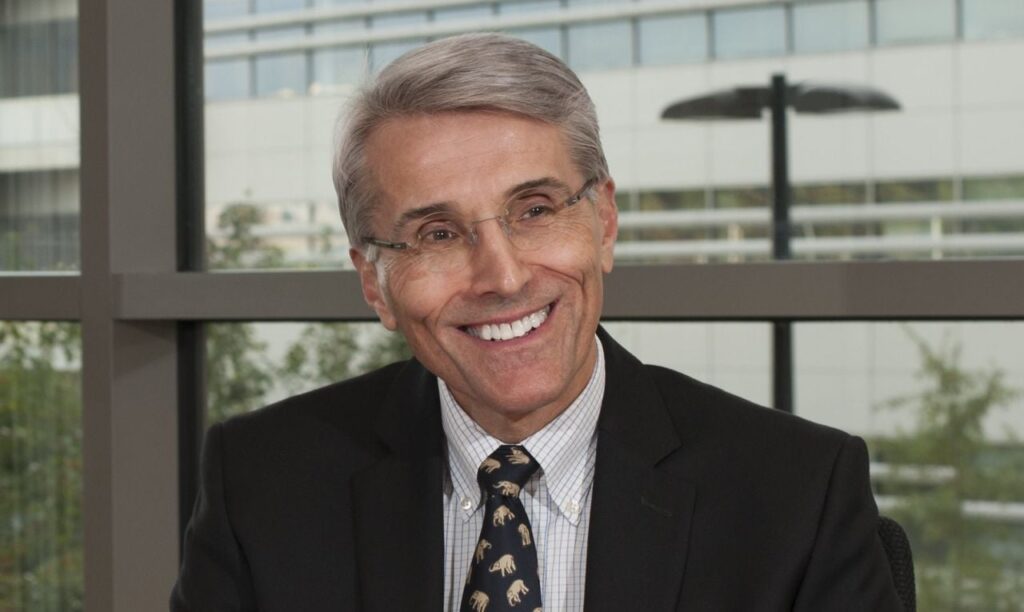
The FDA’s former top drug regulator Richard Pazdur, M.D., has lamented the loss of expert voices at the agency.
“Over the past year, there has really been an attack on the federal workforce,” Pazdur said at a Friday industry partnering event during the annual meeting of the American Association for Cancer Research (AACR) in San Diego.
He especially cited a massive, chaotic reduction in force (RIF) on April 1, 2025, the legality of which is under active scrutiny.
“People entered the FDA [building] and their badges didn’t work,” Pazdur recalled. “We didn’t know who was RIFed, why they were RIFed, what was going to be the current structure after that.”
To this day, FDA leadership has not adequately addressed how the agency will respond to the massive turnover, he added. The layoffs also sparked a “palpable sense of anxiety” among remaining staffers, who worried they might be next.
Though he worries about the loss of senior and mid-career employees at the agency, Pazdur assured the crowd that he has confidence in his former staffers who remain. Pazdur decided to retire from the FDA last December after less than a month in the role as director of the Center for Drug Evaluation and Research. A significant stint of his 26-year career at the agency was as founding director of the Oncology Center of Excellence.
Related
On top of letting vital staff go, the FDA began announcing policy changes through press releases without consulting career staff, Pazdur explained. All told, the “firewall” that separates political appointees from the drug review process has eroded, he said. This is exemplified in the name of the controversial Commissioner’s National Priority Voucher program, which Pazdur and others have warned is ripe for corruption.
“Prior to this administration, I never really had a discussion with a commissioner about whether a drug should be approved,” Pazdur said. “There is this influence that has seeped into the regulatory decision-making.”
Another concerning loss of expertise for Pazdur is the FDA’s recent reluctance to convene advisory committees—panels of outside experts that help the agency wade through complicated scientific issues.
“There have been public statements by this administration that they don’t believe in advisory committees,” he said. “I totally disagree with that. I think that they’re very important.”
For Pazdur, these committees are essential not because they help reach a decision on a specific drug candidate, but because they demonstrate to the public how the FDA is formulating decisions. Advisory committees do this with a level of detail that can’t be matched by the public release of complete response letters, he added, a new policy under the second Trump administration.
With a long tenure serving on the FDA’s Oncologic Drugs Advisory Committee, Pazdur recognizes that reforms are needed. Meetings could be streamlined, and a more diverse membership chosen with input from relevant industry and patient advocacy groups, he suggested.
Though he worries about the FDA’s loss of expertise, that doesn’t mean Pazdur is eager to return to the agency. Asked by Fierce if he’s been requested to come back, or if he’d even consider returning, the veteran regulator shook his head no on both counts.
“Not under this administration,” Pazdur told Fierce. “For obvious reasons.”
The China of it all
As is standard at all biopharma industry events, Pazdur’s chat with Leerink Partners analyst Daina Graybosch, Ph.D., inevitably included a section on China.
But while many in the industry and federal government are considering the implications of China’s booming biotech sector on America’s competitiveness, Pazdur sees the issue through the lens of globalization.
During his tenure leading the Oncology Center of Excellence, the center launched Project Orbis with the goal of boosting international collaboration on drug reviews and approvals, which includes regulators in Canada, Australia, Brazil, Israel, Singapore, Switzerland and the U.K. Pazdur would also like to see China and other Asian nations brought into multiregional collaborations.
This view aligns with that of Roivant Sciences CEO Matthew Gline, who recently told Fierce that he sees concern around China as a “red herring.”
Pazdur also feels, as do many others, that the U.S. has a lot to learn from China’s ability to rapidly conduct phase 1 trials. FDA Commissioner Marty Makary recently outlined a desire for speedier early-stage studies in his 2027 budget request to Congress.
Related
Asked by Graybosch whether he’s aware of any current initiatives at the FDA to develop alternatives to the current investigational new drug (IND) pathway for starting phase 1 trials, Pazdur said no.
“These IND regulations stem from the last century, and obviously the way we develop drugs, the number of drugs that are being developed, are vastly different than what they were,” he said. It may be time for regulations to adjust accordingly, he suggested.
Pazdur’s perspective has changed with the times as well, most notably when it comes to single-arm trials.
“In the early part of my career, I was somewhat skeptical of single-arm trials,” he told the audience. “Over the years, we really have developed in oncology a fairly flexible approach where you’re approving drugs that have meaningful impact on patients.”
Aside from coming around to single-arm trials, does Pazdur have any other regulatory opinions that have changed over the decades?
“No,” he told Graybosch, smiling.