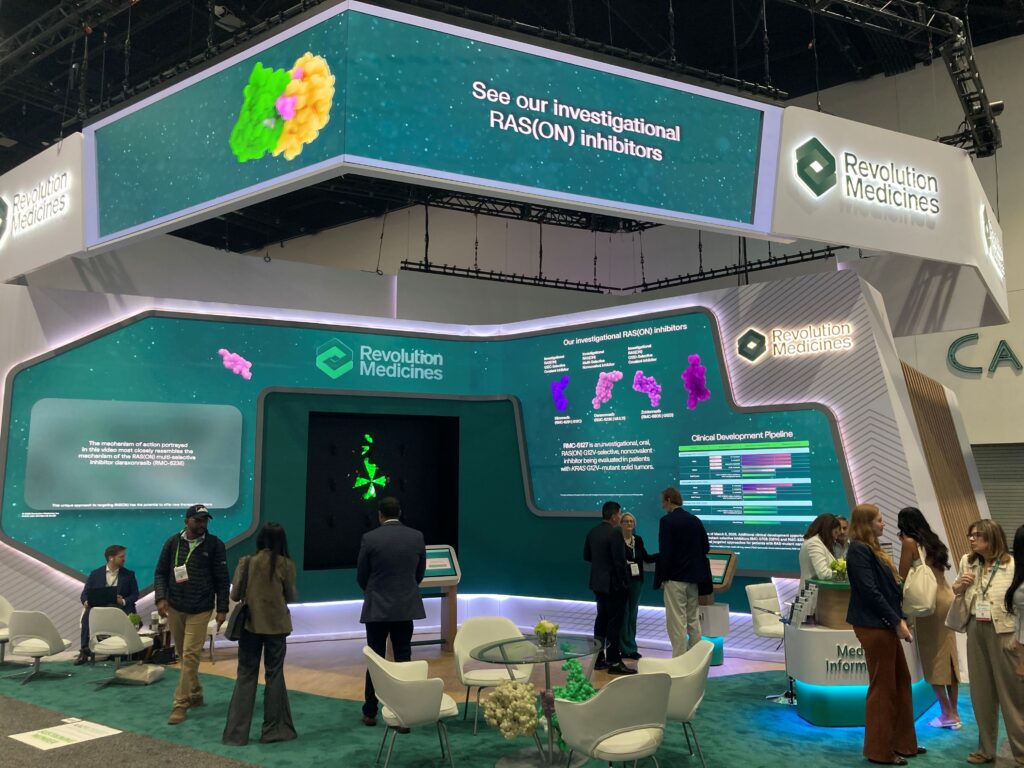
After dropping headline-grabbing phase 3 data for its pancreatic cancer candidate daraxonrasib last week, Revolution Medicines is not resting on its laurels. The Bay Area biotech has spent several days in San Diego highlighting earlier data for its lead candidate and the rest of its pipeline.
The main attraction among RevMed’s presentations at the American Association for Cancer Research (AACR) annual meeting was phase 1/2 first-line data for daraxonrasib alone or in combination with other therapies. These data follow last week’s big win in previously treated patients with metastatic disease, where the drug led to six months of longer survival than chemotherapy.
Those data “really validated our Ras(ON) inhibitor strategy, not only for daraxon, but I think for the portfolio as a whole,” RevMed’s Chief Development Officer Alan Sandler, M.D., told Fierce Biotech during AACR.
Second-line success for daraxonrasib is big, Sandler added, but ultimately just the “tip of the iceberg.”
“The plan is to go as quickly as you can earlier in the lines of therapy, and even potentially into that curable setting,” he said.
Related
In a poster presented at AACR on April 21, RevMed highlighted that daraxonrasib alone was tied to an objective response rate (ORR) of 47% in 38 previously untreated patients with metastatic pancreatic cancer, with a 92% disease control rate. While survival data isn’t final yet, 83% of patients survived to six months, with 71% showing no disease progression during that span.
In an oral presentation on the same day, RevMed scientists described how pairing daraxonrasib with chemotherapy led to a 58% ORR in 40 similar patients, with overall survival of 90% and 84% progression-free survival at six months.
The data so far are competitive, Sandler told Fierce, and support RevMed’s strategy of testing daraxonrasib monotherapy and combinations in ongoing phase 3 trials.
Daraxonrasib is designed to inhibit the Ras protein, which is vital for the survival of several cancers, including the vast majority of pancreatic cancers. There are currently just two approved drugs targeting the protein: Amgen’s Lumakras and Bristol Myers Squibb’s Krazati. Though Ras was one of the first cancer-causing genes identified, it was long considered undruggable due to the protein’s lack of an obvious “pocket” for a drug to bind to, Sandler explained.
Daraxonrasib gets around this by acting as a glue that sticks Ras to another protein, cyclophilin A, which shuts off Ras’ ability to drive cell growth and division.
RevMed’s star asset “is based on a completely different chemistry” than the first generation of Ras inhibitors, Robert Vonderheide, M.D., Ph.D., director of the Abramson Cancer Center at the University of Pennsylvania and president-elect of AACR, told Fierce on the sidelines of the conference. “It wasn’t that long ago where that oncogene was essentially written off as undruggable.”
Daraxonrasib is effective against multiple different Ras mutations, Sandler said, but the same strategy is used for another of RevMed’s drug candidates, zoldonrasib, which is specific for just one kind of mutation.
In a talk at AACR April 19, the biotech highlighted zoldonrasib’s 52% objective response rate in 27 patients with previously treated non-small cell lung cancer, with an average progression-free survival of 11.1 months. Based on the phase 1 data, RevMed plans to launch a phase 3 trial of zoldonrasib in lung cancer.
“This shows our ability to target Ras not only in pancreatic cancer,” Sandler said, noting that about 30% of lung cancers have mutated Ras.
RevMed is testing daraxonrasib in lung cancer as well, and given that the star asset targets the same mutation as zoldonrasib, one may wonder why the company is bothering with the latter inhibitor at all. Sandler said it comes down to giving doctors choices.
“They may have a different safety profile,” he explained. “They have unique abilities in terms of combining with other agents.”
Most enticing for the development leader is the potential of combining daraxonrasib and zoldonrasib in a regimen that doesn’t require chemotherapy, which RevMed is actively testing.
“We’re the only company that can do that at this point,” Sandler said. “We’ve got multiple studies that have been designed to elucidate how one approach may be better than another, and then we’ll let the data speak.”
Investors have certainly shown their enthusiasm, rewarding RevMed with around $2.2 billion in a stock offering following last week’s drop.
Riding the Ras wave
Though Ras remained out of reach for a long time, RevMed is now at the forefront of a recent wave of interest in the target—and plans to keep that position. In addition to daraxonrasib and zoldonrasib, the biotech also shared new data at AACR for a preclinical candidate with an entirely different way of attacking Ras.
This catalytic Ras inhibitor, known as RM-055, is meant to flip activated Ras into an inactivated state, Sandler explained to Fierce. By doing so, RevMed hopes the molecule can “overcome resistance” to Ras inhibitors that cancers inevitably evolve, while also flexing “sustained anti-tumor activity” of its own in preclinical models of pancreatic cancer, lung cancer and colorectal cancer.
“Tumors are very clever,” Sandler said. When the Ras they depend on is gummed up, they can adapt by simply churning out more and more of the protein to overcome the inhibitory effects. RM-055 can do some of what daraxonrasib and zoldonrasib do too, but by also flipping active Ras into an inactive form, the therapy could prevent the cancer from developing resistance to Ras inhibition.
This increased production of the mutated target is a major way that cancer ultimately progresses in patients given daraxonrasib, Sandler explained, pointing to last week’s phase 3 data. “That’s where this new class of agents can potentially be very effective.”
Pursuing a new mechanism for Ras inhibition, even before daraxonrasib secures regulatory approval, is one way RevMed is angling to stay ahead of the competition. AACR was full of other biotechs showcasing their preclinical Ras candidates, including Clasp Therapeutics, Verastem Oncology and BlossomHill Therapeutics.
“There are others that are looking at it, which is great for patients,” Sandler said. “But I’d say we have a nice head start.”
For Vonderheide, the fact that a previously undruggable target like Ras has been cracked bodes well for other intractable targets too.
“Research broke the code on an undruggable target,” he told Fierce. “So maybe we can break the code on the next one, and the next one after that.”