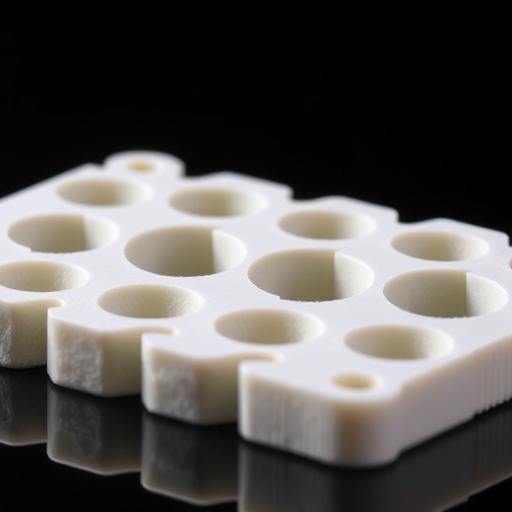
Emerging Horizons in Polymer-Derived Ceramics: Revolutionizing Manufacturing Through Additive Pathways
In the rapidly evolving world of materials science, polymer-derived ceramics (PDCs) have emerged as a transformative class of materials, blending the flexibility of polymers with the robustness of traditional ceramics. A recent comprehensive study spearheaded by Khuje, Ku, Bujanda, and their collaborators delves into the frontier of additive manufacturing technologies tailored specifically for PDCs. This advance not only promises to reshape manufacturing techniques but also unlocks unprecedented functional capabilities in high-performance applications.
Additive manufacturing, popularly known as 3D printing, has revolutionized material fabrication through layer-by-layer construction, facilitating complex geometries previously unattainable via conventional methods. However, adapting these technologies to ceramic materials, especially PDCs, demands profound understanding of the interplay between polymer chemistry and ceramic transformation. The study sheds light on various additive pathways, emphasizing how carefully orchestrated processing parameters can guide the structural evolution and hence the ultimate properties of the ceramics produced.
At the heart of PDCs lies the unique conversion of preceramic polymers into inorganic ceramic networks upon pyrolysis. This process, marked by intricate structural rearrangements, determines the microstructure and consequently the material’s mechanical, thermal, and chemical performance. The researchers extensively dissect how additive manufacturing offers nuanced control over this phase, enabling fine-tuning of porosity, composition, and even incorporating multimaterial functionalities within a single construct.
One of the pivotal challenges addressed is the compatibility of preceramic polymers with existing additive techniques such as stereolithography (SLA), direct ink writing (DIW), and fused filament fabrication (FFF). Each method presents its own constraints, whether in terms of resin viscosity, curing dynamics, or thermal stability during post-processing. The paper presents an integrated perspective on modifying polymer chemistries to enhance printability while preserving their capacity for ceramic transformation, thereby marrying the processing ease of polymers with the performance characteristics of ceramics.
Beyond fabrication, the study pivots to examining the microstructural consequences of these additive routes. It highlights how parameters such as layer thickness, cross-linking density of the polymer network, and pyrolysis profile crucially influence grain size, phase distribution, and defect formation within the ceramic matrix. Such insights are invaluable for industries where material reliability under extreme conditions — high temperature, wear, and chemical inertness — is non-negotiable.
The transformative potential of this research touches several sectors. Aerospace companies, for instance, could leverage PDCs fabricated through tailored additive manufacturing to produce lightweight yet ultra-durable components, optimizing fuel efficiency and endurance. Similarly, the electronics industry stands to benefit from the remarkable electrical properties of PDCs, applicable in sensors and microelectromechanical systems (MEMS), where miniaturization and precision fabrication are crucial.
In parallel, the ability to create intricately designed porous architectures introduces exciting possibilities in biomedical fields. Customized implants, prosthetics, and scaffolds for tissue engineering could exploit the bioinertness, thermal stability, and tunable porosity of PDCs, contributing to improved patient outcomes and longer-lasting implants. This multi-disciplinary relevance underscores the strategic importance of mastering additive manufacturing pathways for these materials.
Methodologically, the paper pioneers a multi-modal characterization approach combining scanning electron microscopy, X-ray diffraction, and spectroscopy to unravel the structural transformations occurring during the polymer-to-ceramic conversion. Coupled with computational modeling, these techniques provide a comprehensive understanding of how processing influences final properties, enabling predictive design frameworks rather than empirical trial and error.
Strikingly, the authors emphasize the functional versatility that additive manufacturing imparts to PDCs. Instead of homogenously structured ceramics, the techniques facilitate spatial modulation of properties within a single part — a leap towards functionally graded materials. Such complexity could mean components tailor-made to withstand variable stress regimes or thermal gradients, significantly extending their service life and operational capabilities.
Furthermore, sustainability considerations find a voice in the discussion. Traditional ceramic manufacturing often involves energy-intensive steps and significant material wastage. Additive manufacturing’s inherent material efficiency, combined with the possibility of room-temperature polymer processing before pyrolysis, offers an environmentally and economically favorable alternative. The implications for greener manufacturing paradigms are profound, aligning with global goals for reduced carbon footprints.
The paper also ventures into future directions, envisioning the fusion of PDC additive manufacturing with emerging digital manufacturing paradigms, including artificial intelligence-driven process optimization, autonomous fabrication systems, and real-time quality control embedded within the printing workflow. These innovations could dramatically accelerate innovation cycles and bring high-performance ceramic components from laboratory benchmarks to mass-market realities.
Challenges remain, notably in scaling up processes to industrial throughput levels while maintaining structural fidelity and reproducibility. The intrinsic brittleness of ceramics means that defects introduced during printing or pyrolysis can have outsized effects on mechanical integrity. Addressing these will require continued innovation in material formulations, printing strategies, and post-processing techniques — a vibrant research frontier underscored in the study.
Intriguingly, the exploration extends beyond conventional ceramics to incorporate advanced compositions, including silicon carbide, silicon oxycarbide, and derivative hybrid phases. Such diversity enables tailored functionalities – from enhanced thermal conductivity to superior oxidation resistance – further broadening application domains. These materials’ amenability to additive manufacturing stands poised to disrupt traditional supply chains and design philosophies.
In conclusion, the work of Khuje and colleagues marks a pivotal moment in material manufacturing science, positioning polymer-derived ceramics within the dynamic ecosystem of additive technologies. This synergy promises to deliver materials that not only meet but exceed the stringent demands of next-generation technologies while fostering sustainable, efficient manufacturing processes. The coming years will likely witness this convergence catalyzing transformative advancements across sectors as disparate as aerospace, electronics, healthcare, and energy.
For practitioners and innovators alike, harnessing the insights detailed in this study offers a roadmap to unlock the full potential of polymer-derived ceramics. By marrying molecular-level chemistry with macro-scale manufacturing processes, the field moves ever closer to realizing designer ceramics with unprecedented structural and functional precision. Truly, additive manufacturing is not just a tool but a paradigm shift enabling a new era of ceramic science and technology.
Subject of Research: Polymer-derived ceramics and their additive manufacturing pathways
Article Title: Additive manufacturing pathways for polymer-derived ceramics: processing, structure, and function
Article References:
Khuje, S., Ku, N., Bujanda, A. et al. Additive manufacturing pathways for polymer-derived ceramics: processing, structure, and function. npj Adv. Manuf. 3, 8 (2026). https://doi.org/10.1038/s44334-026-00068-x
Image Credits: AI Generated
DOI: https://doi.org/10.1038/s44334-026-00068-x
Tags: 3D printing polymer ceramicsadditive manufacturing of polymer-derived ceramicsadvanced ceramic fabrication techniquesfunctional applications of polymer-derived ceramicshigh-performance ceramic materialslayer-by-layer ceramic manufacturingmicrostructure control in ceramicspolymer chemistry in ceramicspolymer to ceramic transformationpyrolysis in polymer-derived ceramicsstructural evolution in ceramicsthermal and mechanical properties of PDCs