
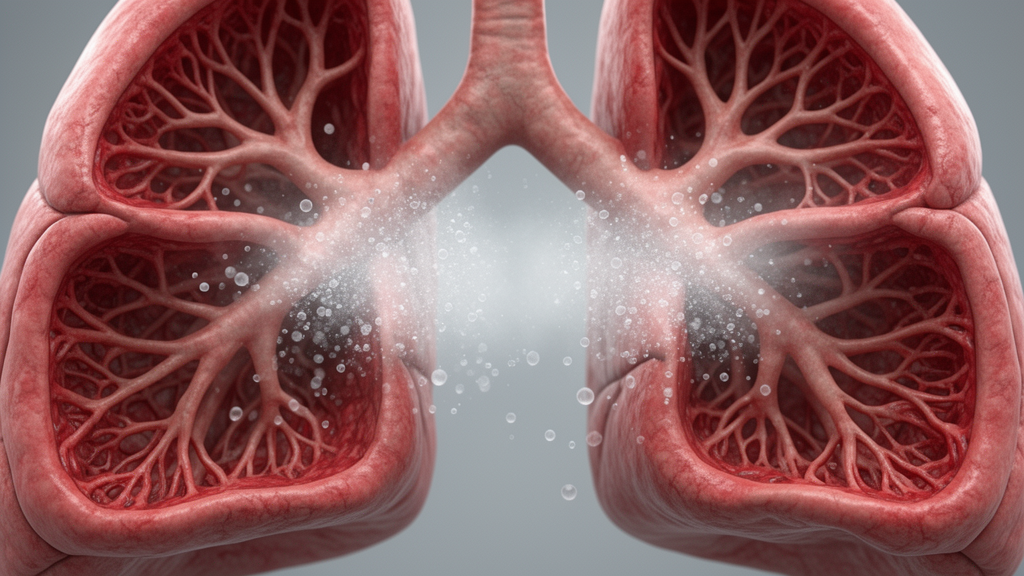
Researchers from Father Muller Medical College Hospital in Mangaluru, India, have published a comprehensive narrative review showing that aerosolized pharmacotherapies in acute respiratory distress syndrome remain constrained by severe delivery barriers, physiological heterogeneity, and an absence of proven survival benefits. Writing in Frontiers in Medicine, Eldhos Jacob, Srishankar Bairy, and Carishma Sheela emphasize that acute respiratory distress syndrome is a complex form of inflammatory lung injury marked by alveolar-capillary barrier disruption, pulmonary edema, surfactant dysfunction, and ventilation-perfusion mismatch. While standard management centers on treating precipitating causes and delivering lung-protective ventilation, positive end-expiratory pressure, and prone positioning, clinicians often employ inhaled agents seeking targeted pulmonary exposure. However, the review clarifies that evidence does not support aerosolized pharmacotherapy as routine disease-modifying treatment. The authors highlight that nominal drug doses loaded into nebulizers do not equal emitted doses, airway-delivered mass, regional lung deposition, or biologically active target tissue exposure across damaged pulmonary compartments.
A central mechanistic theme evaluated by the authors is the profound physical-access paradox created by spatial heterogeneity within the injured respiratory system. In acute respiratory distress syndrome, aerated, poorly aerated, and consolidated lung regions coexist, with dependent areas suffering derecruitment and edema while nondependent compartments remain relatively open. Because inhaled aerosol particles travel preferentially along ventilated airways of least resistance, they inherently bypass flooded or consolidated alveolar units that harbor the most severe tissue injury. Structural damage therefore restricts drug delivery precisely where pharmacological intervention might theoretically be desired. The authors emphasize that biological plausibility or receptor presence cannot overcome this anatomical barrier. Although advanced physiological tools such as computed tomography, electrical impedance tomography, and lung ultrasound provide insights regarding regional aeration and ventilation distribution, the review cautions that none of these imaging modalities directly quantifies regional aerosol deposition or active target exposure within injured lung tissues.
The passage of an aerosol through mechanical ventilation circuits introduces major physical determinants that reduce delivered mass before medication reaches patients. The authors evaluate three primary nebulization technologies alongside metered-dose inhalers: jet nebulizers, ultrasonic nebulizers, and vibrating-mesh nebulizers. Conventional jet nebulizers utilize compressed gas to shear liquid solutions into droplets, frequently adding external driving flow to the ventilator circuit, leaving substantial residual volume, and displaying output variability. Ultrasonic systems use high-frequency piezoelectric vibration to generate high aerosol output, but performance is limited by formulation stability and vulnerability to heat. In contrast, vibrating-mesh nebulizers force liquid through micro-apertures in a perforated membrane, avoiding added driving gas and providing efficient aerosol generation, though performance remains dependent on formulation viscosity and circuit geometry. While bench studies demonstrate that inspiration-synchronized mesh nebulization can increase delivered dose compared with continuous operation, the authors stress that bench efficiency cannot be treated as a substitute for clinical outcomes.
Circuit configuration and respiratory conditioning represent critical yet frequently overlooked determinants of aerosol delivery fidelity. Examining real-world practice patterns, the review highlights findings from the 2025 Aero-in-ICU secondary analysis, which evaluated 53 patients with acute respiratory distress syndrome across nine intensive care units in India, of whom 51 received aerosol therapy. In that observational cohort, nebulizers were placed at the prespecified optimal position of fifteen to thirty centimeters from the Y-junction in only 460 of 918 documented sessions, or 50.1 percent adherence. However, the authors stress that these practice-pattern data identify operational variation rather than proving that non-recommended positioning caused clinical treatment failure or worsened patient outcomes. Furthermore, the review addresses invasive humidification, noting that heated humidifiers and heat-and-moisture exchangers dynamically alter particle aerodynamics through hygroscopic growth. Nevertheless, routine interruption of humidification solely to optimize aerosol delivery is unjustified, as disconnecting circuits compromises airway conditioning and fails to consistently improve delivered drug mass.
To resolve discrepancies between experimental pharmacology and clinical trials, the review characterizes the nominal dose to deposited dose problem as a discontinuous multi-step cascade. Rather than treating loaded drug as an exposure metric, investigators must differentiate between nominal dose loaded into the device, emitted dose leaving the generator, airway-delivered mass passing the artificial airway, deposited dose reaching lung parenchyma, and biologically active exposure at molecular targets. Systematic reviews of invasive mechanical ventilation report substantial circuit losses and wide variation in measured lung deposition, proving that bench-derived values cannot serve as universal bedside conversion factors. To overcome these persistent reporting deficits, the authors propose a candidate minimum reporting dataset encompassing patient phenotypes, drug formulations, generator specifications, circuit configurations, humidification modes, respiratory mechanics, and treatment fidelity measures such as interruptions and suctioning. The authors emphasize that this reporting template is designed as a scientific standardization aid for future research rather than a validated clinical scoring system.
The review assesses inhaled pulmonary vasodilators, using gaseous inhaled nitric oxide as a non-aerosol physiological comparator against nebulized prostacyclins. Inhaled nitric oxide diffuses directly into ventilated alveoli to produce selective microvascular vasodilation, improving ventilation-perfusion matching without aerosol impaction constraints. Nevertheless, a 2026 meta-analysis of eleven randomized trials encompassing 1,302 adults revealed only a modest, low-certainty oxygenation improvement, with a mean PaO2/FiO2 increase of 15.03 millimeters of mercury. Crucially, the pooled analysis found no mortality benefit, showing a relative risk of 1.07, and identified a possible increase in renal replacement therapy requirement, with a relative risk of 1.56. Similarly, for nebulized prostacyclins such as epoprostenol and iloprost, a 2023 meta-analysis of 23 studies in 1,658 patients indicated an average PaO2/FiO2 increase of approximately 40 millimeters of mercury, but evidence certainty was very low. Furthermore, a randomized trial of 150 patients found that day-five oxygenation gains missed statistical significance and yielded no mortality reduction, restricting both agents to rescue therapy.
Beyond vasodilators, the authors critically evaluate candidate aerosol strategies targeted at inflammation, alveolar fluid clearance, coagulopathy, and surface tension. Investigating intra-alveolar fibrin deposition, the multicenter CHARLI phase three randomized trial evaluated nebulized unfractionated heparin at 25,000 international units every six hours via vibrating-mesh nebulizers but failed to improve its primary day-60 physical function endpoint. Although a 2026 meta-analysis of 16 trials in 1,620 adults with acute respiratory failure reported pooled reductions in all-cause mortality and 4.85 additional ventilation-free days, the review stresses that these mixed-etiology findings cannot be applied to established acute respiratory distress syndrome, particularly given imprecise bleeding estimates. Similarly, the randomized ALTA trial evaluated aerosolized albuterol in 282 patients to stimulate alveolar fluid clearance, but observed no ventilator-free-day benefit while noting tachycardia, confirming that routine beta-agonists are inappropriate without bronchospasm. Direct evidence for inhaled corticosteroids in established adult disease remains limited, while trials evaluating exogenous surfactant have consistently failed to demonstrate survival benefits.
The synthesis distinguishes general syndrome-modifying therapies from indication-specific aerosol interventions, including inhaled antibiotics and secretion-directed mucoactive agents. Inhaled antimicrobials address specific microbiological complications, such as ventilator-associated pneumonia, rather than the acute respiratory distress syndrome process itself. A 2025 systematic review of four randomized trials comprising 1,160 ventilated adults found that prophylactic nebulized antibiotics reduced pneumonia incidence with a relative risk of 0.70, but failed to alter intensive care unit or hospital mortality. The authors stress that inhaled antibiotics must serve strictly as pathogen-specific adjuncts under rigorous stewardship protocols and never replace systemic treatment. Regarding mucoactive agents, routine administration based solely on respiratory failure is unsupported, with therapy restricted to documented secretion retention while monitoring for bronchospasm. The review also evaluates aerosolization during noninvasive ventilation and high-flow nasal cannula therapy, noting that substantial aerosol mass is lost through intentional mask leaks and gas dispersion, warning that aerosol treatments must never delay necessary endotracheal intubation.
To bridge the persistent gap between experimental pharmacology and bedside clinical practice, the authors delineate eight operational responsibilities for respiratory therapist-led aerosol delivery and propose a conceptual seven-step translational framework. Respiratory therapists occupy a crucial clinical role, managing prescription verification, generator selection, circuit positioning, humidification monitoring, physiological assessment, and infection control precautions. The authors’ proposed precision-aerosol framework organizes therapy into sequential steps: defining the biological target, characterizing clinical phenotypes, evaluating anatomical aerosol accessibility, matching drug formulations to compatible devices, standardizing delivery parameters, assessing responses against prespecified endpoints, and establishing rigorous stopping criteria. Rather than continuing nebulization indefinitely based on transient surrogate improvements, clinicians must terminate ineffective treatments to avoid unnecessary toxicity and circuit complications. The authors explicitly emphasize that this seven-step pathway is conceptual and hypothesis-generating rather than an established clinical decision algorithm, acknowledging that prospective clinical validation is essential before phenotype-guided aerosol administration can be adopted in routine practice.
In their concluding discussion, the authors acknowledge key methodological limitations of their narrative review, noting that literature searches across PubMed, Scopus, and Google Scholar were conducted without prospective screening logs, PRISMA flow diagrams, or standardized risk-of-bias scoring. Much of the underlying literature relies on bench models, healthy-volunteer studies, or heterogeneous patient populations with disparate definitions of lung injury. Furthermore, an earlier Frontiers in Medicine mini-review published in August 2026 addressed delivery fidelity during invasive mechanical ventilation, meaning this review represents a broader class-wide synthesis rather than the first precision-delivery framework. To transform aerosolized critical care from an empirical rescue attempt into an evidence-based discipline, the authors outline an immediate and sequential research roadmap. Future clinical trials must standardize delivery reporting, deploy validated exposure measurements, stratify patient cohorts using reproducible phenotypes, and evaluate patient-centered outcomes including ventilator-free days and mortality, all while strictly preserving established lung-protective mechanical ventilation protocols.
Subject of Research: Clinical evidence and physiological delivery constraints of aerosol therapy in acute respiratory distress syndrome
Article Title: Aerosol therapy in acute respiratory distress syndrome: from bench to bedside—drug evidence, delivery constraints, and a phenotype-informed translational framework
Article References: Jacob, E., Bairy, S., & Sheela, C. (2026). Aerosol therapy in acute respiratory distress syndrome: from bench to bedside—drug evidence, delivery constraints, and a phenotype-informed translational framework. Frontiers in Medicine, 13, 1969715. https://doi.org/10.3389/fmed.2026.1969715
Image Credits: AI Generated
DOI: 10.3389/fmed.2026.1969715
Keywords: acute respiratory distress syndrome, aerosol therapy, inhaled nitric oxide, prostacyclin analogues, vibrating-mesh nebulizer, jet nebulizers, mechanical ventilation, pulmonary drug deposition, alveolar-capillary barrier, lung-protective ventilation, nebulized heparin, exogenous surfactant, ventilator-associated pneumonia, respiratory therapist, high-flow nasal cannula, noninvasive ventilation, ventilation-perfusion mismatch, positive end-expiratory pressure

