
Cancer remains one of the most formidable health challenges facing Europe, claiming millions of lives across the continent each year and straining health systems from Lisbon to Helsinki. Yet for all the political rhetoric about a European plan to beat cancer, one deceptively simple question has long been difficult to answer with precision: where exactly does the European Union’s cancer money go, and who is actually receiving it? A new analysis published in Health Research Policy and Systems offers the most detailed answer yet, combing through the European Commission’s cancer projects tool to map the full landscape of EU-funded cancer initiatives across three major funding programmes.
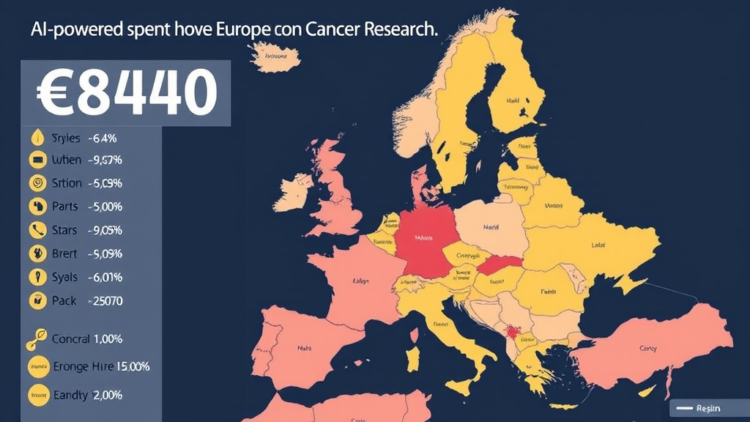
The study, conducted by Antonio Puertas Gallardo and Magdalena Stepien of the European Commission’s Joint Research Centre in Ispra, Italy, together with Antonino Brunetto of ARHS Developments Italia in Milan, examined 102 projects funded under Horizon Europe, the EU4Health programme, and the Digital Europe Programme. Together, these initiatives represent a combined investment of more than 840 million euros dedicated to understanding, detecting, treating and preventing cancer. The work is significant not merely for its headline figures but for its methodology, which demonstrates how modern artificial intelligence tools can bring order to the sprawling, fragmented record of publicly funded research.
The researchers employed a combination of quantitative and qualitative methods to characterise the funding landscape and identify patterns within it. The centrepiece of their approach was the application of large language model methodology to assign standardised keywords to each project in the portfolio. This was no trivial task. EU-funded cancer projects span an enormous range of activities, from laboratory-based investigations of tumour biology to public health campaigns and the construction of digital infrastructure for sharing clinical data. Without a common vocabulary, comparing projects across different programmes and directorates-general becomes nearly impossible, and opportunities for synergy go unnoticed.
By using large language models to read and classify project descriptions, the team developed a set of 56 standardised keywords capable of clustering the 102 projects into coherent thematic groups. This keyword framework allowed the researchers to identify synergies and thematic interconnections among cancer-related initiatives that would otherwise remain buried in separate databases and reporting formats. The most frequent terms to emerge from this analysis related to healthcare, policy and guidance, and digital aspects, reflecting the fact that EU cancer funding is not confined to the bench but extends deep into health systems, regulation and technology.
The thematic findings offer a revealing snapshot of European priorities. Most of the funded projects concentrated on diagnosis, treatment and prevention, the three pillars of clinical oncology. When the analysis turned to specific cancer types, colorectal and breast cancers emerged as the most common areas of focus, a pattern consistent with their status as two of the most frequently diagnosed malignancies in Europe and with the existence of dedicated screening programmes across many member states. The prominence of digital keywords underscores how thoroughly data science, artificial intelligence and e-health technologies have penetrated the cancer research agenda, from computational pathology platforms to federated networks for sharing sensitive patient information.
Equally striking were the geographic patterns the analysis uncovered. Institutions from larger western and southern European countries proved to be the most active participants in EU cancer funding, dominating both the coordination of projects and participation more broadly. Distinct collaboration networks between specific institutions were identified, revealing clusters of organisations that repeatedly join forces across successive funding calls. These networks represent a form of institutional capital that is invisible in simple funding statistics but crucial to understanding how European research capacity is actually organised and reproduced over time.
Perhaps the most politically consequential finding concerns the relationship between national characteristics and funding success. The study found that countries with larger populations were involved in a greater number of projects, but that countries with a higher gross domestic product per capita were not. In other words, wealth per citizen does not predict engagement with EU cancer funding, but sheer demographic weight does. This distinction matters for ongoing debates about the equity of EU research funding. Smaller member states have long voiced concerns that framework programmes disproportionately reward large, well-established research systems, and this analysis provides granular evidence with which such concerns can now be assessed and, potentially, addressed through targeted policy interventions.
The technical achievement underlying these findings deserves attention in its own right. Assigning standardised keywords to research projects has traditionally been a labour-intensive exercise requiring expert panels to read and code hundreds of project abstracts, a process that is slow, expensive and difficult to reproduce. Large language models, by contrast, can process project descriptions at scale and apply a consistent classification scheme, making it feasible to update the mapping continuously as new projects are funded. The authors’ use of this technology within an official Commission analysis signals a broader shift in how public administrations may approach evidence-based policymaking, treating the text of research proposals and reports not as administrative residue but as analysable data.
The practical implications extend beyond academic interest. The European Commission’s cancer projects tool, which provided the data for this study, is designed to give policymakers, researchers and the public a transparent view of EU cancer funding. By demonstrating how the tool’s contents can be systematically analysed, the authors have laid what they describe as the foundation for more strategic planning of EU cancer funding. Identifying thematic clusters makes it possible to spot both overcrowded areas, where additional investment may yield diminishing returns, and neglected ones, where gaps in the portfolio may warrant attention in future work programmes. Mapping collaboration networks similarly allows funders to see which institutions are consistently included and which remain on the margins of European cancer research.
The study arrives at a moment when Europe’s ambition to reduce the cancer burden is codified in policy initiatives spanning research, health systems and digital infrastructure. What this analysis makes clear is that ambition is backed by substantial and traceable resources: more than 840 million euros distributed across 102 projects spanning three complementary programmes. What it also makes clear is that the distribution of those resources follows identifiable structural patterns, shaped by population size, institutional networks and thematic fashion. By making those patterns visible, the Joint Research Centre team has transformed a collection of individual project records into a strategic instrument, one that could help ensure that the next generation of European cancer funding is planned not by habit or accident, but by design.
Subject of Research: Analysis of European Union cancer research funding across Horizon Europe, EU4Health and the Digital Europe Programme
Article Title: Unveiling European cancer funding: insights from the European Commission’s cancer projects tool
Article References: Puertas Gallardo, A., Brunetto, A., & Stepien, M. (2026). Unveiling European cancer funding: insights from the European Commission’s cancer projects tool. Health Research Policy and Systems. https://doi.org/10.1186/s12961-026-01535-9
Image Credits: AI Generated
DOI: 10.1186/s12961-026-01535-9
Keywords: cancer funding, Horizon Europe, EU4Health, Digital Europe Programme, large language models, European Commission, Joint Research Centre, cancer policy, research collaboration, colorectal cancer, breast cancer, health research policy
Cite Scienmag News
APA
MLA
Chicago
Copy citation
Download RIS
Tags: AI mapping of EU cancer initiativesAI-driven analysis of cancer research fundingallocation of €840 million for cancer researchbreast cancercancer fundingcancer policyColorectal cancerDigital Europe ProgrammeDigital Europe Programme cancer investmentsEU health research policyEU4HealthEU4Health cancer funding programsEuropean CommissionEuropean Commission cancer project trackingEuropean Union cancer research funding analysishealth research policyHorizon EuropeHorizon Europe cancer projectsimpact of AI on health research mappingJoint Research Centrelarge language modelsregional distribution of cancer research investmentsresearch collaborationtransparency in EU cancer research funding

