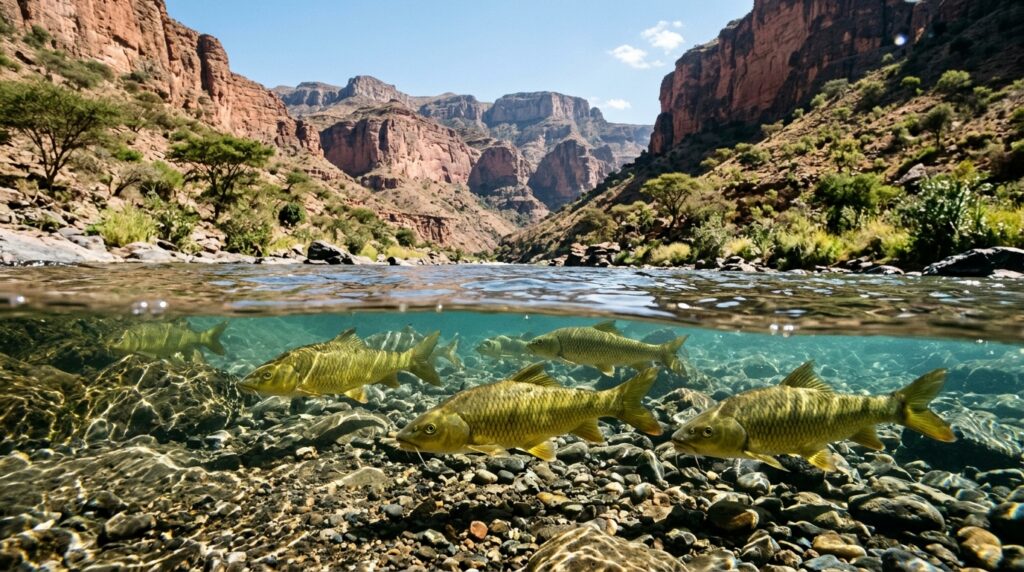
Researchers have documented the fish community structures of four rivers in the Tekeze sub-basin of Tigray, northern Ethiopia, revealing that altitude and associated environmental gradients are primary drivers of species composition and diversity. Published in Discover Life in June 2026, the study by Solomon Tesfay, Mekonen Teferi, and Belay Gebreyohannes provides the first comprehensive assessment of fish diversity and distribution in these specific highland and lowland river systems. The findings highlight a distinct ecological pattern where lower-altitude rivers support significantly higher fish species richness compared to their highland counterparts, a trend attributed to variations in water temperature, conductivity, and turbidity.
The investigation focused on the Atsela, Mesgi, Geba, and Worie rivers, which collectively represent a broad ecological gradient ranging from cold highland environments to warm lowland systems. These rivers flow predominantly from east to west and drain into the Tekeze River system, which ultimately joins the White Nile in Sudan. The study sites spanned elevations from approximately 1,357 to 1,553 meters above sea level, capturing diverse environmental conditions within the basin.
To assess the fish communities, the research team employed standardized electrofishing protocols using the depletion sampling technique, also known as the Zippin method. Sampling was conducted during two distinct seasons: the cold-dry season in November and December 2019, and the hot-dry season in March and April 2020. Each river included four sampling sites, each containing at least two microhabitats such as pools, riffles, and runs. Fish specimens were identified in the field using taxonomic keys, with unidentified specimens preserved in buffered formalin for validation at the Mekelle University Fishery and Aquatic Ecology Laboratory.
Concurrent with fish sampling, physico-chemical parameters were measured to characterize water quality and habitat conditions. These parameters included water temperature, dissolved oxygen, pH, electrical conductivity, turbidity, and chlorophyll-a concentrations. The measurements revealed significant variations among the rivers, with lower-altitude rivers like Geba and Worie exhibiting higher temperatures, conductivity, and turbidity compared to the highland rivers Atsela and Mesgi. The average water temperature ranged from 17.8 ± 2.6 °C in Atsela to 31.75 ± 1.8 °C in Geba, reflecting the strong influence of altitude on thermal conditions.
A total of 2,917 fish belonging to 14 species across four families and three orders were recorded during the study. The family Cyprinidae dominated the catch, accounting for 79% of the species richness and nearly 100% of the individuals in the highland rivers Atsela and Mesgi. Only two species, Garra blanfordii and Garra dembecha, were common to all four rivers, indicating limited faunal overlap between the highland and lowland systems.
Species abundance and relative dominance varied markedly across the river systems. In the Worie River, Garra blanfordii and Labeobarbus intermedius were the most abundant species, each comprising approximately 40% of the catch. In the Geba River, Labeobarbus intermedius was the dominant species, accounting for 54.4% of individuals, followed by Garra blanfordii at 27.2%. The highland rivers showed a different pattern, with Garra dembecha dominating in Mesgi (68.1%) and Garra blanfordii in Atsela (69.1%).
Multivariate analysis using Canonical Correspondence Analysis (CCA) demonstrated that altitude was the most significant factor determining fish species distribution and community structure. The CCA axes explained 65.7% of the variation in environmental variables and fish abundance. Axis 1 was strongly associated with turbidity, salinity, and electrical conductivity, while being negatively correlated with altitude and water transparency. Species such as Labeobarbus intermedius, Clarias gariepinus, and Labeo forskalii were positively associated with this axis, indicating a preference for the warmer, more turbid conditions found in lower-altitude rivers. Conversely, Garra blanfordii and Garra dembecha were negatively associated with Axis 1, aligning with their dominance in the cooler, clearer highland streams.
The study also noted seasonal variations in fish abundance and species richness. The total fish abundance was nearly twice as high in April as in December across all rivers. This seasonal difference may be attributed to hydrological changes, such as higher water levels in December creating a larger distribution area for fish, whereas reduced flow in April restricts fish to pools, making them more susceptible to capture. Additionally, the composition of fish in Worie and Geba increased in April, with species such as Chiloglanis niloticus and Oreochromis niloticus appearing only during this period, suggesting that seasonal environmental shifts may influence the presence of certain species.
The findings underscore the ecological and socioeconomic importance of these river systems, which support diverse fish communities that contribute to local food security and livelihoods. The researchers emphasized that lower-altitude rivers, while supporting higher fish diversity, are also more susceptible to human impacts such as water extraction for irrigation and sand mining. These activities can alter water levels and quality, potentially disrupting fish spawning, feeding, and growth activities. The study recommends targeted conservation strategies and proper management of riparian areas to protect the biodiversity of these vulnerable ecosystems.
Limitations of the study include the fact that sampling did not cover the entire length of the rivers from headwaters to their confluences, which may limit the generalizability of the findings to the full basin scale. The researchers recommend further studies in multiple sections and stretches of the rivers to provide a more comprehensive understanding of fish community dynamics. Additionally, while the study identified several species not previously reported in the region, such as Chiloglanis niloticus and Chelaethiops bibie, the taxonomic identification of some specimens relied on limited local resources, highlighting the need for continued taxonomic research in Ethiopian freshwater systems.
The research addresses a substantial knowledge deficit regarding riverine fish ecology in Ethiopia, a nation frequently characterized as the water tower of Eastern Africa. Across the country, roughly 7,400 square kilometers of lake surface and 7,000 kilometers of rivers sustain over 200 fish species. Ethiopia’s waterways encompass three major drainage systems flowing toward the Nile Basin, the Rift Valley, and the Indian Ocean. Despite this extensive aquatic geography, domestic fishery development relies solely on inland waters, harvesting less than 38 percent of an estimated annual potential of 51,481 tonnes. While commercial harvests have expanded from Lake Tana and the Tekeze reservoir, riverine fish communities remain poorly documented, making targeted baseline surveys essential for managing regional biodiversity and supporting escalating local protein demands.
To collect ecological data, the investigators selected study sites based on stream fordability and accessibility while accounting for flow velocity, depth, channel width, sediment characteristics, and livestock disturbances. Electrofishing transects of 50 to 100 meters were sampled through two five-minute runs separated by 20-minute rest intervals across distinct microhabitats, encompassing scoured deep pools, turbulent shallow riffles over gravel and cobble, and calm deeper runs. In situ water conditions were quantified using specialized equipment, including a 6-centimeter diameter Snell tube for transparency, a field fluorometer for turbidity and chlorophyll-a concentrations, and portable meters for dissolved oxygen, pH, and conductivity. Community diversity was subsequently evaluated using PAST-3 software through the Shannon diversity index.
Catch numbers and species richness varied markedly across elevation gradients. The highland Mesgi River yielded 1,250 individual fish representing only two species, while the Atsela River produced 838 individuals across three species. In contrast, the lowland systems supported lower individual numbers but richer assemblages, with Geba yielding 261 fish across nine species and Worie producing 568 fish across 11 species. Physicochemical measurements showed dissolved oxygen concentrations between 4.8 and 10.5 milligrams per liter, while pH values fell below 7 across all systems. Electrical conductivity averaged 0.39 millisiemens per centimeter in Worie and 0.40 millisiemens per centimeter in Geba, reflecting higher solute concentrations in warmer downstream reaches. Seasonal dynamics also altered catches, with species such as Garra dembeensis and Garra geba recorded in Geba during December but absent during April sampling.
The surveyed assemblages integrate diverse biogeographical elements, uniting East African taxa like Labeobarbus intermedius and Oreochromis niloticus with Nilo-Sudanic species including Labeo forskalii. Taxonomic evaluations identified distinctive diagnostic features among newly recorded regional fishes: Chiloglanis niloticus exhibited a specialized sucker-like mouth with a papillose circular lip, while Chelaethiops bibie, a small cyprinid, presented characteristic branched anal fin rays. When compared with the neighboring Tekeze Reservoir, which previously documented between 10 and 15 fish species, the river survey revealed critical community differences.
Multivariate analysis untangled the environmental factors structuring these fish assemblages, with the first two canonical axes explaining 65.7 percent of cumulative variation. Axis 1, accounting for 50.2 percent of variation, aligned with turbidity, salinity, depth, and conductivity, while opposing altitude and water transparency. Axis 2 represented 15.5 percent of variation, positively associating with altitude. Species ordination positioned Garra blanfordii positively alongside altitude, whereas Garra dembecha and Garra ignestii showed negative associations across both axes.
Subject of Research: Fish community composition and environmental drivers in Tekeze sub-basin rivers, Ethiopia
Article Title: The composition of fish communities of four Tekeze sub-basin rivers of Tigray, Northern Ethiopia
Article References: Tesfay, S., Teferi, M., & Gebreyohannes, B. (2026). The composition of fish communities of four Tekeze sub-basin rivers of Tigray, Northern Ethiopia. Discover Life, 56(1), Article 20. https://doi.org/10.1007/s11084-026-09739-3
Image Credits: AI Generated
DOI: 10.1007/s11084-026-09739-3
Keywords: freshwater ecology, fish diversity, Tekeze basin, Ethiopia, river conservation, environmental gradients, electrofishing, species richness, highland rivers, lowland rivers, composition, fish