The global biopharma industry is placing increasing importance on regional support rather than only centralized expertise to help complex programs advance. A key benefit is access to local expertise in or near their time zone.
The localization movement “is part of a global shift [in which] companies are assessing how they balance cost, quality, and risks across regions rather than relying on any single market,” Jessay Devassy, PhD, global R&D director, Ecolab Life Sciences, tells GEN.
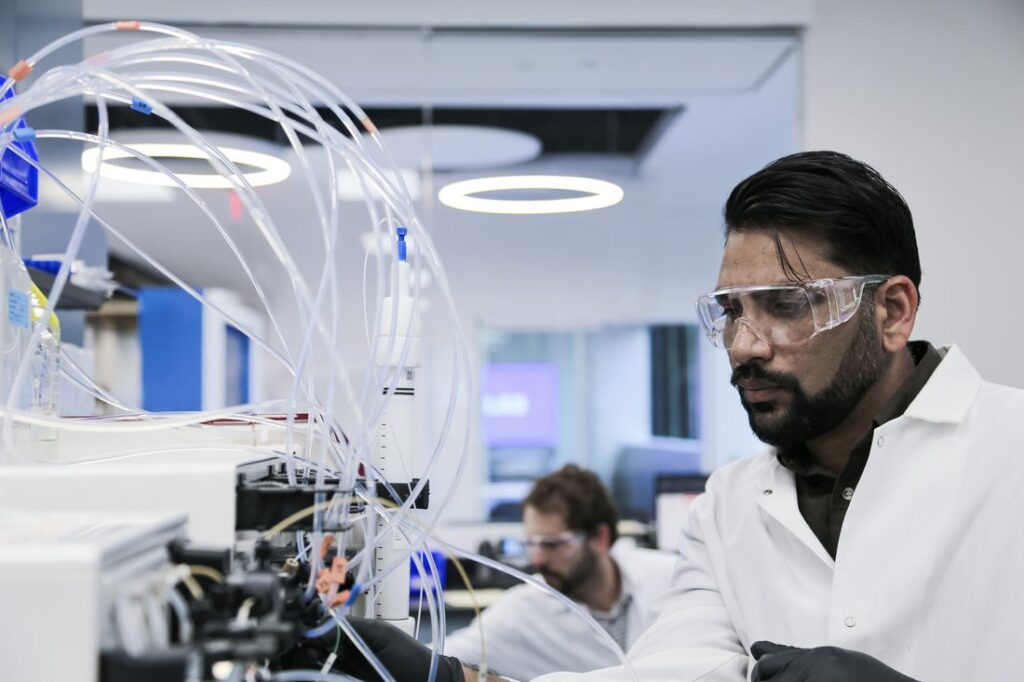
Ecolab opened a bioprocessing applications lab in Korea this spring. “Being in Korea allows the exchange of ideas in an iterative fashion…so knowledge moves seamlessly between regions. That’s much easier if you’re in their proximity,” Devassy points out.
This is the company’s first bioprocessing lab in Asia. Situated in Dongtan, Korea, it supports process development studies from early- to commercial-scale, focusing on biologics’ downstream purification.
Korea was a logical choice. “Korea is highly advanced in manufacturing,” Devassy continues. Now it’s evolving from a manufacturing hub to a comprehensive biopharma ecosystem, with active contributions from R&D all the way through clinical development, with home-grown and multinational companies alike.
With its biologics manufacturing history, “I think Korea has become one of the most trusted locations globally,” he says. “Its quality standards are well-aligned with North American and European standards.” Consequently, global clients are assured that the same approaches and standards are applied to development as in the United States or Europe.
Korea’s aspirations
Government support is part of that. The Korean government designated biopharma as a strategic industry after COVID-19 and reiterated that goal in 2023’s Third Five-year Comprehensive Plan for Development and Support for the Bio-Pharmaceutical Industry. Key points include developing two blockbuster drugs by 2027, doubling pharmaceutical exports to $16 billion, and positioning Korea among the top six nations for pharmaceutical development.
At the end of 2025:
- New venture capital investments in biotech and medical companies reached $830 million, up approximately 11% from the prior year.
- Total venture investments in the biotech and medical sector rose more than 29% from 2024, more than for any other industry.
- Continuous bioprocessing is expected to experience a compound annual growth rate of nearly 20% between 2025 and 2030, reaching revenues exceeding $21 million.
Challenges
The competition to attract biopharma companies is robust. India is the fastest-growing Asia-Pacific market, but, Devassy says, “China has a cost advantage…[in] manufacturing and development.” It’s also the largest biopharma market in the Asia-Pacific region.
“Japan has more established domestic systems for biomanufacturing,” Devassy continues. According to Grand View Horizon, Japan leads the pack for projected revenue from continuous bioprocessing to 2030.
Devassy positions Korea “somewhere in between” China and Japan. “It’s strong technically, but is still navigating regulatory complexity and global competition.” Currently, it generates 2.2% of the world’s continuous bioprocessing revenues.
“Biopharma exports from Korea have seen strong growth recently…and Ecolab is playing a strong part in supporting the manufacturers behind that growth,” Devassy says. “This is our first step toward making our global expertise accessible to growing markets in Asia.”