
European biotechs presented a range of interesting technologies and novel therapeutic biotechs at the recent BioTrinity conference, organized by BioUK, formerly OBN. The meeting highlighted a spectrum of cell and protein-based therapies, as well as novel delivery methods, with eye-catching investments and partnering opportunities.
One of the stand-out technologies discussed by U.K.-based University of Southampton spin-out Renovos Biologics was the use of synthetic nanoclays. However, these are not being used for their traditional application of controlling drug release, but rather, for medical delivery. According to Agnieszka Janeczek, PhD, “We are developing an injectable, biodegradable nanoclay for use with bone morphogenetic protein 2 (BMP-2), a crucial growth factor in bone regeneration. We intend to use this on patients who have had spinal fusions after trauma or sports injuries.”
Current treatments to encourage bone growth after spinal fusion, such as BMP-2 in its current formulations, are poorly retained around the spine, causing inflammation or, worse, bone growth outside the spine. This often leads to patients needing revision surgery at a cost of up to $50,000. “BMP-2 was used around fusions in the cervical spine, but the growth of bone and inflammation caused some patients to develop breathing difficulties and has resulted in a black box warning against using BMP-2 for this application,” noted Janeczek.
To overcome these issues, the company has developed a synthetic nanoclay that provides a localized environment conducive to cell infiltration. The nanoclay retains the BMP-2 bioactive molecule until newly regenerated tissue gradually replaces it.
“We have used RENOVITE® with BMP-2 so that this protein is injectable with a 23-gauge needle to deliver BMP-2 in a gel to allow precise templating of new bone formation, and therefore safer and more efficient bone fusion,” she continued. “Using our nanoclay, we see better quality bone growth as the bone grows evenly around and through the fusion, unlike BMP-2 on its own, which can sometimes initiate bone growth around the fusion to create an eggshell effect with bone only on the outside.”
The Renovos nanoclay retains the BMP-2 protein more readily around the fusion. As a result, it is possible to administer BMP-2 in a lower dosage, giving it the potential benefit of use in lower-cost markets, said Janeczek, and concluded that “Twenty-one percent of lumbar fusions are in patients that are younger than 45 years old, and the market for bone fusion could be worth $24.5 billion by 2035. Our lead asset RENOVITE BMP-2 will enter first-in-human trials by 2027, and we welcome investment to help assess this game-changing product in the clinic.”
Patching up wounds
Thomas Hafner, CEO of Onya Therapeutics, based in Ebbw Vale, U.K., stated that “For 25 years, wound care has been an innovation desert because therapies are difficult to scale and are not easy to adapt. This is not a glamorous area, but it is a massive opportunity.”
To address this issue, several companies are developing devices, artificial skin, or anti-microbials. Others are developing sponges for managing exuding wounds, making them thicker for better absorption. As Hafner pointed out, they are doing this without asking, “Is this the right approach? “Wound care is a massive problem. For example, 30% of patients with diabetic foot ulcers will lose a limb within five years. Globally, there are triple the number of patients with chronic wounds as there are with cancer—wound care is a $400 billion crisis in plain sight.”
Currently, with wound care, 90% of the costs are for the labor to manage the wound and only 6% for the products themselves. To address this, Onya says it is developing a treatment that could collapse the 90% costs of wound management by accelerating healing. The company calls it active exudate therapy.
“In chronic wounds, the amount of exudate increases, and so instead of mopping up the exudate with dressings, we have found a way of turning off the tap. By doing this, we encourage healing and reduce amputations, potentially saving billions of dollars,” Hafner noted.
Onya, which closed a £2.6 million seed financing round in 2025, is utilizing a compound known as OTX-PP01, based on potassium permanganate, a molecule with long-established clinical safety and broad antimicrobial and astringent action. This compound is delivered via a patch. “Unlike other wound management treatments, we don’t absorb the fluid; instead, our OTX-PP01 patch supports reduction of excessive exudate by addressing chronic inflammation, and creating the conditions for healing to restart,” said Hafner.
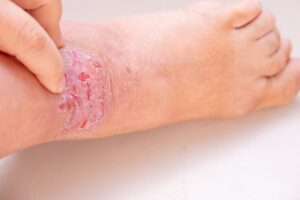
The compound does this in two ways: first, it targets exudate with an astringent action that can reduce excessive wound fluid at the source, targeting the inflammatory cycle that can stall healing. Second, it addresses inflammation using a broad-spectrum antimicrobial action targeting pathogens through oxidation.
“OTX-PP01 is not a new molecule. It has over 150 years of safe clinical use, but the delivery method is new,” explained Hafner. “The patch is easy to fit, and a nurse can put it on the wound and leave it on for 15 minutes for the compound to absorb and do its job of healing. After removing the patch, a nurse can then redress the wound.”
Onya has designed its OTX-PP01 patch product to treat diabetic foot ulcers, venous leg ulcers, and pressure ulcers. It does not have to undertake Phase I studies as these were waived based on the established safety profile of the active compound. “We have a Phase II/III adaptive trial design, which we hope to complete in the next four to five years. Our aim with OTX-PP01 is to transform wound management to wound healing,” said Hafner.
Eyes on the prize
Therapies for treating ophthalmic diseases were also noteworthy at BioTrinity, with StemSight and Link Biologics presenting data on their promising clinical candidates. StemSight, based in Tampere, Finland, is a biotech company spun out from Tampere University. The firm is developing off-the-shelf induced pluripotent stem cell (iPSC) therapies to cure corneal blindness.
According to Laura Koivusalo, PhD, CEO and founder of StemSight, the market value of regenerative medicine products across a variety of indications was $63 billion in 2026. However, the bottleneck for making these therapies widely available is manufacturing and scaleup. Koivusalo said that “Recently in Japan, the first iPSC treatments have been approved for use, and the advantage of using iPSCs combined with biomaterials is that they provide efficient and durable therapies.”
Her company is developing a therapy to treat limbal stem cell deficiency (LSCD), a rare disease that causes blurry vision due to corneal epithelium loss and eventually blindness. There are over 240,000 sufferers worldwide, and there are currently no treatments for this condition available for most patients.
“The only treatment option for LSCD is available only to patients with one healthy eye,” Koivusalo explained. “Scientists can harvest limbal stem cells from the healthy eye and transplant them into the diseased one to restore the damaged surface cells. The therapy proves that the cell transplantation approach works, but this is a personalized autologous treatment. Additionally, if both eyes have LSCD, and the patient is truly blind, this treatment is not possible as there are no healthy stem cells available to harvest. That’s where the high value of cure is really measured.”
StemSight is developing an allogenic limbal stem cell therapy, which uses gene-edited iPSCs to reduce immunogenicity. Currently, the firm can produce one hundred patient doses per batch using a GMP-compliant process. It then freezes these cells until their delivery on a biomaterial carrier for patients.

“Our process produces high-quality stem cells for a low cost of goods,” continued Koivusalo. “We are currently in late preclinical development with our lead product, STE-101, and have shown that we can regenerate corneal epithelium in rodent models using imaging and histology. These are objective measures of efficacy, as we cannot ask rodents if they can read a chart.”
StemSight is aiming to treat ten patients in a Phase I/II study starting early 2028.
Unlike StemSight, Link Biologics, a U.K.-based spin-out from the University of Manchester, is developing first-in-class biologics to treat Dry Eye Disease (DED) and Wet Age-related Macular Degeneration (AMD). The firm is developing therapies based on TSG-6 (Tumor Necrosis Factor-α-Stimulated Gene/Protein-6), a secreted glycoprotein that has an endogenous role to protect tissues from inflammatory damage and promote repair. Link’s TSG-6-based therapies have enhanced activities compared to the native protein and thus have a unique combination of anti-inflammatory, tissue-protective, and tissue-reparative properties.
Reuben Dawkins, CEO and co-founder of Link Biologics, stated that “We are using these protein biologics to treat DED and wet AMD because these are billion-dollar markets where there are limited treatment options available. Current standard of care for DED, for example, involves cyclosporine, which has a 15% response rate, or Xiidra, where 50% of pivotal trials did not show improvement in key efficacy measures vs no treatment. Overall, nine in ten DED patients stop using their initial medication within one year.”
The company’s lead candidate, LB001, is in preclinical development for the treatment of DED. Dawkins presented data to show that in mouse models, twice daily administration of LB001 for seven days reduced corneal epithelial damage and suppressed inflammatory markers compared to a branded cyclosporine (Restasis).
“Unlike other treatments, LB001 has a dual tissue-repair and anti-inflammatory action which may make this molecule more effective than current therapies,” noted Dawkins. “We have completed CMC so are able to manufacture LB001 to GMP standards, and it is stable as an eye drop formulation. We will be taking LB001 into a 180-patient Phase I/II clinical trial, which we aim to commence in 2027.”
Sue Pearson, PhD, is a freelance writer based in the U.K.