In the rapidly evolving realm of artificial intelligence and deep learning, conventional electronic computing architectures are increasingly strained by the demands of large-scale data processing and intricate computational tasks. Optical computing has risen as a compelling alternative, leveraging the inherent physical phenomena of light—such as interference and diffraction—to execute computations fundamentally differently from traditional electronics. By harnessing these optical effects, optical computing systems (OCS) promise unparalleled advantages: notably superior processing speeds, heightened energy efficiency, and a natural aptitude for massive parallelism. These attributes make optical computing especially attractive for intensive applications like image processing, machine learning, and big data analytics, holding transformative potential across these domains.
Yet, despite these promising characteristics, contemporary optical computing platforms grapple with a significant bottleneck rooted in their hardware-centric development workflows. Conventionally, researchers must directly engage with physical OCS hardware to develop, tune, and validate computational tasks. This process entails sequential access to a limited number of costly and often heavily utilized devices. Users must physically occupy the system to load parameters, fine-tune configurations, and iteratively calibrate the hardware—an intrinsically tedious and time-consuming cycle. Each new user or task demands resetting the system state, leading to protracted queues, repetitive adjustments, and redundant calibrations. The resulting workflows impose long hours of equipment occupation and elevated trial-and-error expenses, stifling the possibility for concurrent task development and drastically curtailing research throughput and system agility.
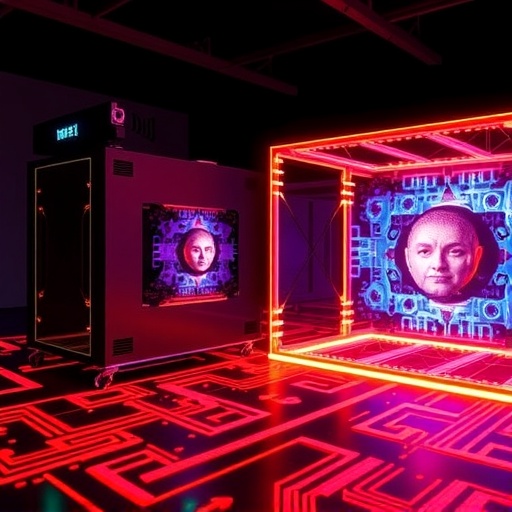
To surmount these entrenched challenges, cutting-edge research has introduced the concept of the Digital Twin Optical Computing System (DT-OCS). This innovative approach establishes a high-fidelity digital replica—a “digital twin”—of the physical OCS that accurately models its input-output behavior under varying configuration parameters. Crucially, the digital twin allows researchers to perform extensive offline simulations, training, and optimization without the constraints of physical hardware availability. Analogous to a digital simulator software that mirrors a complex “real machine,” DT-OCS enables extensive task development and parameter tuning within a virtual environment, dramatically decoupling software development from hardware dependency. Consequently, optimized parameters validated digitally can be seamlessly transferred back to the physical system for deployment, bypassing numerous iterative hardware trials.
The implications of DT-OCS extend well beyond mere time savings. By effectively creating a “digital development toolkit” for optical computing, this framework revolutionizes the research ecosystem—transforming optical computing platforms from isolated, hardware-bound experiments to versatile, shareable research infrastructures. Researchers can now conduct task training, performance benchmarking, and method comparisons entirely within a unified digital realm, fostering collaborative innovation. Distinguished from legacy OCS paradigms, DT-OCS supports parallel task development workflows, allowing multiple computational problems to be advanced simultaneously without hardware conflicts. This capability markedly enhances flexibility, reduces development bottlenecks, and accelerates the maturation and practical adoption of optical computing technologies.
Envisioning the trajectory of optical computing, the integration of digital twin models with physical hardware appears indispensable. Contemporary transportation systems, for instance, benefit from the synergy between tangible road networks and dynamic digital mapping platforms. Similarly, next-generation optical computing platforms should embody dual representations: a robust physical computing infrastructure supplemented by perpetually updated digital twins. This paradigm champions accessibility, reproducibility, and scalability—cornerstones for fostering broad-scale collaboration. It paves the way for unified validation standards and equitable performance comparisons, catalyzing optical computing’s evolution into a general-purpose, widely deployable resource rather than a niche experimental setup.
The DT-OCS framework’s hallmark is its strategic decoupling of task development from hardware constraints. In traditional optical computing, task training and parameter fine-tuning necessitate iterative hardware engagements involving adjustments, diagnostics, and recalibrations. This approach encumbers the process with inefficiencies and precludes simultaneous multi-task development. DT-OCS obviates these impediments by faithfully modeling the physical system’s responses across parameter spectra, enabling exhaustive offline optimization. This digital-first workflow increases research agility, minimizes hardware occupancy, and substantially compresses the development timeline. Consequently, DT-OCS amplifies the throughput and adaptability of optical computing research endeavors.
The real-world efficacy of the DT-OCS framework has been experimentally validated using a cutting-edge high-speed optical computing system incorporating silicon photonic feature-computing chips. These empirical studies demonstrated DT-OCS applications in diverse computational domains, including image classification and sequential decision-making. Notably, configurations optimized within the digital twin translated flawlessly to the physical hardware, with observed task performance closely mirroring digital forecasts. This underscores not only the high fidelity of the DT-OCS model but also its robust transferability across practical scenarios. Moreover, by enabling parallel task development within the digital domain, DT-OCS expedites the overall research workflow, markedly elevating efficiency.
An illustrative application of the DT-OCS system involved offline training and deployment for the Fashion-MNIST image classification task—a benchmark dataset widely used in machine learning. This practical demonstration affirms DT-OCS’s capacity to bridge digital model development with real-world optical computing implementations. Beyond efficiency gains, DT-OCS signifies a conceptual shift toward disentangling computational task design from the idiosyncrasies of physical system constraints. Historically, optical computing research has been hamstrung by its dependence on specific hardware platforms and accessibility limitations, hindering reproducibility and cross-task comparisons. The introduction of an open-source digital twin framework surmounts these barriers by democratizing access and standardizing evaluation protocols.
By openly releasing the DT-OCS framework alongside associated task datasets, the research fosters a community-driven ecosystem where software-based task design, training, and validation can proceed independently of physical system constraints. This openness engenders scalability, reproducibility, and collaborative potential that traditional optical computing architectures cannot easily achieve. Researchers worldwide gain the freedom to explore broader task horizons, perform comprehensive benchmarking, and validate innovative approaches within a consistent computational substrate. Such a paradigm shift propels optical computing from isolated experimental configurations into accessible and extensible platforms, expediting technological advancements and practical deployments.
This pioneering work advocates a transformative application paradigm for optical computing platforms: the symbiotic coexistence of physical hardware and computationally equivalent open-source digital twin models. Only by embracing such dual-system architectures can the field transcend limitations imposed by experimental variability and hardware scarcity. The resultant platforms will be shareable, replicable, and adaptable to a diverse array of research challenges. As optical computing moves towards becoming a mainstream computational resource, the principles embodied by DT-OCS may well establish the foundational infrastructure that underpins scalable, collaborative innovation in photonic information processing.
Subject of Research: Not applicable
Article Title: Digital twin optical computing system
News Publication Date: 21-Apr-2026
Web References:
DOI: 10.29026/oea.2026.250254
References:
DOI: 10.29026/oea.2026.250254
Image Credits: Dr. Tingzhao Fu from the National University of Defense Technology, China, and Dr. Hongwei Chen from Tsinghua University, China
Keywords
Artificial intelligence, Computer science, Photonics, Engineering, Machine learning, Computer modeling, Computer processing, Semiconductors, Optics, Applied optics
Tags: AI and deep learning hardwarebig data analytics with opticscalibration challenges in optical systemsdigital twin technology in computingenergy-efficient computation methodshardware bottlenecks in optical computinghigh-speed optical processorsmachine learning hardware accelerationoptical computing development workflowsoptical computing for image processingoptical computing systemsparallel processing with light