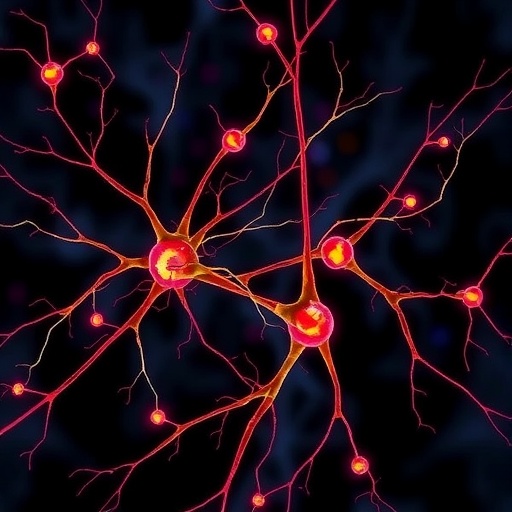
A groundbreaking study published in Nature Communications this year reveals a stunning new dimension to the intricate dialogue within our brain’s striatal region. Scientists have demonstrated that the synchronous activation of specific neurons known as striatal cholinergic interneurons triggers a localized release of serotonin, a pivotal neurotransmitter widely recognized for its role in mood regulation and cognitive functions. This discovery not only deepens our understanding of striatal neurochemistry but also paves the way for novel therapeutic strategies targeting neuropsychiatric disorders.
The striatum, an essential hub for motor control and reward processing, is densely populated with various neuronal subtypes, including the relatively rare but functionally crucial cholinergic interneurons. These cells, though constituting only a small percentage of striatal neurons, have long been appreciated for their modulatory influence on the network’s excitability and plasticity. Until now, the relationship between cholinergic activity and serotonergic signaling within the striatum remained elusive, mainly due to the technical challenges in dissecting these interactions in vivo.
Employing cutting-edge optogenetic techniques, Matityahu and colleagues achieved precise, synchronous stimulation of striatal cholinergic interneurons in animal models. This targeted activation led to a robust and rapid release of serotonin within the local microenvironment, a phenomenon previously undocumented. This coupling suggests a direct functional link whereby cholinergic interneurons can exert immediate control over serotonergic tone, fine-tuning striatal output in real time.
The research team utilized genetically encoded fluorescent sensors specific for serotonin, enabling them to visualize neurotransmitter dynamics with exceptional spatiotemporal resolution. Through this approach, the transient yet reproducible serotonin release following cholinergic neuron firing was clearly captured, validating the hypothesized interaction between these two neuromodulatory systems. Such precise measurement tools are revolutionizing neuroscience by illuminating the interplay between distinct chemical messengers as never before.
These findings carry profound implications for our broader understanding of brain function. Serotonin is known to modulate mood, cognition, and reward, and its dysregulation underlies a spectrum of psychiatric conditions including depression, anxiety, and addiction. By uncovering that cholinergic interneurons can swiftly instigate serotonin release locally within the striatum, this study highlights a potential pathway by which neural circuits integrate diverse neurochemical signals to shape behavioral outcomes.
Moreover, this revelation challenges the traditional view that serotonin release in the striatum primarily originates from distal serotonergic neuron projections originating in the raphe nuclei of the brainstem. Instead, it reveals a more nuanced mechanism where local interneurons directly participate in regulating serotonergic tone, adding a layer of complexity to the synaptic architecture of the striatum. This paradigm shift carries significant weight for both basic neuroscience and clinical translational research.
By expanding our mechanistic understanding of striatal circuitry, this research offers promising avenues for drug development. Modulating cholinergic interneuron activity could represent a novel strategy to control serotonin levels locally, possibly allowing for more targeted treatments with fewer systemic side effects than current serotonergic drugs. Such precision therapies could revolutionize the management of neuropsychiatric disorders with striatal involvement.
The meticulous dissection of neuron-to-neuron communication in this study relied on combination methodologies integrating electrophysiology, optogenetics, and high-resolution fluorescence imaging. This multidisciplinary approach exemplifies the future of neuroscience, enabling the decoding of complex biochemical interactions fundamental to cognition and behavior. It also underscores the importance of technological innovation in unraveling brain mysteries.
Importantly, the authors explored the behavioral consequences of synchronous cholinergic interneuron activation. Their data indicate that induced serotonin release correlates with modifications in motor activity and reward-seeking behaviors, consistent with the striatum’s known functions. Such behavioral experiments are crucial, linking molecular discoveries to tangible effects, bridging the gap between bench science and real-world relevance.
The temporal precision of serotonin release following cholinergic neuron stimulation observed in this work also suggests a potential role in rapid adaptive responses. Unlike classical slow neuromodulation attributed to serotonin, this mechanism implies a capacity for swift neurochemical adjustments in reaction to salient stimuli. This dynamic ability may be critical for cognitive flexibility and emotional regulation, domains often impaired in mental health disorders.
In addition to serotonin, cholinergic interneurons are known to influence other neurotransmitter systems including dopamine and GABA. This study enriches the portrait of their multifaceted influence within the striatum, revealing cholinergic neurons as central conductors orchestrating a symphony of chemical signals. Understanding this network-level coordination will be essential to unraveling the pathophysiology of complex behaviors and diseases.
On the cellular signaling front, the mechanism underlying serotonin release triggered by cholinergic activation likely involves nicotinic acetylcholine receptors situated on serotonergic terminals or surrounding glia, facilitating neurotransmitter exocytosis. Further investigations into the molecular cascades mediating this release will be essential to dissect the precise regulatory checkpoints, enabling rational drug design targeting specific receptor subtypes or intracellular pathways.
This research also sparks intriguing questions about whether similar mechanisms operate in other brain regions where cholinergic and serotonergic systems converge. The possibility that local interneuron populations may modulate serotonergic tone elsewhere invites a broader reassessment of neurochemical integration across neural circuits, with ramifications for understanding global brain states such as arousal, attention, and mood.
In summary, the study by Matityahu et al. revolutionizes our conception of striatal neurotransmission, revealing that synchronous firing of cholinergic interneurons provokes a potent local release of serotonin. This discovery sheds light on the intricate neurochemical orchestration within the basal ganglia, opening new horizons for understanding brain function in health and disease. As the field progresses, unraveling these intricate neural dialogues promises to propel the development of innovative therapies targeting neuropsychiatric disorders with unprecedented precision.
This seminal advance reaffirms the relentless pursuit within neuroscience to untangle the brain’s complexity. By harnessing state-of-the-art tools to reveal hidden layers of cellular communication, researchers are poised to transform our approaches to mental health, providing hope for novel interventions that restore the delicate neurochemical balance underpinning human cognition and emotion.
Subject of Research: Neural mechanisms underlying neurotransmitter release in the striatum, focusing on the interaction between cholinergic interneurons and serotonergic signaling.
Article Title: Synchronous activation of striatal cholinergic interneurons induces local serotonin release.
Article References:
Matityahu, L., Hobel, Z.B., Berkowitz, N. et al. Synchronous activation of striatal cholinergic interneurons induces local serotonin release.
Nat Commun 17, 2278 (2026). https://doi.org/10.1038/s41467-026-70359-6
Image Credits: AI Generated
DOI: https://doi.org/10.1038/s41467-026-70359-6
Tags: advances in brain optogenetics researchcholinergic interneurons and serotonin releaselocalized neurotransmitter release mechanismsneuron interaction in reward processingneuropsychiatric disorder therapeutic targetsneurotransmitter modulation in the brainoptogenetic stimulation of striatal neuronsserotonin role in mood regulationstriatal interneurons and cognitive functionstriatal neurochemistry and neurotransmissionstriatum function in motor controlsynchronous activation of cholinergic neurons