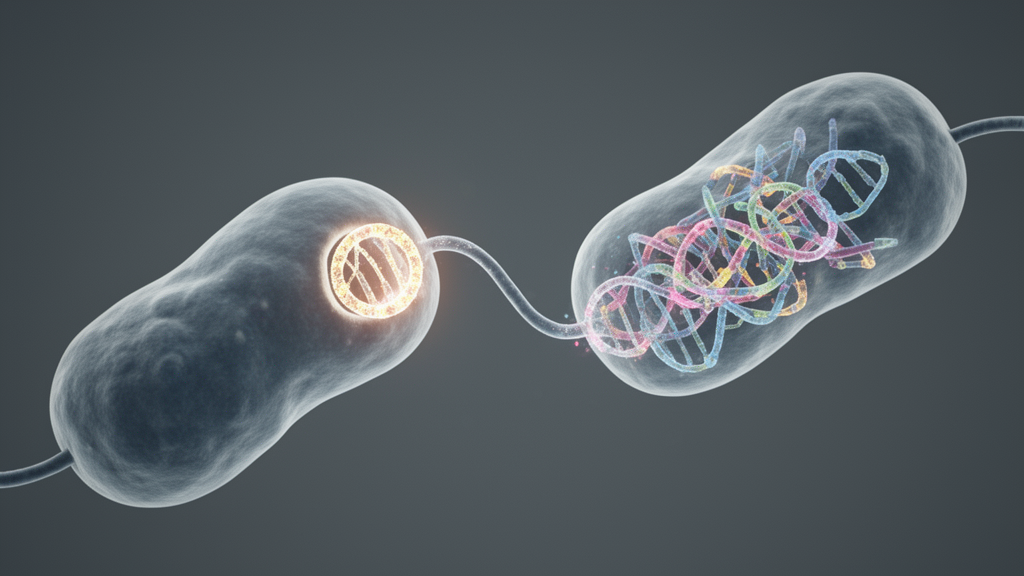
Transferring a plasmid carrying the colistin-resistance gene mcr-8.2 into two distinct Escherichia coli recipient backgrounds produces divergent RNA abundance profiles along with alterations in resident genetic content, according to an experimental study published in BMC Microbiology. The laboratory research investigated how the introduction of the same resistance-bearing plasmid influences cellular transcript levels and genomic structures across differing bacterial host environments.
The investigation centred on pXNCD19, a 95,080-base-pair donor plasmid that carries the colistin-resistance determinant mcr-8.2. The research team transferred this mobile element into two separate bacterial recipients: the standard laboratory strain E. coli C600 and the blaNDM-positive clinical strain TH2. This procedure generated two corresponding transconjugant strains, named CD19C and TH2C, allowing direct comparison of host responses to the acquisition of the donor plasmid.
To evaluate transcriptional alterations, the authors reanalysed twelve RNA sequencing libraries, representing three independently grown cultures per strain. The sequence reads were evaluated against recipient-specific composite references that incorporated the complete 95,080-base-pair donor plasmid sequence. Composite-reference mapping successfully detected mcr-8.2 RNA in all six transconjugant libraries, verifying the active transcription of the newly transferred resistance determinant across both bacterial recipient backgrounds.
Differential expression analysis revealed substantially different transcriptional patterns between the two recipient backgrounds. In CD19C compared to parental C600, researchers identified 312 recipient-reference loci displaying altered expression, with 143 loci showing higher RNA abundance and 169 loci showing lower RNA abundance. In contrast, the comparison between TH2C and parental TH2 identified 181 differentially expressed loci, with 21 loci exhibiting higher RNA abundance and 160 loci exhibiting lower RNA abundance.
The study also examined specific gene groups and statistical robustness within the dataset. Four of five plotted arn loci met the differential expression threshold in CD19C, though the Gene Ontology lipid A term did not survive statistical false-discovery correction. Single-sample removal analysis demonstrated that the overall direction of the primary RNA abundance differences was preserved, even though omitting individual samples altered the exact counts of loci meeting the significance threshold.
Whole-genome data comparisons between TH2 and TH2C demonstrated that observed reductions in RNA abundance were linked to physical DNA loss. A 113,338-base-pair IncHI1B-associated contig identified in TH2 showed near-zero relative DNA coverage in the TH2C transconjugant. Notably, 99 of the 160 loci that exhibited lower RNA abundance in TH2C mapped directly to this missing contig, whereas other major resident plasmid-associated sequences and the incoming mcr-8.2 element retained DNA support.
To contextualize their experimental findings, the researchers screened 7,930 public E. coli genome assemblies, which primarily contained the related resistance gene mcr-1.1. Analysis of this public dataset stratified by exact sequence type identified three KEGG Orthology detection associations. The authors concluded that pXNCD19 acquisition produced distinct RNA profiles in the two recipients alongside a resident genetic-content change in TH2C, highlighting the necessity of considering genetic-content changes when interpreting RNA abundance differences following plasmid transfer.
Subject of Research: RNA abundance and genetic content changes after mcr-8.2 plasmid acquisition in Escherichia coli
Article Title: RNA-abundance and genetic-content changes associated with acquisition of an mcr-8.2-carrying plasmid in two Escherichia coli recipient backgrounds
Article References: Nie, W., Tian, R., Xia, X., Xu, S., Xia, P., Zeng, T., Wang, R., Yue, Y., Chen, W., & Xia, L. (2026). RNA-abundance and genetic-content changes associated with acquisition of an mcr-8.2-carrying plasmid in two Escherichia coli recipient backgrounds. BMC Microbiology. https://doi.org/10.1186/s12866-026-05828-5
Image Credits: AI Generated
DOI: 10.1186/s12866-026-05828-5
Keywords: Escherichia coli, mcr-8.2, colistin resistance, plasmid transfer, pXNCD19, RNA sequencing, differential expression, C600, TH2, blaNDM, IncHI1B, arn loci, lipid A, whole genome sequencing, KEGG Orthology, mcr-1.1