Deep brain stimulation, a technique best known for quieting the tremors of Parkinson’s disease, is now being tested against one of medicine’s most stubborn phantom perceptions: tinnitus, the persistent ringing or buzzing in the ears that affects hundreds of millions of people worldwide. In a letter published in the Journal of Neurology, a team of Dutch clinicians and neuroscientists led by Shabnam Babakry and Marcus L. F. Janssen of Maastricht University Medical Centre reports two-year follow-up data on a small group of patients with severe, treatment-refractory tinnitus who received deep brain stimulation of the medial geniculate body, a tiny egg-shaped relay nucleus buried deep in the thalamus. The report represents one of the longest published observations of this audacious approach, and it offers a cautious but meaningful signal that the benefits observed in earlier short-term studies may endure over time.
Tinnitus is far more than an annoyance. According to a widely cited 2022 meta-analysis in JAMA Neurology, the condition affects roughly one in seven adults globally, and in a substantial minority of cases it becomes a debilitating, life-altering disorder associated with insomnia, anxiety, depression and, in the most severe cases, suicidal ideation. For the overwhelming majority of sufferers, management relies on sound therapy, hearing aids, counseling approaches such as cognitive behavioral therapy, and in some countries off-label medications. None of these eliminates the percept. When tinnitus resists every conventional option — the definition of refractory tinnitus — patients are left with few realistic prospects, which is precisely the clinical gap the Maastricht group set out to address with an intervention borrowed from functional neurosurgery.
The scientific rationale for targeting the medial geniculate body, often abbreviated MGB, rests on a modern understanding of tinnitus as a brain disorder rather than a purely ear disorder. While tinnitus frequently begins with cochlear damage — noise exposure, ototoxic drugs, infection or age-related hearing loss — the phantom sound is generated and sustained by maladaptive plasticity along the central auditory pathway. When the ear falls silent, neurons in the brainstem and thalamus that once responded to specific sound frequencies undergo compensatory changes: spontaneous firing rates increase, inhibitory control weakens, and neural representations of missing frequencies expand into neighboring channels. A landmark 2010 review by Roberts and colleagues in the Journal of Neuroscience described this cascade as the central nervous system “turning up its own gain” in response to lost input. The thalamus, which sits at the gateway between the ear and the auditory cortex, is considered a critical node in this pathological network, and the medial geniculate body in particular has been implicated in the thalamocortical dysrhythmia thought to underlie the conscious percept of ringing.
Surgical team, led by neurosurgeons Yasin Temel and Linda Ackermans together with clinical neurophysiologist Marcus Janssen, had previously reported compelling early evidence. In 2023, the group published a case report in Brain Stimulation describing a patient with intractable tinnitus who experienced marked relief after bilateral implantation of electrodes in the medial geniculate body. That proof-of-principle was followed by a feasibility study published in Neurotherapeutics, which formally evaluated whether implanting stimulating electrodes in the MGB of patients with refractory tinnitus was technically achievable, safe and potentially efficacious. The new letter in the Journal of Neurology extends that work, documenting what happened to patients’ tinnitus over a full two years of chronic stimulation — a crucial test, because any neuromodulation therapy must prove that its effects do not simply fade as the brain adapts to the stimulation or as patients habituate to the novelty of relief.
Deep brain stimulation itself is a well-established neurosurgical technique. It involves implanting thin quadripolar electrodes through a small burr hole in the skull, guided by stereotactic navigation and, in many centers, by magnetic resonance imaging that allows the surgical team to visualize deep brain structures directly. The electrodes are connected via subcutaneous extension wires to a pulse generator implanted near the collarbone, similar to a cardiac pacemaker. Once activated, the device delivers continuous high-frequency electrical pulses that modulate the activity of the targeted nucleus. How stimulation exerts its effects remains an active area of research; it may suppress pathological oscillations, restore more normal firing patterns, or broadly rebalance the excitatory and inhibitory traffic flowing through the relay station. In the auditory system, the medial geniculate body is the obligatory relay between the inferior colliculus in the brainstem and the auditory cortex, meaning that modulating it has the theoretical potential to recalibrate the entire ascending auditory signal — including the aberrant activity generating the tinnitus percept.
Targeting the MGB accurately is a formidable technical challenge. The nucleus measures only a few millimeters across, sits adjacent to other thalamic relay nuclei, and its exact position varies between individuals. The Maastricht group’s approach draws on high-resolution neuroimaging of subcortical auditory structures, work spearheaded by co-author Michelle Moerel, whose 2015 study in Scientific Reports mapped frequency and location processing within human subcortical auditory areas using ultra-high-field MRI. Such imaging advances have made it possible to individualize target planning rather than relying solely on population-based atlas coordinates. After implantation, clinicians also rely on the physiological responses observed during test stimulation — and, in tinnitus patients, on the patient’s own real-time report of how the phantom sound changes — to refine the final electrode settings. This feedback loop between stimulation and perception is one of the intriguing features of tinnitus DBS: unlike movement disorders, where benefit is measured by a clinician observing tremor, here the patient’s moment-to-moment auditory experience provides an immediate readout of whether the electrodes are in the right place and at the right settings.
The choice of the medial geniculate body also distinguishes this program from earlier attempts to treat tinnitus with brain stimulation. Previous explorations targeted the caudate nucleus, a structure in the basal ganglia. A Phase I trial of caudate DBS for treatment-resistant tinnitus, published in the Journal of Neurosurgery in 2020 by Cheung and colleagues at the University of California, San Francisco, demonstrated that stimulation could modulate the loudness of tinnitus in some patients, but the results were variable and did not establish a durable therapy. A separate Dutch case from Amsterdam, published in Brain Stimulation in 2018 by Dijkstra and colleagues, reported effective DBS for intractable tinnitus in a patient undergoing psychiatric neurosurgery, hinting that tinnitus modulation could emerge as a side benefit of electrodes placed for other reasons. The MGB program is, by contrast, the first to deliberately target the auditory thalamus itself on the basis of a mechanistic model of tinnitus pathophysiology — a strategy laid out in a 2022 review in Brain Research by Almasabi, Janssen and colleagues that made the case for the MGB as a treatment target.
What does two years of follow-up add? For a field contemplating a shift from isolated case reports to formal clinical development, longitudinal durability data are the currency of credibility. Neuromodulation therapies are littered with interventions that showed striking short-term effects — often driven by expectation, attention or placebo — only to wash out within months. Demonstrating that patients continue to derive benefit from chronic MGB stimulation two years after implantation, while remaining stable from a safety standpoint, substantially strengthens the argument that the effect reflects genuine modification of the pathological neural circuitry rather than a transient neuropsychological response. It also addresses practical questions that regulators and funding bodies will inevitably ask: whether the implanted hardware remains well tolerated over years, whether stimulation parameters need continual escalation to maintain benefit, and whether the psychological burden of severe tinnitus — the depression, anxiety and sleep disturbance that often accompany it — improves in parallel with the perceptual loudness of the sound itself.
The authors and their collaborators in the DBS Tinnitus Study Group, which includes researchers from Maastricht University’s Faculty of Psychology and Neuroscience and clinicians from Zuyderland Medical Centre, are careful to frame the work as an early-stage investigation. The number of patients involved remains small, and the letter format of the Journal of Neurology report underscores that these are preliminary observations rather than the definitive verdict of a randomized controlled trial. Even so, the trajectory of the program — from mechanistic review, to single case report, to feasibility study, to multi-year follow-up — follows a disciplined path that neuromodulation researchers will recognize as the standard route toward a pivotal trial. The ultimate test will be a controlled study in which some patients receive active stimulation and others receive sham stimulation, ideally with participants and assessors blinded to treatment assignment, so that the true therapeutic effect can be separated from expectation.
If that next step succeeds, the implications would extend beyond tinnitus itself. The medial geniculate body is emerging as a junction box for far more than simple sound transmission: it participates in auditory attention, the emotional valuation of sound through its limbic connections, and the fusion of what we hear with what we expect to hear. A therapy that safely and reversibly tunes this nucleus could in principle be adapted for other disorders of auditory perception, or could provide a research tool for probing how thalamocortical circuits construct conscious sensory experience. Conversely, the tinnitus program illustrates a broader trend in neuroscience: as our ability to image and target ever-smaller deep brain structures improves, the old distinction between “neurological” and “sensory” diseases is dissolving, and conditions once managed only at the periphery — the ear, in this case — are becoming legitimate targets for centrally acting devices.
For now, millions of people with ringing ears should not expect electrodes in the thalamus to become a routine option any time soon. The procedure is invasive, requires a skilled functional neurosurgical team, and remains appropriate only for the most severely affected, treatment-refractory patients within a research setting. But the two-year follow-up from Maastricht adds an important piece of evidence to a small but growing dossier: that the source of intractable tinnitus may indeed lie within reach of a stimulating electrode, and that when the auditory brain is nudged back toward balance, the phantom sound can fade — and, remarkably, stay faded.
Subject of Research: Deep brain stimulation of the medial geniculate body of the thalamus as a treatment for severe, treatment-refractory tinnitus, with two-year follow-up of safety and durability of benefit
Subject of Research: Medicine
Article Title: Deep brain stimulation of the medial geniculate body for refractory tinnitus: a 2 year follow-up
Article References: Babakry, S., Hellingman, C. A., Devos, J. V. P., Ackermans, L., Smit, J. V., Leue, C., Duits, A. A., Temel, Y., Janssen, M. L. F., The DBS Tinnitus Study Group, Brinkmann, P., George, E. L. J., Kotz, S. A., Moerel, M., Roberts, M. J., & Schwartze, M. (2026). Deep brain stimulation of the medial geniculate body for refractory tinnitus: a 2 year follow-up. Journal of Neurology, 273(9), Article 505. https://doi.org/10.1007/s00415-026-14055-x
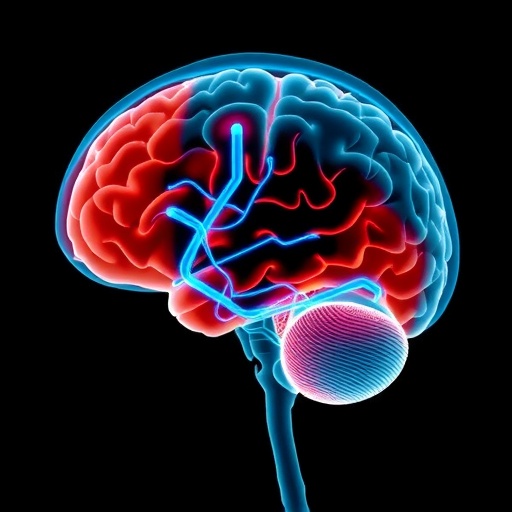
Image Credits: AI Generated
DOI: 10.1007/s00415-026-14055-x
Keywords: tinnitus, deep brain stimulation, medial geniculate body, thalamus, refractory tinnitus, auditory pathway, neuromodulation, thalamocortical dysrhythmia, Journal of Neurology, Maastricht University, two-year follow-up
Cite Scienmag News
APA MLA Chicago
Cassandra Pierce. (September 5, 2026). Deep brain stimulation eases severe tinnitus over two years of follow-up. Scienmag. https://scienmag.com/deep-brain-stimulation-eases-severe-tinnitus-over-two-years-of-follow-up/
Copy citation Download RIS
Tags: clinical trials for deep brain stimulation in tinnitusclinical trials for tinnitusDeep brain stimulation for tinnitusDeep brain stimulation for tinnitus reliefimpact of tinnitus on mental healthinnovative therapies for tinnituslong-term effects of deep brain stimulationmanagement of chronic tinnitusmedial geniculate body stimulationneural mechanisms of tinnitusneurological basis of tinnitusneuromodulation techniques for auditory disordersneurostimulation for auditory perceptionneurostimulation techniques for auditory disorderspersistent tinnitus treatment optionsthalamic deep brain stimulationtinnitus and neurological interventionstinnitus management and therapeutic innovationstreatment-refractory tinnitus