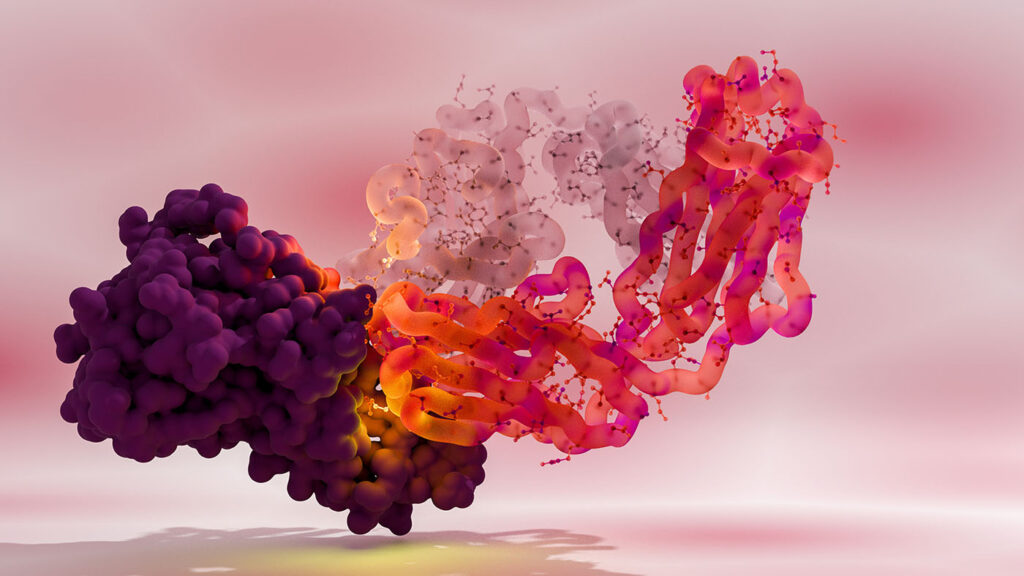
With the advent of AI-powered protein design tools, protein-based therapeutics may no longer be constrained by the limits imposed by natural selection.
Protein-based therapeutics have been tremendously successful, with a global market of about $375 billion and growing. These products include antibodies, hormones, enzymes, and many others, even engineered molecules like antibody-drug conjugates or bispecifics. Still, proteins pose significant challenges for drug developers. They are spectacularly effective at what they do because they have evolved within living systems over millennia, but the flip side of that is that they are difficult to extensively customize due to their complex three-dimensional folding and interactivity.
Now, artificial intelligence (AI) may be handing humanity the tools to design proteins free of natural constraints. The 2024 Nobel Prize in Chemistry celebrated accomplishments in two aspects of AI-driven protein engineering: de novo design and three-dimensional structure prediction. Half of the prize went to David Baker, PhD, director of the Institute for Protein Design at the University of Washington. Baker’s lab developed RosettaFold diffusion (RFdiffusion), a deep-learning framework called a diffusion model, similar to those used for image generation. RFdiffusion enables users to create completely novel proteins based on molecular specifications. The other half went to the inventors of AlphaFold2, which uses a neural network to predict three-dimensional structure from a protein sequence with unprecedented accuracy.

AlphaFold2 “made comparative modeling really easy,” says Sam DeLuca, PhD, former director of engineering at Cyrus Biotechnology and co-founder of Levitate Bio. “When I was in grad school, it took a week of hands-on time at a computer to make it work, and probably a couple thousand CPU hours. And now AlphaFold2 comes along and you can get a model of usually about the same quality, even if you don’t have good homologs, in a couple of hours on a mid-range GPU. That’s a really big deal.”
In addition to AlphaFold2 and RFdiffusion, a variety of AI tools have been created to address different aspects of protein engineering, and many are publicly available. ProteinMPNN and ThermoMPNN, for example, are message-passing neural networks that can take a protein structure and generate an amino acid sequence that will fold into that structure. “Now you can take a protein that exists and make another protein that folds into the same shape, if you were to express it, but it has a totally different sequence,” DeLuca says. “It turns out that you can now design small binders to proteins that have picomolar binding affinity, which is obviously incredibly powerful as a drug design tool.”
Smashing the limits of natural design
“It’s pretty incredible what these design models can do,” says James Lazarovits, PhD, co-founder and CEO of Archon Biosciences. “You’re able to create proteins that have never existed before, that have brand-new functions that you could only dream of.”
Lazarovits co-founded Archon with George Ueda, PhD, based on software they developed with Baker at the Institute for Protein Design. Archon makes “antibody cages” (AbCs), a completely novel class of biologic consisting of antibodies linked to AI-designed protein sequences that induce a particular folding structure.
Optimizing an antibody to a desired function often means changing its amino acid sequence, and that imposes natural limits on how much it can be altered. “With a natural protein, you can only change it so much. They didn’t evolve for massive sequence changes,” he says. “With the antibody cage, we can change antibody structure without altering antibody sequence.”
Adding computationally-designed binding proteins to the antibody can alter its structure in ways that make large changes to its biological behavior, Lazarovits says. “Many of the best antibodies against the best targets fail in the clinic, and that’s because their therapeutic activity and toxicity are constrained by the limits of antibody structure,” he adds. “In order to serve the complex biology that modern medicine demands, we need something more.” The design method for antibody cages allows fine-tuning of shape, size, and composition properties, enabling changes to the distribution pattern as well as the way the antibody engages with its target.
A key strength of Archon’s approach, Lazarovits says, is the ability to focus on properties, like activity, manufacturability, and developability, that can ultimately make or break a commercial product. “That’s the huge power of what we’re able to do,” Lazarovits says. “We aren’t creating a generalized foundation model for everything, but we’re actually building a generalized approach to being able to collect high-quality, robust, reproducible data sets that allow us to fine-tune and optimize our design models to get it more correct each and every time.”
User-friendly protein design portal
Traditional biotech and pharma companies are also incorporating AI tools into their process, even without a Nobel-adjacent computational biologist on board. Many of the most popular AI protein design tools are freely available, but they can be difficult to just pick up and use without specialized training. If your company doesn’t have the budget for a dedicated computational biology team, however, don’t despair. Companies like Tamarind Bio in San Francisco, California, and AI-DT in Leipzig, Germany, are creating user-friendly applications that make these software tools more accessible to the non-specialist.

Tamarind Bio, launched in 2023, has built a web interface where researchers can access hundreds of AI tools, some open source and some licensed, and get guidance and support in how to use them.
“Instead of going to the publication, finding a code, downloading it yourself, setting it up, and often having to have a computational teammate do that for you, we just have a simple web interface for each of these,” says Deniz Kavi, PhD, co-founder of Tamarind. “You have several hundred of these tools in one place–AlphaFold, RFdiffusion, OpenFold, etc., and then we make it easy to consume those as a bench scientist.” Tamarind also provides the computing resources necessary to use these tools on a large scale, Kavi says. “We handle the plumbing and infrastructure side of things, so you can do the science.”
In addition to their paid service, which Kavi says is being used by dozens of biotech and pharma companies globally, Tamarind also offers a free version for academic use. “Our goal is to make it available to any scientist,” he says.
Because new tools are continually being published, it is difficult to stay current with what’s out there. Tamarind keeps up with published benchmark data, Kavi says, and has implemented an AI copilot to help guide users through the process of selecting the most appropriate tool for a given task and handling the scaling-up that’s needed for a high-throughput lab setting. Researchers have the option to browse the library of available tools in Tamarind’s library and select for themselves which ones they want to use, or to start with the copilot and describe the protein engineering goal they want to tackle, and the copilot will suggest where to begin.
In a similar vein, AI-DT is building an AI interface that will guide users in selecting the right tool for the job, executing the tools, and most importantly, understanding how those tools have generated their results. “They get the explanation, and it’s not just a black-box system,” says Ivan Ivanikov, PhD, chief technology officer at AI-DT. “You see the results, and you can also reproduce them if you want, because most of the software is open source.”
Ivanikov cautions that it’s not as simple as plugging in your parameters and the AI delivers you a perfect protein, but using AI tools does speed up the process by reducing the number of trials needed, compared with designing and testing by human researchers based on experience and intuition. “They know what they’re doing, they’re fantastic, but it’s often still a feeling. So they know how to iterate through it, and then maybe in 10 iterations, they get to the result they want,” Ivanikov says. “With AI methods, you are now able to get it in three or four iterations. It’s still ‘playing lottery’, but with a bit of cheating.”
AI-DT has been particularly mindful of trust issues around AI products and data privacy, Ivanikov says. Currently, the company is taking contract research projects to help build that reputation of trustworthiness, and their product is scheduled for wide release in 2026. “We try to aim for small and medium-sized companies that can’t afford to build up their own AI department,” Ivanikov says. “They just don’t have the time or money to spend on AI expertise, because it takes so much time to get to know all the tools and deploy them.”
From the cradle to the bench
Some researchers may not relish the task of reviewing and comparing the available options for themselves before selecting what protein design tool to use for each project. “In order to evaluate what these models are generating, you have to go into the lab and actually test these sequences,” explains Elise de Reus, PhD, co-founder of Cradle Bio. “That’s expensive and time consuming, and you don’t have the luxury to compare all the different approaches for every project that you’re working on.” Cradle offers a machine learning platform for protein design that companies can license for their own use.
The company maintains an in-house wet lab to continually evaluate new methods as they are published, testing them in various use cases and types of projects before incorporating them into the Cradle Platform, de Reus says. A customer begins by specifying what requirements their protein must meet, and Cradle generates a set of variants, optimized for functionality and diversity, that the scientists then test in their assays. The data from those tests then improves the performance of the project-specific model on the Cradle platform. The generative AI approach is particularly useful for multi-property optimization because the platform can adjust all the different properties simultaneously. “Optimizing for multiple properties, like efficacy and developability and manufacturability, all at once,” she says. “That’s where you can save a lot of time and resources by getting it right through the use of generative AI.”
As a software provider, Cradle does not take any royalties or IP on assets developed using the platform, de Reus says, nor do they use customer data to train their model. “We care deeply about the security and privacy of data for all our customers,” she says. “Any data that a customer uploads into their environment on the Cradle platform stays private to them, and no model that touches their data will ever be used in connection with other customers’ projects.”
Some large pharma companies already use Cradle, including Johnson & Johnson and Novo Nordisk, and the company offers a limited number of free licenses for academic use. “The long-term vision,” de Reus says, “is that this will drastically reduce the R&D costs, bringing better products to market, and also making startups who want to tackle some of these big problems a lot more feasible and investable.”