
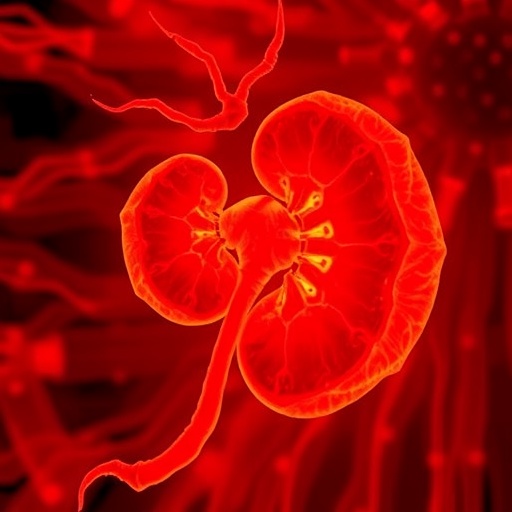
A groundbreaking prospective study conducted by an interdisciplinary team from University Hospitals Cologne and Bonn has unveiled a promising approach to treating congenital lower urinary tract obstruction (cLUTO) in fetuses at an exceptionally early stage. This innovative investigation, which marks the world’s first prospective assessment of vesicoamniotic shunt implantation during the first trimester, sheds new light on improving survival rates and preserving kidney function in unborn children afflicted by this serious condition. By intervening during the delicate first trimester, researchers aim to transform the prognosis for cLUTO—potentially sparing affected infants from the lifelong burden of dialysis.
Congenital lower urinary tract obstruction is a critical prenatal condition characterized by blockage in the unborn fetus’s urine flow. The obstruction causes urine to accumulate, leading to increased pressure that severely overstretches the urinary tract, disrupting the natural development of the kidneys. This abnormal pressure can inflict irreversible damage on the developing renal tissue during a pivotal stage of organogenesis. Furthermore, diminished urine output reduces the quantity of amniotic fluid, a vital component essential not only for cushioning but also for promoting lung development. In many cases, the scarcity of amniotic fluid correlates with lethal pulmonary hypoplasia, a major cause of postnatal mortality among cLUTO-affected infants.
Historically, attempts to mitigate the impact of cLUTO have involved prenatal interventions during the second trimester, notably the implantation of vesicoamniotic shunts to decompress the fetal bladder. However, these procedures have yielded disappointing results. Large international studies consistently reported no significant improvement in renal outcomes or overall survival following these midgestation interventions. The late timing of these therapies may be insufficient to prevent the early renal damage inflicted during the critical window of kidney precursor cell development. This shortcoming compelled researchers to reconsider the optimal timing and technical feasibility of in utero treatment.
The Cologne-Bonn team pioneered a paradigm shift by leveraging recent technological advances to perform vesicoamniotic shunting as early as the end of the first trimester. Utilizing a novel foldable shunt capable of insertion through a substantially smaller needle, they achieved minimally invasive decompression of the fetal bladder when the embryo is approximately the size of a hen’s egg. This early intervention hypothesis is grounded in developmental biology, recognizing that kidney organogenesis occupies a highly sensitive phase in the initial weeks of gestation. By alleviating the obstructive pressure during this vulnerable window, the procedure aims to safeguard the nephrogenic precursor cells essential for future renal function.
Between June 2019 and January 2024, the prospective study enrolled 40 pregnancies diagnosed with severe fetal megacystis due to cLUTO. The primary endpoint was survival until the first year of life, alongside assessment of kidney function and the need for postnatal dialysis. The results, published in The Lancet Child & Adolescent Health, are striking: 75% of treated fetuses were born alive, and 68% survived beyond their first birthday. Among these survivors, 90% who received active treatment avoided dialysis during infancy and largely exhibited normal or only mildly impaired renal function. Such outcomes represent a significant advancement over historical control cohorts, where survival and kidney preservation had been substantially lower.
Clinicians involved in the study emphasize that the early shunting not only prevents irreversible kidney damage but also improves lung maturation by restoring sufficient amniotic fluid levels. This dual benefit counteracts the two most lethal consequences of cLUTO: renal failure and pulmonary hypoplasia. Dr. Stefan Kohl, a pediatric nephrology specialist, highlights that the approach could revolutionize management protocols by balancing the risks and benefits of early fetal intervention, offering hope for avoiding the devastating long-term sequelae traditionally associated with this anomaly.
Importantly, the research demonstrated that patient selection remains critical. Fetuses without additional serious malformations experienced the greatest benefit, underscoring the necessity of comprehensive prenatal diagnostic workup. The procedure’s technical safety was meticulously documented, with no excessive complications attributable to the use of the smaller needle and foldable shunt design. This technological refinement facilitated safer access and expanded the window of opportunity to intervene precisely when it matters most during organogenesis.
The study represents a hallmark of interdisciplinary collaboration. Specialists spanning prenatal medicine, pediatric nephrology, pediatric urology, and neonatology worked synergistically to evaluate not only the surgical feasibility but also the long-term outcomes and kidney function trajectories of treated children. This integrated care continuum reflects the mission of the Centre for Family Health (CEFAM) at University Hospital Cologne—an institutional model that unites diverse clinical disciplines to manage complex fetal and neonatal diseases from diagnosis through infancy.
From a scientific standpoint, the findings corroborate experimental data suggesting that persistent urinary tract pressure exerts cytotoxic stress on the metanephric mesenchyme, the kidney’s progenitor tissue. Relieving this obstruction during the narrow window when nephron progenitor cells are actively proliferating and differentiating appears essential to preserving nephron endowment and functional renal reserve. Prof. Christoph Berg, a pioneer in fetal surgery at Cologne, identifies this developmental biology rationale as the conceptual foundation underpinning the success of the early shunting program.
The implications of this research extend beyond cLUTO. It exemplifies how deep understanding of embryology and physiology can inform the precise timing of prenatal interventions, potentially transforming therapeutic opportunities for a spectrum of congenital anomalies. The combination of innovative medical device engineering, rigorous clinical trial design, and a multidisciplinary care approach highlights the future direction of fetal therapy—where early, targeted interventions minimize morbidity and enhance long-term health trajectories.
Looking ahead, the Cologne-Bonn team plans to expand their research cohort and extend follow-up analyses into later childhood, to assess the durability of improved kidney function and to refine patient selection criteria further. Additional translational studies are underway to elucidate the molecular mechanisms by which early decompression preserves nephron progenitors. Such insights may offer adjunctive therapeutic targets that complement mechanical shunting.
Beyond clinical and scientific achievements, this study underscores the importance of supportive research infrastructure. Funding from the University of Cologne’s Faculty of Medicine and targeted grants like the Gusyk Funding and Cologne Fortune Programme facilitated the seamless integration of clinical responsibilities with pioneering research endeavors. The commitment to fostering physician-scientists who balance patient care with scientific inquiry played a crucial role in the trial’s success.
In conclusion, this landmark investigation represents a quantum leap in the prenatal management of congenital lower urinary tract obstruction. By harnessing technological innovation and applying developmental biology principles, the interdisciplinary team at University Hospitals Cologne and Bonn has rewritten the narrative for fetuses affected by cLUTO. Their findings offer a beacon of hope for improved survival, preserved kidney function, and a future free from dialysis for many children who would otherwise face daunting prognoses. This pioneering study paves the way for a new age in fetal surgery, where early, informed intervention safeguards health before birth.
Subject of Research: People
Article Title: Intrauterine shunting for first-trimester fetal megacystis (IUS1st)
News Publication Date: March 12, 2026
Web References: 10.1016/S2352-4642(26)00011-8
References: Published in The Lancet Child & Adolescent Health
Image Credits: Not specified
Keywords: cLUTO, congenital lower urinary tract obstruction, vesicoamniotic shunt, fetal megacystis, prenatal intervention, kidney development, nephrogenesis, fetal surgery, amniotic fluid, lung maturation, dialysis avoidance, first-trimester intervention
Tags: amniotic fluid role in fetal developmentcongenital lower urinary tract obstruction treatmentearly intervention in fetal megacystisfetal kidney function preservationfetal megacystis prognosisfirst trimester vesicoamniotic shuntimproving survival in cLUTO fetusesinterdisciplinary fetal therapy researchprenatal dialysis prevention strategiesprenatal urinary tract obstruction managementpulmonary hypoplasia in fetal urinary obstructionUniversity Hospitals Cologne and Bonn study

