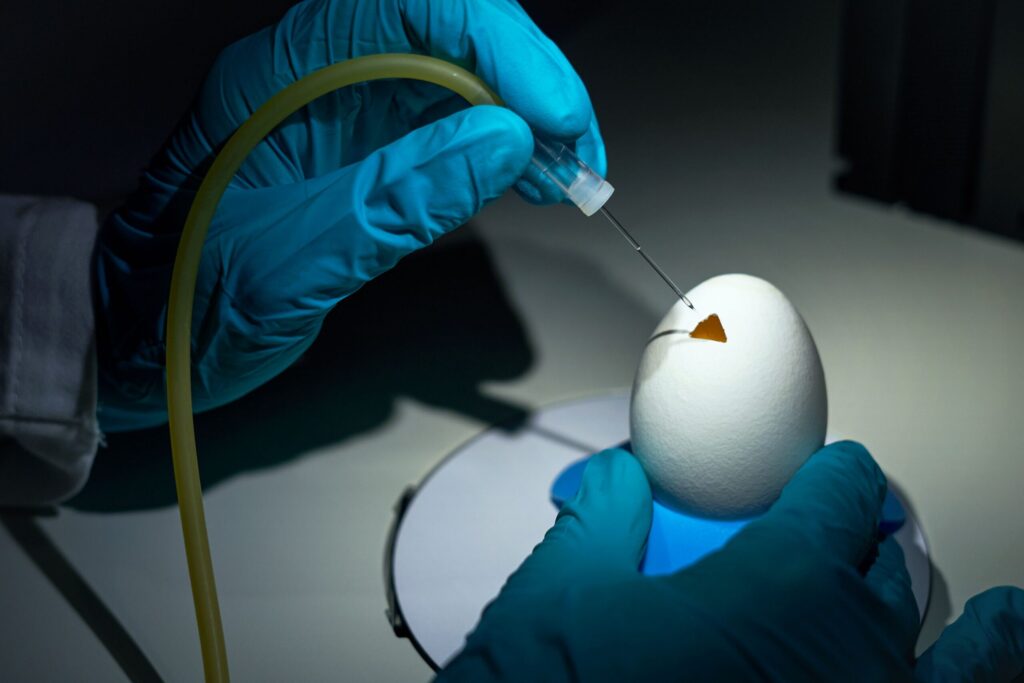
![Neion Bio’s Raptor technology uses genetic engineering tools to produce recombinant biologics in eggs. The company says the platform is made possible by recent advances in precision genome engineering, the availability of large genomic data sets, and the ability to grow avian primordial germ cells. [Neion Bio]](https://www.genengnews.com/wp-content/uploads/2026/03/Egg-photo-scaled.jpg "Egg photo")
Neion Bio has emerged from stealth mode and signed its first co-development and supply agreement with an unnamed major global pharmaceutical company. Neion’s Raptor™ platform products recombinant biologics in eggs, enabling scalable and efficient production of virtually any therapeutic protein, according to company officials.
This commercial deal provides Neion with near-term revenue through up-front and milestone payments, along with long-term participation through profit sharing once products are commercialized, notes Dimi Kellari, company co-founder and CEO.
![From left to right: Dimi Kellari, co-founder and CEO; Sam Levin, PhD, co-founder and chief technology officer; Ming Li, president, commercial operations; and Sven Bocklandt, PhD, chief scientific officer. [photographed at Neion Bio’s headquarters at Rockefeller University]](https://www.genengnews.com/wp-content/uploads/2026/03/team-photo-300x238.jpg)
“Biopharma manufacturing has not changed in decades and has become a major bottleneck in advancing medical breakthroughs, increasing accessibility of existing therapies, and localizing domestic production of critical medicines,” says Kellari. “Neion Bio’s platform removes the capital intensity and process constraints of traditional biomanufacturing enabling highly scalable and resilient production while materially lowering the cost of development and supply.”
Neion views its Raptor platform as harnessing “nature’s most powerful molecular factory—the egg”—to create a reproducible and consistent manufacturing process. The company re-engineers these self-contained, naturally sterile vesicles to produce virtually any biological therapeutic at an order of magnitude lower costs, continues Kellari, adding that the platform enables consistent protein expression, simplified operations, and a level of manufacturing control that is difficult to achieve in traditional cell-culture-based manufacturing.
The platform is reportedly made possible by recent advances in precision genome engineering, the availability of large genomic data sets, and the ability to grow avian primordial germ cells (PGCs).
“Millions of years of evolution have sculpted this system into an extremely prolific producer of complex proteins. By leveraging this natural architecture, we’ve created a fundamentally superior way to produce biological therapeutics,” points out Sam Levin, PhD, co-founder and CTO of Neion Bio. “Our platform delivers improved control and scalability versus conventional biomanufacturing without the burden and cost of large steel tanks or disposable plastics. As AI dramatically reduces the time and cost to design breakthrough medicines, we are enabling a pathway to bring these to market far more efficiently and sustainably than traditional manufacturing.”
“I am thrilled to be joining Neion Bio and equally excited that our first commercial agreement comes in the biosimilar space, which is a market and regulatory framework undergoing rapid positive changes,” says Ming Li, Neion’s newly appointed president of commercial operations. “As clinical requirements ease for biosimilars, we expect a major increase in investment across the biosimilar sector, and our platform offers the kind of structural advantage companies will need to succeed.”
Founded by Kellari and Levin in 2024 with approximately $11 million in financing from a consortium of VC firms, the Neion team includes Sven Bocklandt, PhD, the company’s CSO, formerly of Colossal Biosciences, where he directed genetic engineering efforts central to Colossal’s pioneering de-extinction work.