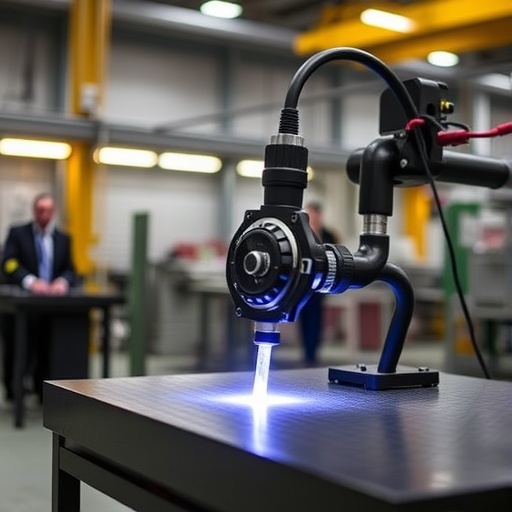
Scientists from the Institute of Physical Chemistry of the Polish Academy of Sciences have achieved a groundbreaking milestone in the precise control of carbon microfibers through the application of electricity. These microfibers, approximately the thickness of a human hair or even thinner, have traditionally posed immense challenges in manipulation due to their minute scale and structural complexity. However, this pioneering research demonstrates that carbon fibers can be electrically actuated to mimic the function of microscopic tweezers, opening new frontiers in micromechanics and soft robotics. The study, recently published in the prestigious journal Nature Communications, lays out the first proof-of-concept for inducing motion in pristine carbon fibers using asymmetric electrochemical reactions intrinsic to the material.
Over the past few decades, advances in nanotechnology and materials science have propelled the ability to fabricate fibers with diameters far below the width of human hair. These developments support a wide array of applications ranging from biomedical devices to advanced textiles. Smart materials, particularly polymers, have been explored extensively for their capacity to respond dynamically to environmental stimuli such as temperature, pH, light, or electric fields. These stimuli-responsive materials can alter fundamental properties—shape, color, or conductivity—and subsequently revert to their original state, embodying reversible behavior essential for adaptive technologies.
Despite this progress, controlling the orientation and movement of microfibers and nanofibers on demand remains a formidable challenge. Most smart fibers require intricate coatings or structural modifications to respond predictably to stimuli, complicating their manufacture and limiting practical applications. The gap between laboratory demonstrations and functional, reversible fiber actuators usable in real-world scenarios has remained wide.
The breakthrough achieved by the team led by Dr. Wojciech Nogala at the Institute of Physical Chemistry (IChF) addresses this gap directly. By employing unmodified, pristine carbon fibers suspended in an electrochemical setup, the researchers demonstrated reversible electrical actuation without the need for specialized coatings or composite materials. Carbon fibers offer an ideal platform for this experimentation due to their exceptional mechanical strength coupled with a remarkably low weight relative to traditional metals such as steel or aluminum. Moreover, their inherent electrical conductivity makes them suitable candidates for electrochemical manipulation.
Central to the research is the use of a closed bipolar electrochemical cell—a technique dating back to the 1970s but innovatively repurposed here to achieve wireless actuation of carbon fibers. Within this setup, a single micro-scale carbon fiber, either with a smooth or roughened asymmetric surface, is immersed in an electrolyte solution containing ions such as lithium (Li⁺) and perchlorate (ClO₄⁻), as well as redox-active organic molecules benzoquinone and hydroquinone. When an external voltage is applied, these ions intercalate into or are expelled from the fiber surface in a non-uniform manner due to the asymmetric surface morphology.
Notably, the roughened carbon fibers exhibit a natural asymmetry in pore distribution across their surface, facilitating uneven ion insertion that results in bending motion. This bending is induced as one hemisphere of the fiber expands more than the other during ion intercalation. Conversely, when the voltage polarity is reversed or removed, ions are expelled, causing the fiber to revert to its original position—a straightening process that underscores the reversibility of the mechanism. The phenomenon is thus akin to motion induced by microscopic tweezers, controlled wirelessly via electrochemical reactions.
Dr. Nogala emphasizes the significance of the fiber’s asymmetry: “We successfully used a closed bipolar cell to wirelessly actuate a freestanding carbon fiber electrochemically. The naturally asymmetric groove configuration fosters an uneven electrical double layer crucial for generating differential tension and contraction within the fiber. This asymmetric electrochemical environment is fundamental for producing the bending we observed.”
The research further elucidates that the magnitude of fiber motion is contingent on several parameters, including the applied voltage and fiber length. By modulating these variables and employing pulsed voltage cycles, the carbon fiber can be made to rhythmically bend and straighten repeatedly. This dynamic behavior introduces the potential for the fibers to serve in applications demanding precise micro-actuation, such as synthetic muscles in miniature robotic systems, targeted drug delivery mechanisms, or responsive materials in micro-electromechanical systems (MEMS).
An intriguing aspect of this discovery is its reliance on pristine carbon fibers unlike previous systems that often necessitated complex structuring or chemical modifications. This simplicity heralds a practical pathway toward scalable manufacturing of fiber-based actuators that are lightweight, robust, and electrically controllable. The wireless nature of the actuation facilitated by the bipolar electrochemical cell further enhances integration prospects for these actuators in constrained environments where direct wiring is impractical or undesirable.
Beyond the immediate demonstration of carbon fiber motion, the research intimates broad interdisciplinary implications. Controlling material shape and orientation at micron scales via electricity bridges fundamental gaps in the design of smart materials. It suggests a route toward systems capable of on-demand mechanical responses without relying on external mechanical components, shifting the paradigm of actuator design toward purely material-centric solutions.
Funding for this pioneering work was provided by the National Science Center (NCN) in Poland via grant 2022/46/E/ST4/00457. The research team anticipates that their findings will stimulate further exploration into asymmetric carbon fibers with engineered surface morphologies that enhance or diversify actuation capabilities. Such developments could revolutionize sectors ranging from wearable robotics to adaptive sensing technologies.
In conclusion, this innovative electrochemical approach to shaping and actuating carbon fibers marks a seminal advance in materials science. It harnesses the natural structural asymmetry of pristine carbon fibers and couples it with electrochemical principles to create reversible, controllable motion at scales previously inaccessible. As the exploration of miniaturized, smart actuators expands, this research lays a foundational blueprint for future devices capable of performing intricate tasks within confined spaces and complex environments.
Subject of Research: Electrical actuation and shape control of pristine carbon microfibers using asymmetric electrochemical processes.
Article Title: Controlled Shaping of Carbon Microfibers via Electrochemical Wireless Actuation
News Publication Date: Information not provided
Web References: http://dx.doi.org/10.1038/s41467-025-65036-z
References: Nogala, W. et al. Nature Communications. DOI: 10.1038/s41467-025-65036-z
Image Credits: IPC PAS, Grzegorz Krzyzewski
Keywords
Carbon fibers, microactuators, electrochemical actuation, asymmetric electrochemistry, bipolar cell, reversible fiber bending, smart materials, micromechanics, soft robotics, nanotechnology, wireless actuation, synthetic muscles.
Tags: advancements in micromechanics and soft roboticsapplications of carbon fibers in biomedical devicesbreakthroughs in carbon fiber shaping technologyelectric control of carbon microfiberselectrochemical reactions in materials sciencefuture of soft robotics and nanofabricationinnovations in nanotechnology for textilesInstitute of Physical Chemistry researchNature Communications publicationprecise manipulation of nanofibersreversible behavior of stimuli-responsive materialssmart materials and environmental responsiveness