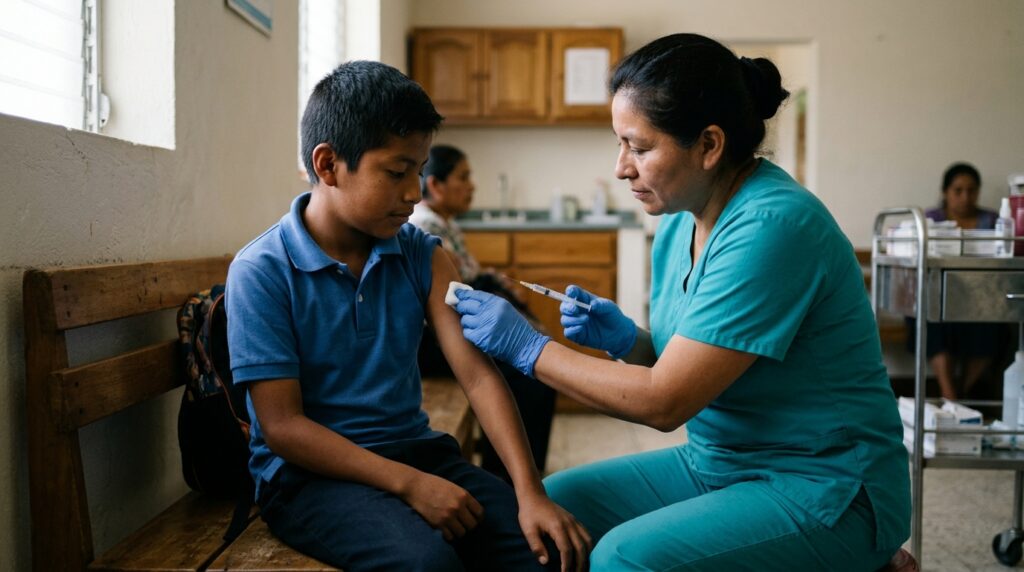
A long-term cost-effectiveness analysis evaluated the economic efficiency of expanding human papillomavirus vaccination to boys within Guatemala’s public health system. Cervical cancer remains a leading cause of cancer-related morbidity and mortality across Guatemala, resulting in 1,555 new diagnosed cases and 872 deaths each year. On a global level, cervical cancer represents a substantial preventable malignancy burden that disproportionately affects low- and middle-income nations. Although Guatemala has provided human papillomavirus vaccination to ten-year-old girls since 2018, public health decision-makers have faced the critical policy question of whether extending routine immunization coverage to boys represents an efficient allocation of limited resources.
To address this question, researchers led by Beatriz Hernández evaluated the long-term economic outcomes of extending vaccination programs using locally derived epidemiological and cost data. The investigation adopted the perspective of the national public health system and implemented the PLANTEVEC static model. Methodological design and reporting strictly adhered to the CHEERS 2022 guidelines. To capture long-term health and financial impacts, the investigators applied an extensive 100-year analytic horizon. Future health outcomes and economic costs were both discounted at a standard annual rate of 3 percent, ensuring consistency across long-range projections.
Model estimates established incremental cost-effectiveness ratios, or ICERs, measured in United States dollars per disability-adjusted life year avoided. The evaluated interventions were compared directly against Guatemala’s gross domestic product per capita, which was established at USD 4,354.89 as the decision benchmark. Maintaining vaccination exclusively for girls yielded an estimated ICER of USD 1,089 per DALY avoided. In comparison, transitioning to a gender-neutral vaccination strategy covering both girls and boys yielded an estimated ICER of USD 1,959 per DALY avoided. Crucially, the modeled costs of both immunization strategies remained well below the benchmark threshold of one GDP per capita.
Based on these findings, the study concluded that human papillomavirus vaccination strategies in Guatemala are economically efficient under established decision criteria. While expanding routine immunization to include boys carries a higher cost per disability-adjusted life year avoided than vaccinating girls alone, the gender-neutral intervention remains fully within accepted cost-effectiveness thresholds. Consequently, extending coverage beyond ten-year-old girls to include male cohorts provides an economically justifiable approach for the public health sector that directly supports equity-oriented prevention across the country.
Subject of Research: Cost-effectiveness of extending HPV vaccination to boys in Guatemala
Article Title: Long-term cost-effectiveness of HPV vaccination for girls and boys in Guatemala
Article References: Hernández, B. (2026). Long-term cost-effectiveness of HPV vaccination for girls and boys in Guatemala. Cost Effectiveness and Resource Allocation. https://doi.org/10.1186/s12962-026-00811-3
Image Credits: AI Generated
DOI: 10.1186/s12962-026-00811-3
Keywords: HPV vaccination, Guatemala, cervical cancer, cost-effectiveness analysis, gender-neutral vaccination, PLANTEVEC model, public health system, incremental cost-effectiveness ratio, disability-adjusted life years, DALY, GDP per capita, CHEERS 2022 guidelines, cancer prevention, ten-year-old girls, preventable malignancy, health economics