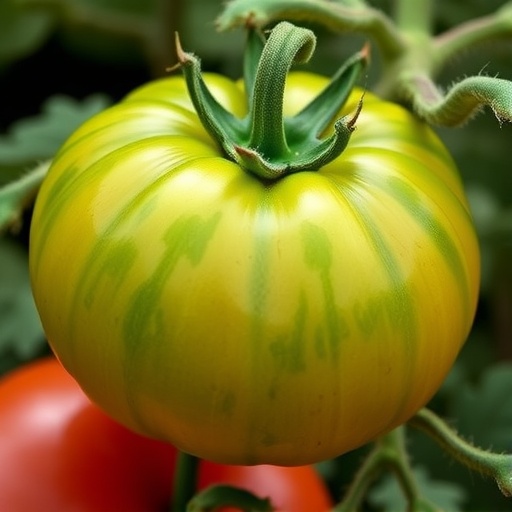
Scientists have unveiled a new artificial intelligence framework that dramatically improves a robot’s ability to find and trace the slender stalks that connect tomatoes to the vine—a problem that has long stymied efforts to automate one of agriculture’s most labor-intensive harvesting tasks. The system, called YOLO11-FFTDA, fuses two sophisticated computational techniques: frequency-domain image enhancement based on the Fast Fourier Transform, and deformable attention inspired by the way flexible sampling can track irregular shapes. The result is a model that identifies tomato pedicels with 88.1 percent precision and a mean average precision of 32.9 percent under the strict mAP50–95 metric, outperforming a lineup of state-of-the-art competitors including Mask R-CNN, YOLACT, SOLOv2, and several recent members of the YOLO detection family.
The work, published in the journal Artificial Intelligence in Agriculture, addresses what researchers describe as a fundamental bottleneck in agricultural robotics. For a harvesting robot to cut a tomato cleanly, it cannot merely locate the fruit; it must pinpoint the pedicel—the thin fruit stalk—so that its cutting or gripping end-effector can sever the stem without damaging the crop. Bounding-box detection, which most fruit localization systems rely on, provides nowhere near the geometric detail needed to plan a collision-free cutting path. Instance segmentation, which traces pixel-level contours around each target, does. But applying instance segmentation to pedicels in a real orchard has proven stubbornly difficult for two reasons that the team identifies as the core of the problem.
The first challenge is the loss of small-target features during image processing. Tomato pedicels, especially those of cluster tomatoes grown in trusses, are extraordinarily slender, often spanning only a few dozen pixels in width. Standard convolutional neural networks—the workhorses of modern computer vision—process images by repeatedly applying convolutions and pooling operations that shrink the spatial resolution of feature maps layer by layer. Mathematically, this cascading downsampling acts as a low-pass filter: it preserves smooth, large-area, low-frequency information such as leaf surfaces and fruit skins while progressively discarding high-frequency signals, which encode sharp edges and fine, threadlike structures. A pedicel’s essential visual signature lives precisely in that high-frequency band. By the time the image data has traveled through a deep network, the pedicel’s features have been smoothed into indistinguishability, rendering the target invisible against background clutter—a primary cause of missed detections.
The second challenge is environmental chaos. In genuine orchard conditions, pedicels are surrounded by branches, petioles, vines, and leaves that are nearly identical in color, texture, and morphology to the targets themselves. Heavy occlusion is routine: fruits and foliage routinely block the view of the very stalks a robot needs to cut. Conventional attention mechanisms such as Squeeze-and-Excitation and Coordinate Attention improve focus but lack the geometric adaptability to handle non-rigid, irregular targets amid dense clutter, producing false positives and imprecise segmentation masks.
YOLO11-FFTDA attacks both problems with an unusual architectural strategy. Rather than trying to recover lost detail after the fact through spatial-domain feature fusion—the approach taken by prior frameworks such as multi-scale attention mixing heads and TriFPN—the researchers intervene before the information vanishes. Their Convolutional Feature Pyramid Module, inserted into the backbone network at four scales, contains a Frequency-Pyramid Attention Module whose core engine, FFTAT, applies the Fast Fourier Transform to shift spatial features into the spectral domain. In that domain, the slender topology of a pedicel appears as distinct high-frequency components. The module decomposes the transformed signal into amplitude and phase, treats the frequency representation as a feature set, and applies multi-head self-attention over frequency components, modulated by a learnable matrix that acts as a frequency mask. This mask is trained to explicitly amplify the high-frequency patterns characteristic of tomato pedicels while suppressing noise-dominated frequencies. A parallel branch learns spatial weights from the real part of the transformed signal, preserving location-specific frequency information. The enhanced global and local frequency features are then fused and converted back to the spatial domain via the inverse Fourier Transform. The result is a backbone that actively protects the delicate edge information of thin stalks at every stage of downsampling rather than passively lamenting its loss.
The cascaded structure of the pyramid is itself novel. Instead of processing multiple scales in parallel, the module chains atrous, or dilated, convolutions with escalating dilation rates—3, 5, and 7—alternating each spatial extraction step with an FFTAT frequency-enhancement step. Each cycle broadens the receptive field while repeatedly re-amplifying the high-frequency features critical to pedicel identification, filtering interference at every stage.
To confront the occlusion problem, the team embedded Deformable Attention into the neck of the network, creating a hybrid module dubbed C2PSADA that combines polarized self-attention with deformable sampling. Unlike standard self-attention, which densely and uniformly attends to every position on a regular grid—including vast stretches of irrelevant leaves and soil—deformable attention learns a set of sparse, data-dependent sampling points. A lightweight offset network generates coordinate displacements that shift fixed reference points toward the parts of the image that actually matter. The network then samples features via bilinear interpolation at these deformed positions, allowing it to trace the irregular, winding geometry of a partially hidden pedicel while actively avoiding background confusion. Integrated after the deepest feature layer, the module confers what the authors describe as active interference avoidance and key-target focusing, concentrating computational resources on the sparse, irregular stalks rather than diluting attention across the entire scene.
The architecture also adds a dedicated small-object detection branch derived from the highest-resolution P2/4 feature layer, connected directly to its own segmentation head. This ensures that the finest details of minute, distant, or awkwardly angled stems are not diluted during subsequent feature fusion. Four parallel segmentation heads—one per scale—simultaneously predict classification confidence, bounding-box coordinates, and pixel-level mask coefficients, trained with a combination of binary cross-entropy, CIoU, and distribution focal losses.
The empirical case for the design is built on a dataset of nearly 1,600 pedicel instances collected from real orchards across multiple acquisition sessions, spanning varied lighting, viewing angles, and occlusion levels, with pixel-level polygon annotations produced using LabelMe. The statistics underscore the difficulty: average stem width and height were only 39.4 and 36.0 pixels respectively, with a long-tailed size distribution. Crucially, the team split data into training, validation, and test sets at the scene and fruit-cluster level—8:1:1—so that adjacent frames or the same clusters viewed from different angles never leaked between splits, a rigor many agricultural vision studies lack. Training used stochastic gradient descent over 300 epochs on an RTX 4070 GPU, and five-fold cross-validation yielded extremely low standard deviations across metrics, indicating that the reported performance reflects genuine robustness rather than favorable data partitioning.
In head-to-head mask segmentation comparisons, YOLO11-FFTDA achieved 88.1 percent precision, a Dice coefficient of 81.9 percent, and mAP50 of 80.0 percent—leading all competitors on the strictest measures. Heatmap visualizations showed the model’s attention concentrating cleanly on pedicels where other models scattered focus across foliage, and mask overlays demonstrated substantially cleaner contours against cluttered backgrounds.
The researchers are explicit that the significance extends beyond tomatoes. Slender, non-rigid agricultural targets—grape pedicels, cucumber tendrils, delicate pruning branches—suffer from the same high-frequency signal loss and background confusion when processed by standard convolutional networks. Because the proposed enhancements operate at the level of how the network represents visual information rather than how it handles one particular crop, the authors argue they constitute a foundational, generalizable paradigm for a broad class of unresolved agricultural perception problems. As labor shortages and aging workforces intensify pressure on global food production, teaching machines to reliably see the thin, hidden connections that hold a harvest together may prove one of the more consequential victories of frequency-domain thinking in the field.
Subject of Research: Instance segmentation of tomato pedicels for robotic harvesting using frequency-domain enhancement and deformable attention within a YOLO11-based deep learning framework.
Subject of Research: Agriculture
Article Title: YOLO11-FFTDA: fusing frequency-domain enhancement and deformable attention for robust tomato pedicel segmentation
Article References: Qin, C., Lin, Y., Zheng, H., Yang, Y., Zhang, S., Cheng, L., Wang, H., Gong, L., & Liu, C. (2026). YOLO11-FFTDA: fusing frequency-domain enhancement and deformable attention for robust tomato pedicel segmentation. Artificial Intelligence in Agriculture, 16(3), 1405-1427. https://doi.org/10.1016/j.aiia.2026.08.007
Image Credits: AI Generated
DOI: 10.1016/j.aiia.2026.08.007
Keywords: tomato pedicel segmentation, YOLO11-FFTDA, frequency-domain attention, Fast Fourier Transform, deformable attention, instance segmentation, agricultural robotics, smart agriculture
Cite Scienmag News
APA
MLA
Chicago
Alan Morgan. (September 6, 2026). Frequency-domain and deformable attention boost tomato pedicel segmentation. Scienmag. https://scienmag.com/frequency-domain-and-deformable-attention-boost-tomato-pedicel-segmentation/
Copy citation
Download RIS
Tags: agricultural roboticsAI framework for labor-efficient harvestingAI-based fruit and stem detectionautomated fruit harvestingbounding-box vs. instance segmentation in crop analysisdeep learning for crop harvestingdeformable attention in agricultural roboticsdeformable attention in AIdeformable sampling techniquesenhancing slender plant structure recognitionFast Fourier Transform in computer visionFast Fourier Transform in image processingfrequency-domain image enhancementimproving robot manipulation in farmingmean average precision in agricultureobject detection in agricultureprecision in tomato fruit localizationrobotic tomato harvesting automationstate-of-the-art AI models for agriculturestate-of-the-art object detection models comparisonTomato pedicel segmentation