
In recent years, the artificial intelligence (AI) conversation has been dominated by increasingly capable large language models. Every few months, models improve on mathematical reasoning and coding benchmarks, while inference costs drop. Since 2025, programmers have become more familiar with Claude Code and OpenAI Codex, autonomous software engineering agents running locally in a developer’s terminal, navigating code repositories and editing files across codebases.
For the biotech and pharmaceutical industry, AI’s impact has also been profound. Researchers can now identify potential drug targets faster, predict protein structures with remarkable accuracy (thanks to advances like AlphaFold and RoseTTAFold), analyze vast scientific literature in seconds, and generate molecular insights that would previously have taken months to uncover.
Yet despite these advances, AI applications in scientific research have not experienced their “Claude Code” moment. A scientist investigating a drug target for a specific disease may consult multiple databases, retrieve scientific papers, run molecular analyses, compare outputs from different AI models, and move a protein structure prediction from one platform into a docking tool on another, and then wonder whether a different model would have given a better answer.
The compute power exists. The models exist. What’s missing is a system that coordinates them.
Why Agentic AI Matters
For all the excitement surrounding AI, much of the infrastructure required to apply it effectively in scientific research remains out of reach for many organizations. Access to frontier AI models, large-scale computing resources, molecular simulation platforms, scientific retrieval systems, and workflow orchestration tools often requires substantial investment and technical expertise. This creates a growing divide between organizations that can afford to assemble sophisticated AI-driven discovery environments and those that cannot.
Unlike traditional AI systems that generate outputs in response to prompts, agentic AI systems are designed to function more like a coordinated research team. They understand objectives, plan tasks, retrieve context, coordinate tools, evaluate results, and recommend next actions. In other words, agentic AI offers a potential path to democratize drug discovery by bridging the gap between generating an insight and acting on it.
Even with AI, scientific discovery rarely occurs in a single step. New therapies often emerge through a chain of interconnected discoveries. By handling the iterative workflows necessary for drug discovery, agentic systems free up researchers to pursue breakthroughs that depend on creativity, intuition, and the ability to ask questions nobody has thought to ask before.
How Agentic AI Actually Works
The preclinical drug discovery process flows across distinct phases, from target identification and hit screening through lead optimization, preclinical validation, and ultimately translational readiness. Across all of them, a central challenge repeats: knowing which model to use, and when.
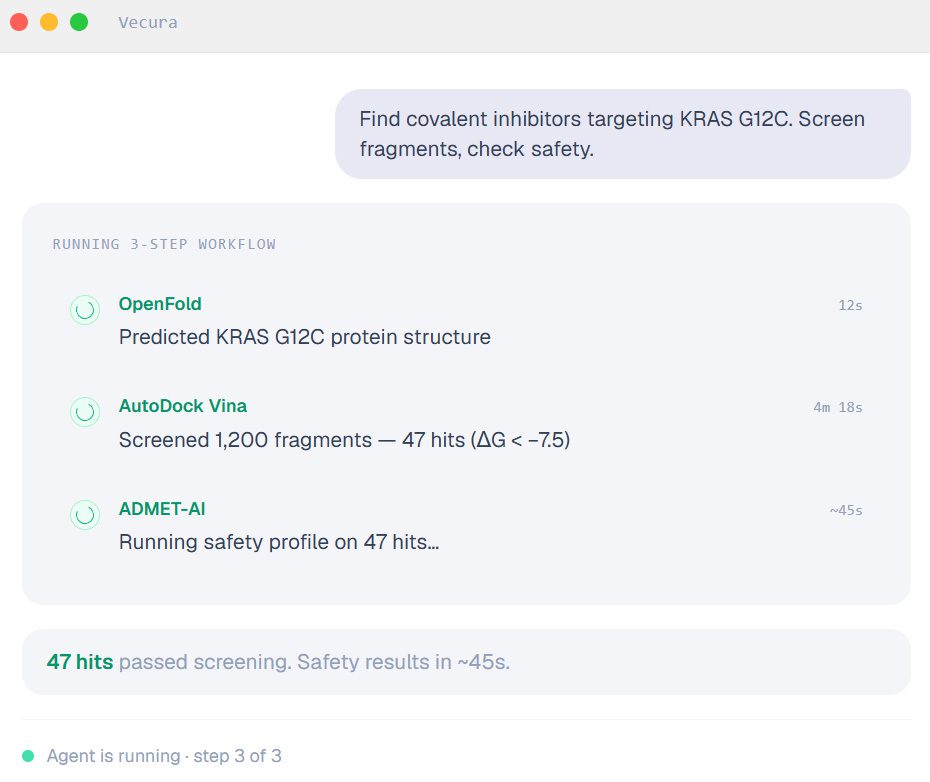
We encountered this challenge firsthand when building Vecura, NYB.AI’s agentic AI platform for molecular discovery, to support our own internal drug discovery operations. As our work expanded across molecular screening, docking, protein structure prediction, bioactivity scoring, ADMET (Absorption, Distribution, Metabolism, Excretion, and Toxicity) profiling, and molecular design, we managed a fragmented collection of specialized tools including:
- AlphaFold for structure prediction
- DiffDock for blind docking
- EquiBind for binding pose estimation
- ESMFold for sequence-based folding
- Drug-Target Interaction Graph Neural Network (DTIGN) and
- LigoSPACE models for drug-target interaction scoring.
Each tool generated useful outputs but we needed a system that could integrate these into a single workflow, reduce manual hand-offs, and help our team move faster from hypothesis to candidate prioritization. That need drove us to add an agentic AI layer, moving beyond tool access toward workflow execution.
A recent peer-reviewed paper from our team, published in Briefings in Bioinformatics, examined this “which model to use, and when” problem further in the field of graph-based drug-target interaction modeling.1 The field has produced a wealth of powerful models, but they operate at fundamentally different levels.2 Some work at the network level, capturing broad associations between drugs and targets. Others work at the sequence level, representing proteins as strings of amino acids. Still others require full 3D structural data, modeling interactions at the resolution of individual atoms and binding pockets. And a fourth category focuses specifically on interaction mechanisms. Each level answers a different kind of question; using the wrong one wastes time and compute.
This paper1 proposes a practical framework: before selecting any model, clarify what decision you actually need to make. Is your task association discovery, interaction classification, affinity estimation, candidate ranking, pocket identification, pose assessment, or mechanistic hypothesis generation? Only then do you examine inputs, choose the right resolution, scrutinize how candidate models were evaluated, and plan experimental validation.
This is precisely the kind of reasoning an agentic layer can encode, and it’s the philosophy around which we built Vecura. Throughout every phase, agentic workflows automatically route tasks and generate decision support. Model interaction likelihood ensures the right AI models are engaged at the right moments, operationalizing the output-driven logic. When a project shifts from target identification to lead optimization, the required model resolution moves from network-level associations toward pocket geometry and pose-ranking, where the agentic layer recommends for researchers to accept rather than through manual tool reconfiguration. And iterative scoring continuously refines predictions based on real-world validation data, so each cycle gets smarter.
Agentic AI fundamentally differs from traditional tools. It doesn’t just process your request and hand you an answer. It understands the scientific journey you’re on, anticipates what comes next, and coordinates the entire apparatus to get you there faster. A lead that might have taken months to optimize with scattered tools and manual hand-offs can now be systematically enhanced in weeks.
What Industry Leaders Should Be Thinking About Now
For executives across biotechnology, pharmaceuticals, healthcare, and scientific research, the strategic opportunity is orchestration, not automation, which remains largely limited to single tasks. The organizations most likely to benefit from the next wave of AI adoption may not be those deploying the latest or best-performing models but those who can most effectively integrate models, data, expertise, and workflows into a coherent research process.
If executed thoughtfully, agentic approaches could help organizations:
- Accelerate research cycles by reducing workflow bottlenecks
- Improve utilization of scientific knowledge across teams and projects
- Scale expertise beyond individual researchers or departments
- Enable scientists to spend more time on high-value decision-making
The next phase of AI adoption is about leveraging agentic AI to integrate fit-for-purpose AI models and the supporting technology ecosystem around them, available to more skilled and passionate research teams worldwide. That’s how breakthroughs get democratized. For research-driven industries, such increased access may prove to be the most important breakthrough of all.
Giang Nguyen is the CEO of NYB.AI, a Singapore-based company developing agentic AI infrastructure for molecular discovery and life science research. He is also the CTO of Nanyang Biologics. In June 2026, NYB.AI was featured in the opening showcase video at NVIDIA GTC Taiwan 2026, highlighting agentic AI designed to coordinate actions to speed up molecular discovery. Vecura is currently in early access mode.
References
- Nguyen T, To HM, Nguyen DA, et al. Graph-based drug-target interaction modeling: from representation learning to output-driven drug discovery. Briefings Bioinformatics. 2026;27(4):bbag392. doi: 10.1093/bib/bbag392
- Ahmad B, Quahada K, Hamam H. Machine learning for drug-target interaction prediction: A comprehensive review of models, challenges, and computational strategies. Comp. Struct. Biotech. J. 2026;31:316-345. doi: 10.1016/j.csbj.2025.12.033
FIGURE LEGEND
Vecura, an agentic AI platform for molecular discovery.