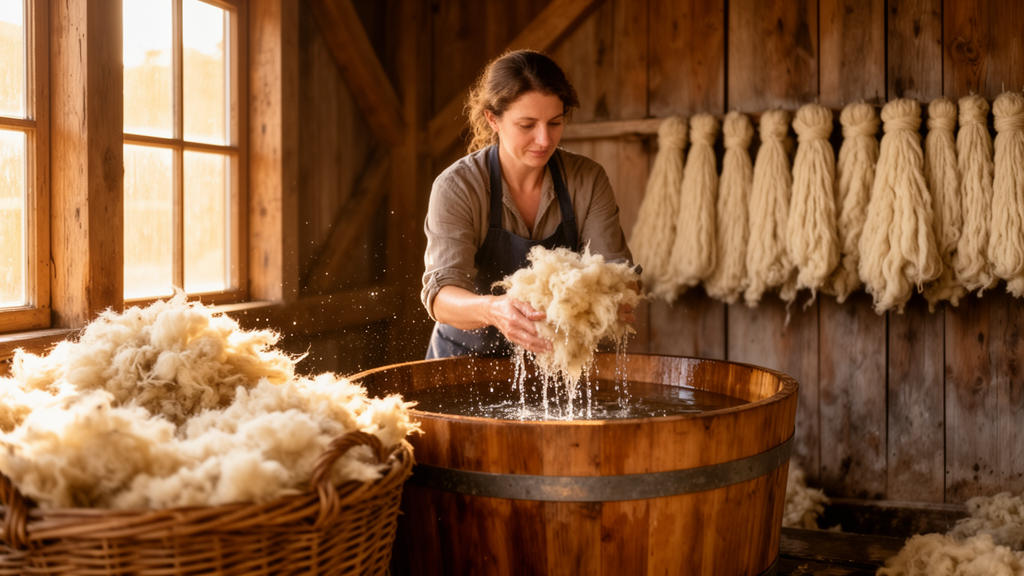
In a newly published investigation examining agricultural by-products within the European circular bioeconomy, researchers Nikolas Bublik and Sebastian Hess evaluated the economic and structural factors that determine whether sheep farmers in Germany generate revenue from wool. Although raw wool is a renewable, biodegradable material with natural thermal insulation, crimp, and elasticity, global synthetic fiber substitution has reduced wool to roughly one percent of the worldwide textile fiber market. Across European agricultural systems, sheep farming predominantly persists on marginal land for meat production and landscape management, while shorn wool is frequently treated as an unprofitable waste stream rather than a recognized commodity. Drawing on survey responses from 326 German sheep farmers alongside qualitative interviews with sector experts, the study deployed econometric models to understand why producers face persistently depressed prices or net disposal fees. The findings demonstrate that wool price realization in fragmented domestic settings is primarily governed by the marketing channel chosen by the producer and the presence of basic on-farm processing, whereas conventional animal attributes such as herd size or breed premiums fail to secure higher financial returns.
To provide broader context for the study, the authors documented that global wool output stabilized at lower levels after peaking during the early 1990s. Commercial export nations such as Australia, China, New Zealand, and Turkey lead international production, whereas European flocks operate under fundamentally different commercial realities. In Germany, the national sheep flock has remained relatively low but stable at approximately 1.5 million head since roughly 1990, contrasting with much larger flocks in Spain, France, and Italy. In commercial wool-producing countries, scouring yields are substantially higher: in 2021, the clean-to-greasy wool conversion ratio was 73 percent in New Zealand and 64 percent in Australia. In Germany, greasy wool production reached 11,492 metric tons in 2021, equivalent to 6,436 tons of clean wool, representing a conversion ratio of only 56 percent. Because German sheep husbandry emphasizes landscape conservation and meat rather than fiber harvesting, shearing is legally mandated once per year under animal welfare regulations regardless of whether wool can be sold profitably.
Qualitative interviews with five sheep farm managers and two wool processors, analyzed through a structured political, economic, social, technological, environmental, and legal framework, highlighted pervasive institutional roadblocks across the value chain. Politically and legally, raw wool is classified under European Union Regulation 1069/2009 as a Category 3 animal by-product, which designates it as an animal-based material requiring specific transport, documentation, and handling protocols. This regulatory designation generates substantial administrative complexity and direct disposal expenses, creating a legal barrier that discourages recycling into products like organic fertilizer pellets, building insulation, or biochar. Economically, domestic processing infrastructure—such as industrial washing, scouring, and spinning facilities—is virtually non-existent in Germany. Greasy fleece intended for industrial textile production must often be transported abroad to facilities in Belgium or Portugal before processed fiber can return for weaving, imposing prohibitive logistics costs on an already low-margin secondary product.
The quantitative component of the research utilized an online questionnaire distributed between March 28 and July 1, 2025, through professional sheep breeding organizations and farming periodicals. The final sample reached 326 respondents, of whom 53 percent identified sheep husbandry as the main purpose of their enterprise. In terms of employment status, 52 percent operated on a part-time basis, 27 percent maintained flocks as a hobby, 12 percent farmed full-time as their primary occupation, and 4 percent were retired. The recorded operations kept an average flock size of 118.47 animals, with a median of 30.0 sheep and a standard deviation of 263.34 sheep. Farm expectations reflected widespread financial strain: 73 percent of respondents stated that wool represented a pure financial cost factor, 10 percent achieved break-even cost coverage, 15 percent viewed wool as a minor revenue contributor, and merely 2 percent derived their primary revenue from wool sales.
Descriptive marketing figures gathered from 301 respondents showed that 51 percent earned zero revenue from wool. Among those reporting income, 24 percent received 0.50 euros per sheep, 9 percent obtained 1.00 euro per sheep, 5 percent earned 1.50 euros per sheep, and 11 percent achieved more than 1.50 euros per sheep. Meanwhile, shearing costs averaged 5.95 euros per animal across 305 valid observations, with a median of 5.00 euros and a standard deviation of 6.55 euros. Because shearing costs regularly exceed raw fiber sales, storing or disposing of fleeces has become commonplace. Within the sample, 86 percent of farmers stored wool in sacks, enduring an average storage duration of 14.39 months with a median of 12.0 months. Marketing routes were similarly dispersed: 29.93 percent utilized direct marketing, 13.16 percent sold to dealers or exporters, 1.97 percent sold through agricultural cooperatives, 26.64 percent placed wool into storage or collection points, 2.63 percent stored wool awaiting disposal, and 25.66 percent utilized other informal channels such as local gardening, home composting, or gifting to community members.
To model the statistical determinants of wool revenue when half of the respondents earn nothing, the researchers employed a Cragg two-stage hurdle specification. In this econometric framework, the first hurdle models the discrete probability of clearing the revenue threshold—earning any positive income versus zero—via a probit estimation. Conditional on crossing that threshold, the second stage estimates the continuous magnitude of revenue per kilogram using a lognormal distribution, reflecting the right-skewed empirical distribution of positive earnings across ordinal price brackets ranging from zero to greater than 4.00 euros per kilogram. A Vuong test confirmed that an uncorrelated specification was parsimonious and that omitting herd size did not impair model fit, allowing the sample size for the primary hurdle model to expand to 302 farms. Robustness checks utilizing an ordered probit model on the 137 positive earners corroborated the stability of the coefficients across distinct estimation methods.
The econometric findings established that marketing channel selection was the single most powerful predictor of both market participation and conditional revenue. In the first hurdle, producers relying on wool storage or collection depots experienced a 46.7 percentage point decrease in the probability of earning positive revenue compared to peers using direct marketing. Disposing of wool through other informal routes decreased the participation likelihood by 32.2 percentage points, while utilizing commercial dealers or export buyers reduced it by 19.5 percentage points. In the second hurdle, conditional on receiving any revenue, selling through dealer or export channels, storage, or other pathways reduced expected returns by 1.1 to 1.4 price categories compared to direct marketing. Calculating average marginal effects on unconditional expected revenue revealed that dealer and export routes reduced overall expected revenue by 1.728 categories, whereas storage channels lowered it by 0.729 categories.
On-farm wool preparation also exhibited significant predictive importance. While 44 percent of surveyed farmers reported that sorting unwashed wool was technically feasible on their premises, 64 percent undertook no fleece processing, 32 percent sorted unwashed wool, 3 percent washed fleece, and only 1 percent sorted washed wool. Regression results demonstrated that farms executing no pre-processing suffered a 22.2 percentage point reduction in the likelihood of obtaining positive wool revenue compared to the reference baseline of washing and sorting washed wool. In the second hurdle, the complete absence of processing was associated with a 0.467 reduction in the latent log-price index, translating to an average marginal decrease of 1.074 price categories in unconditional expected earnings. Crucially, sorting unwashed wool did not yield a statistically significant advantage over no processing, indicating that market mechanisms penalize the total absence of preparation rather than rewarding intermediate sorting steps.
Conversely, biological and operational farm characteristics failed to establish meaningful associations with price outcomes. Although keeping Merino sheep is traditionally linked with high-value apparel fibers, the Merino binary indicator was statistically insignificant across both hurdle stages and unconditional expectations. Similarly, herd size did not correlate with revenue levels or participation probabilities, demonstrating that economies of scale are ineffective within an uncoordinated, localized marketplace. Whether sheep constituted the main production branch of the farm exerted a modest positive influence on market entry, increasing the probability of earning revenue by 9.0 percentage points, but it exerted no detectable effect on the price category achieved once inside the market. Regional location influenced outcomes primarily in western Germany, where farmers exhibited a 16.0 percentage point lower probability of market entry relative to southern producers.
Synthesizing the empirical results, the authors argued that Germany’s domestic wool market is trapped in a low-quality, low-price coordination failure where supply and demand constraints reinforce one another. Because specialized washing and spinning infrastructure is absent domestically, farmers lack financial incentives to clean or classify their clip. Concurrently, commercial processors face insufficient supplies of sorted wool to warrant capital investments in regional scouring facilities. While individual producers who bypass intermediaries through direct marketing achieve comparatively higher prices, this approach cannot absorb nationwide shearing volumes. The researchers emphasized that the cross-sectional survey design captures descriptive associations rather than verified causal mechanisms, acknowledging that unmeasured producer relationships and fiber properties may influence outcomes. Resolving this systemic deadlock, they concluded, will require targeted interventions such as regional cooperative scouring hubs, transitional compliance assistance, and reforming Category 3 waste classifications to enable circular bioeconomy utilization.
Subject of Research: Farm-level and market determinants of sheep wool revenue and market participation in Germany
Article Title: Wool Without Value? Price Determinants within a Fragmented Market
Article References: Bublik, N., & Hess, S. (2026). Wool Without Value? Price Determinants within a Fragmented Market. Cleaner and Circular Bioeconomy, 15, Article 100234. https://doi.org/10.1016/j.clcb.2026.100234
Image Credits: AI Generated
DOI: 10.1016/j.clcb.2026.100234
Keywords: agricultural economics, by-product valorization, circular bioeconomy, Cragg hurdle model, direct marketing, European agriculture, German wool market, hedonic price analysis, landscape management, market fragmentation, on-farm processing, raw wool trade, resource recovery, rural policy, sheep farming, textile supply chain, waste reclassification, wool scouring