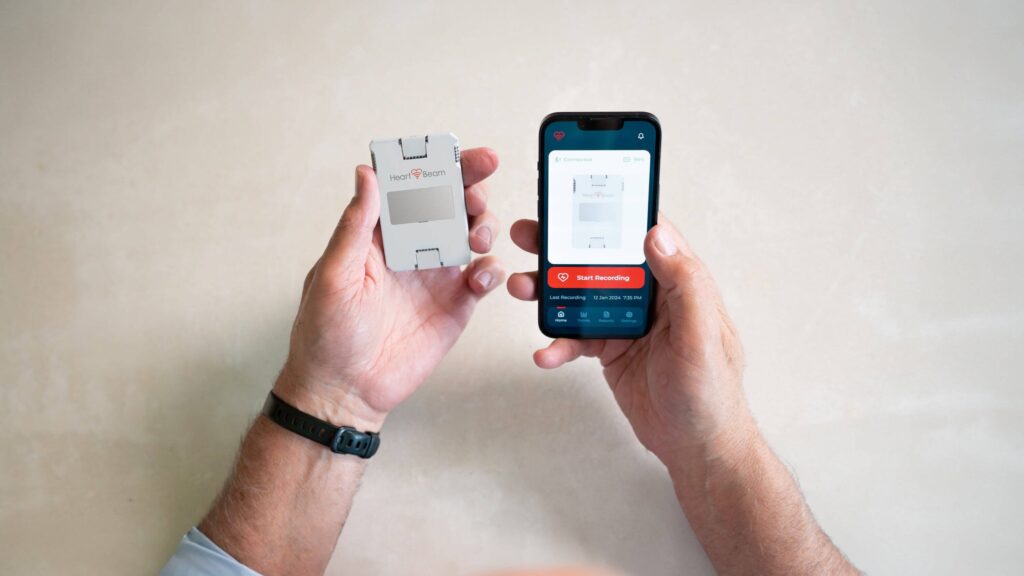
After receiving word late last month that the FDA would not be issuing a 510(k) clearance to its cable-free electrocardiogram, HeartBeam has successfully appealed the decision and now touts a green light.
The company’s portable, credit card-sized system senses the electrical activity of the heart and turns it into a recording similar to a 12-lead hospital ECG.
HeartBeam said it hopes that users will carry the device with them and quickly capture their arrhythmias anywhere, at the first sign of symptoms, before forwarding the results to their clinicians.
“This FDA clearance is a defining moment for HeartBeam, and the true beginning of our mission to revolutionize cardiac care,” CEO Robert Eno said in a statement. “We look forward to initiating our U.S. market introduction while advancing our efforts on heart attack detection, an on-demand 12-lead extended wear patch, and AI-based screening and prediction algorithms trained on our unique longitudinal data.”
In late November, the company reported that the FDA found its application to be “not substantially equivalent” to a predicate device, a prerequisite to earning a 510(k).
At the time, HeartBeam said the agency “signaled a willingness to work with the Company towards a constructive resolution,” and that it felt reviewers’ concerns could be addressed by modifying its proposed labeling. The FDA previously issued a clearance to HeartBeam’s underlying technology for measuring 3D ECGs in December 2024.
While the official appeal process carries a timeline of 60 days, HeartBeam turned it around in just over two weeks.
The company first submitted the 12-lead software for review in January, and results from its pivotal clinical study were presented a few months later at the annual conference of the Heart Rhythm Society in San Diego. The trial showed that HeartBeam’s synthesized ECGs matched up with simultaneous 12-lead recordings 93.4% of the time across nearly 200 patients. Later clinical data showed high rates of accuracy in detecting atrial fibrillation, atrial flutter and normal sinus rhythms.
Related
“The Company wishes to thank the FDA for its expeditious and constructive engagement throughout the review and appeal process, as well as its thorough evaluation of HeartBeam’s clinical data,” said Eno, who took on the role of CEO in October 2024 to prepare the company for commercialization.
HeartBeam’s stock price rocketed up about 160% upon the FDA’s change of heart, landing at around $2.25 per share as of this morning. The jump erased losses from last month, when the stock price dropped by 65%.
Going forward, HeartBeam said it is planning a limited initial rollout in the first three months of next year, starting with “select concierge and preventive cardiology practices.” It also plans to seek a new FDA indication for the detection of heart attacks, while developing an extended-wear version of its sensor.