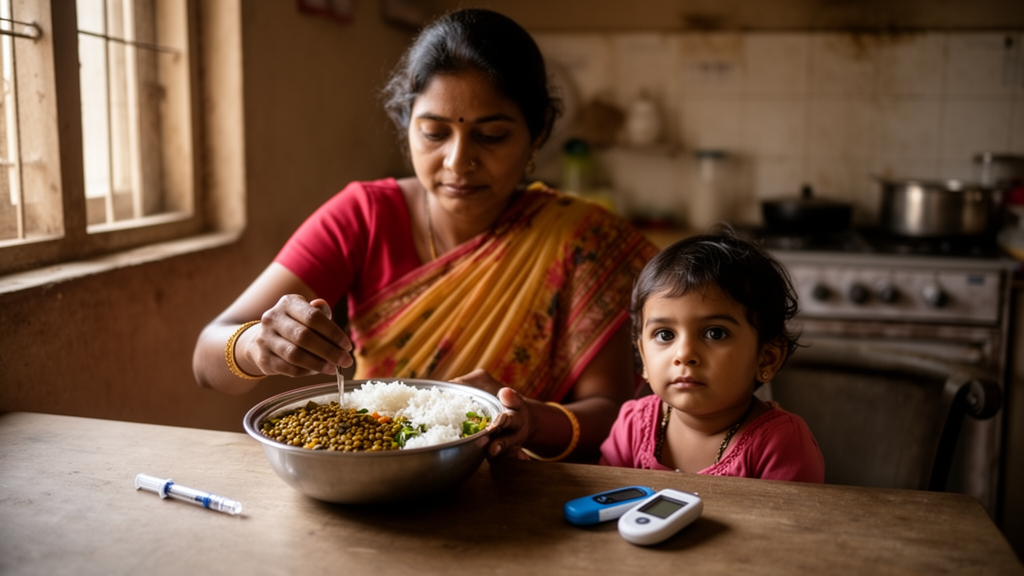
Children and adolescents in India living with type 1 diabetes mellitus (T1DM) show widespread micronutrient inadequacies that track closely with impaired growth, according to a nine-year retrospective longitudinal study published in BMC Nutrition. The findings suggest that so-called hidden hunger — deficiencies of vitamins and minerals that are often overlooked when clinical attention focuses on macronutrients and blood sugar control — may be quietly shaping the growth trajectories of young diabetes patients.
Researchers analysed data from 435 children and adolescents aged 5 to 19 years with T1DM, drawn from a single-centre observational study conducted between 2015 and 2024. Annual assessments covered dietary intake, anthropometry and body composition. Nutrient adequacy was judged against the ICMR-NIN Estimated Average Requirements of 2020, while growth deficits were defined using WHO and IAP standards. Associations between nutrient adequacy and growth outcomes were tested with generalized estimating equations, a statistical approach suited to repeated measurements over time.
The results paint a consistent picture of growth shortfalls. Mean height, weight and BMI Z-scores sat below reference values across all age groups throughout the study period. Stunting remained persistently high, rising from 14 percent at baseline to 20 percent at endline, while wasting ranged between 8 and 13 percent. Because the data are longitudinal, these figures represent repeated observations of the same clinical population rather than a single snapshot, underscoring how entrenched the growth deficits appear to be.
Dietary adequacy was low across the board. Energy intake was inadequate for most participants, with adequacy falling to just 66 percent during puberty — a stage when nutritional demands are at their highest. Micronutrient inadequacies were even more widespread: calcium, iron, zinc, folate and riboflavin were consistently suboptimal across the cohort, and each of these declined further during puberty, the very window in which linear growth and lean mass accrual should peak.
The statistical analysis linked specific nutrient shortfalls to specific growth outcomes. Stunting was associated with lower adequacy of B-vitamins, including thiamine, riboflavin, niacin and folate, each with an odds ratio of 0.98, as well as with minerals including iron, zinc, copper, sodium, potassium, manganese and phosphorus, with odds ratios ranging from 0.96 to 0.99. Wasting was associated with inadequate energy intake and with deficiencies in thiamine, fiber, iron, copper, manganese, niacin and an overall micronutrient deficiency index, each with odds ratios around 0.98.
Body composition also showed nutrient-related patterns. Lean body mass was positively associated with calcium and folate intakes, both with odds ratios of 1.01. Fat percentage, meanwhile, was associated with intakes of iron, sodium, copper and thiamin, each again with an odds ratio of 1.01.
Importantly, the authors report that these associations held independent of glycaemic control, meaning that poor blood sugar management alone does not explain the link between micronutrient inadequacy and impaired growth.
The study’s design carries limitations worth noting. It was a secondary analysis of retrospective, single-centre data, so the associations reported cannot establish causation, and the findings may not generalise to other regions or care settings. The authors describe the work as an observational analysis of routinely collected clinical data rather than a controlled trial of nutritional intervention.
Nevertheless, the researchers conclude that Indian children and adolescents with T1DM exhibit persistent, widespread micronutrient inadequacies that are associated with both stunting and wasting. They argue that the findings highlight the need to integrate routine micronutrient assessment and optimisation into standard diabetes care, so that growth support for young patients addresses the full spectrum of nutritional needs rather than energy and glucose alone.
Subject of Research: Micronutrient deficiencies and growth outcomes in Indian children and adolescents with type 1 diabetes
Article Title: Hidden hunger and altered growth trajectories in Indian children and adolescents living with type 1 diabetes mellitus
Article References: Deshpande, M., Wagle, S., Shah, N., Gondhalekar, K., & Khadilkar, A. (2026). Hidden hunger and altered growth trajectories in Indian children and adolescents living with type 1 diabetes mellitus. BMC Nutrition. https://doi.org/10.1186/s40795-026-01521-y
Image Credits: AI Generated
DOI: 10.1186/s40795-026-01521-y
Keywords: type 1 diabetes, hidden hunger, micronutrient deficiency, stunting, wasting, child growth, adolescent nutrition, India, body composition, B vitamins, puberty, longitudinal study